
NVIDIA is joining IBM and the U.S. Department of Energy’s Fermi National Accelerator Laboratory to co-design next-generation quantum computers.
The companies will connect NVIDIA DGX B200 systems with IBM quantum computers to build a modular quantum-classical co-design platform and conduct research into error correction and scientific applications.
NVIDIA has also unveiled TCBP-JOBS, a decoding algorithm that it says can accelerate calculations needed for quantum error-correction research by up to 13,000 times. The company said it could cut calculations for quantum-computer design research from 12 weeks to 45 minutes.
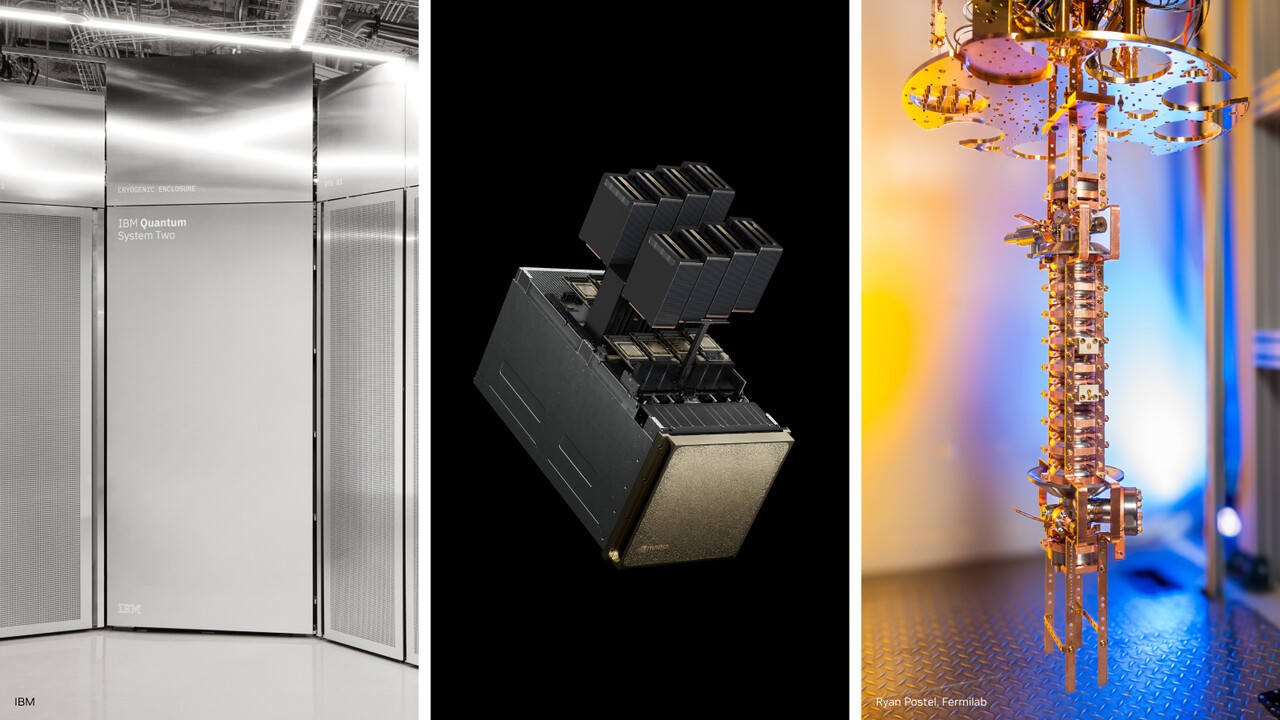
NVIDIA is teaming up with IBM and Fermi National Accelerator Laboratory in the United States to co-design next-generation quantum computers. The partners will connect quantum processors with GPU-based high-performance computing systems and develop an integrated platform for quantum error-correction research and scientific applications.
On the 16th, local time, NVIDIA announced a quantum-computing collaboration involving IBM and Fermi Lab, which is part of the U.S. Department of Energy. The initiative will advance modular quantum-computer design, scientific research applications, and integration with supercomputers.
NVIDIA also unveiled a new decoding algorithm that it says can accelerate calculations required for quantum error-correction research by up to 13,000 times. The company said the algorithm could reduce calculations for quantum-computer design research from 12 weeks to 45 minutes.
Connecting IBM quantum computers with NVIDIA GPUs
IBM and NVIDIA will install NVIDIA DGX B200 systems alongside IBM quantum computers to establish an integrated research environment. The setup will also include systems equipped with IBM’s latest quantum processor, Quantum Nighthawk.
The integrated systems will use a modular quantum-computing design platform being developed jointly by IBM, Fermi Lab, and NVIDIA. Researchers will use the environment to develop quantum error-correction codes and decoding algorithms, and to evaluate applications combining quantum computers with conventional high-performance computers.
Modular quantum computers expand computing capacity by connecting multiple quantum processors. The research teams will study designs that allow conventional computing systems to scale alongside the number of quantum processors.
Fermi Lab will contribute its research experience in high-energy and nuclear physics. The three organizations plan to use real scientific problems to assess the performance and system architectures needed for future fault-tolerant quantum computers.
“Some of the most fundamental problems in science are difficult to solve without quantum computing,” said Jerry Chow, IBM’s chief technology officer for quantum-centric computing. “Scaling quantum and conventional computing together will open up new research possibilities in areas such as high-energy and nuclear physics.”
Fermi Lab CTO Anna Grassellino also stressed the importance of accelerated computing technologies that support not only advances in quantum hardware, but also algorithm design, error analysis, and the operation of complex quantum systems.
From 12 weeks of work to 45 minutes
NVIDIA also unveiled TCBP-JOBS, a new decoding algorithm for quantum error-correction research.
Qubits, the basic units of quantum computation, are sensitive to external noise and environmental changes, making errors likely during calculations. Quantum error correction stores information across multiple physical qubits and analyzes measurement results to identify and correct errors.
A program that analyzes measurement data to estimate where errors have occurred is called a decoder. Decoders run on conventional computers, and as quantum computers grow, the volume of data and the amount of computation they must handle also increase.
NVIDIA’s TCBP-JOBS algorithm accelerates calculations required for this error-correction research. The company said it delivers processing speeds up to 13,000 times faster than the previous best-performing algorithms while maintaining high accuracy.
According to NVIDIA, the algorithm can reduce calculations for research into new quantum-computer designs from 12 weeks to 45 minutes. Researchers can more quickly compare different error-correction codes and decoder settings, and assess designs that use physical qubits efficiently.
TCBP-JOBS has been available since the 16th through NVIDIA’s CUDA-Q QEC 0.9.0 library.
“To use quantum computers for scientific research, we need to advance not only error correction and applications, but also systems that integrate quantum processors with accelerated computing,” said Krista Svor, NVIDIA vice president of quantum computing applications research.
Integrating quantum processors
NVIDIA is also expanding the capabilities of Slurm, an open-source workload-management tool, so quantum processors can be managed alongside conventional CPUs and GPUs in supercomputers.
Slurm schedules research workloads on supercomputers and allocates computing resources such as CPUs and GPUs. NVIDIA is adding an interface for connecting quantum processors, while IBM will support integrated workloads through its Quantum Resource Management Interface (QRMI).
With the new capabilities, researchers will be able to reserve quantum processors and assign workloads using the commands and management tools they already use. The aim is to reduce the need for research institutions to develop their own connection methods.
NVIDIA also highlighted scientific research using hybrid quantum-classical computing. IBM and Japan’s RIKEN connected an IBM quantum computer with RIKEN’s GPU supercomputer ROQUO to perform chemical calculations related to drug development. ROQUO uses NVIDIA GB200 systems and Quantum-X800 InfiniBand networking technology.
The researchers calculated the energy involved in the binding of proteins and ligands, which are candidate drug molecules. They divided two types of protein-ligand complexes into smaller parts and combined quantum sampling with GPU-accelerated calculations.
Using this approach, they modeled complexes containing up to 12,635 atoms—more than 40 times the 303-atom scale previously used as a benchmark for hybrid quantum-classical calculations.
The research was named a finalist for the 2026 ACM Gordon Bell Prize, a major award in supercomputing. The work also involved a project to develop a hybrid quantum-supercomputer platform supported by Japan’s New Energy and Industrial Technology Development Organization (NEDO), which operates under the Ministry of Economy, Trade and Industry.
NVIDIA plans to expand research combining quantum computers with GPU-based high-performance computing systems through the collaboration. The company said some of the products and features announced are still in development, and their availability and release schedules may change.