
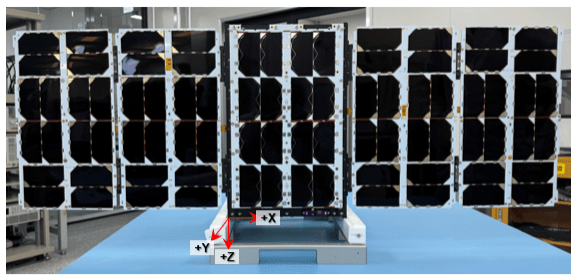
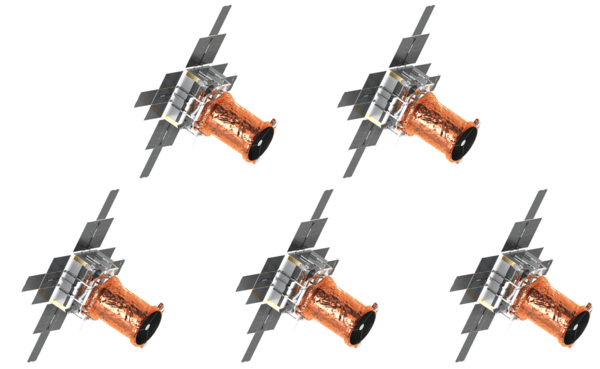
The Korea AeroSpace Administration confirmed on the 27th that it will launch the Nuri rocket, carrying five ultra-small constellation satellites, on October 7. A launch management committee held its first meeting and set the launch date after reviewing the readiness of the rocket, the payload satellites, the launch pad at the Naro Space Center in Goheung, South Jeolla Province, and the tracking system.
Considering weather and space environment conditions, as well as the possibility of collision with space objects, the committee determined that October 7 was appropriate. To prepare for unexpected variables such as worsening weather, it designated October 8 to 14 as the backup launch window.
The launch time has been set between 12:23 p.m. and 1:23 p.m. on the day of launch, with the exact time to be finalized on launch day. To place the ultra-small constellation satellites accurately into their target orbit, the rocket must be launched during a specific time slot calculated according to Earth’s rotation and the position of the sun.
All 15 payloads, the most ever carried on a Nuri launch, include five ultra-small constellation satellites and 10 CubeSats developed by universities, industry, and research institutions.
Constellation satellites divide missions among multiple satellites flying in formation. While a single satellite takes a little over 90 minutes to complete one orbit around Earth, placing several satellites in the same orbit at staggered intervals allows much more frequent observation of the same area. This makes it possible to re-image disaster zones within just a few hours.
The ultra-small constellation satellites were developed with the goal of building a high-frequency, high-precision surveillance system for national security and disaster response. This will be the first time that constellation satellites are injected into orbit in South Korea.
Work at the Naro Space Center is proceeding smoothly. Final assembly is underway there, including joining the Nuri rocket’s stages and installing pyrotechnics. The launch vehicle is built in three stages before being integrated into a single rocket.
The five ultra-small constellation satellites arrived at the space center on the 24th and are undergoing functional checks. The 10 CubeSats are expected to arrive by the 31st. Performance verification tests for the launch pad and tracking system have been completed, and inspections will continue until launch.
Safety preparations are also under way. On the 15th of last month, the Korea AeroSpace Administration conducted a drill for the launch safety control command team, and in early September it plans a comprehensive exercise involving 12 organizations, including the government, military, police and local governments.
Administrator Oh Tae-seok of the Korea AeroSpace Administration said, “This Nuri 5th launch is an important mission that will carry the most satellites ever, 15 in total, and for the first time in Korea inject a constellation of satellites into orbit. It will be an opportunity to take Nuri’s mission capability and space transportation capacity to the next level.”
Whether the launch succeeds depends on whether the satellites are placed accurately into their target orbit. Sequentially separating and positioning 15 satellites at different locations requires more precise control than previous launches. It will be a test of whether Nuri can establish itself as a transport vehicle capable of carrying multiple satellites at once.