
Key points
An international team using the James Webb Space Telescope to study the early universe has found a cluster of 17 galaxies with unusually low levels of heavy elements, dating to when the universe was about 1 billion years old. The findings were published in Nature Astronomy on September 29 (local time).
The galaxies have an average metallicity of about 3% of the Sun’s. That is less than half the level found in galaxies from the same era in similarly dense environments. Heavy elements are made in stars, so low metallicity indicates that the gas has been less enriched by generations of stars.
Gas near the galaxy cluster contains unusually high proportions of carbon and silicon relative to oxygen. This matches the predicted chemical signature of supernova debris from the universe’s first stars, also known as Population III stars.
A cluster of galaxies bearing what may be traces of the universe’s first stars has been discovered.
An international research team led by Li Zhihao, Koki Gakiichi, and Lise Christensen of the Cosmic Dawn Center at the Niels Bohr Institute, University of Copenhagen, announced on September 29 (local time) in Nature Astronomy that it had found a group of 17 galaxies with unusually low levels of heavy elements, dating to when the universe was about 1 billion years old. The team used the James Webb Space Telescope.
The collaboration included 27 researchers from 11 countries, among them scientists from Tsinghua University in China; the Trieste Astronomical Observatory and the University of Florence in Italy; the Max Planck Institute for Astronomy in Germany; and the University of Arizona and the University of Michigan in the United States. A researcher from the Department of Physics at the Korea Institute for Advanced Study was also a co-author.
The gas near the galaxy cluster showed an elemental abundance pattern consistent with the predicted supernova debris of the first stars. The paper is titled “First-star imprints in a metal-poor galaxy overdensity near the end of reionization.”
Could we find the first stars?
Just after the Big Bang, the universe contained only hydrogen and helium. All heavier elements, such as carbon, oxygen, and iron, were made inside stars.
Astronomers call all elements heavier than helium “metals.” The universe’s first stars, then, formed from gas containing no metals at all.
Astronomers call the first generation of stars Population III stars. Stars like the Sun, which contain many metals, are Population I; the generation before them is Population II; and the very first stars are Population III. The numbering runs backward because the populations were identified in that order.
Population III stars exist only in theory. Metal-free gas was difficult to cool, so it needed to gather into large clumps before stars could form. As a result, these stars are thought to have been enormous—tens to hundreds of times the mass of the Sun. Stars that massive would explode as supernovae after only a few million years.
The long-standing view was that all such stars had disappeared within a few hundred million years of the Big Bang and could no longer be seen with today’s telescopes. But there is another approach: look for the debris scattered by their explosions. Theory predicts that supernovae from the first stars would release unusually large amounts of carbon and silicon compared with oxygen. Finding gas with that abundance pattern would point to the presence of the first stars.
Using the light from 12.8 billion years ago as a beacon
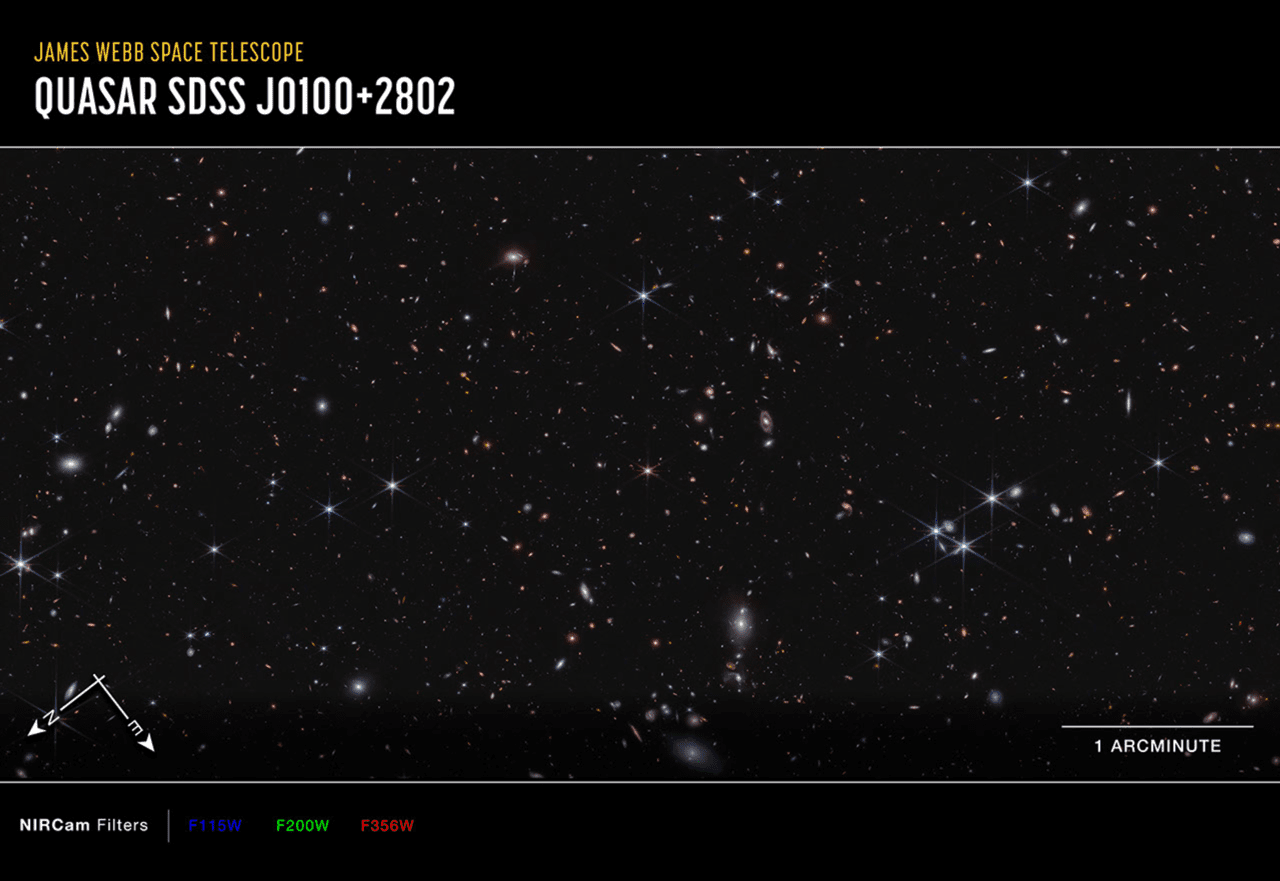
The researchers used a quasar as their beacon. A quasar is an object in which a supermassive black hole at the center of a galaxy consumes surrounding material and shines more brightly than the entire galaxy.
The target was quasar SDSS J0100+2802, located between the constellations Pisces and Andromeda. It is the brightest known quasar from within the first billion years after the Big Bang and has been observed since 2022 by EIGER, one of JWST’s early-universe observation programs.
The principle is much like using a flashlight. As quasar light travels toward Earth, it passes through clouds of gas, whose elements absorb light at specific wavelengths. When the light is spread out by wavelength, the absorbed portions appear as dark lines. Measuring which wavelengths are absorbed, and by how much, reveals which elements are present in the gas and in what quantities.
The team identified a gas cloud at a redshift of 5.945 in the quasar spectrum obtained with the European Southern Observatory’s Very Large Telescope spectrograph. Redshift measures how much light has been stretched by the expansion of the universe. A redshift of 5.945 means the light began its journey about 12.8 billion years ago, when the universe was about 950 million years old.
For a time after the Big Bang, the universe was covered in a fog of neutral hydrogen. Ultraviolet light from the first stars and galaxies gradually cleared it. Astronomers call this period the Epoch of Reionization, which is thought to have ended when the universe was about 1 billion years old.
A redshift of 5.945 places the gas near the end of that period, when the fog had mostly lifted. By examining regions where light passed through before and after the gas cloud, the researchers concluded that the cloud lay inside a large, already ionized bubble and was exposed to intense radiation from nearby objects. This suggests that the site containing the first stars’ remnants was not isolated, but in a region where stars and galaxies were shining actively.
The gas cloud contained unusually high proportions of carbon and silicon relative to oxygen—the abundance pattern predicted for the remnants of Population III supernovae. The researchers compared it with models calculating the elements released by supernovae from both the first and second generations of stars, and concluded that the gas was mixed primarily with debris from the first stars. For comparison, they also identified a gas cloud in the same data with an abundance pattern matching debris from second-generation stars.
There was not just debris, but a neighborhood
The next question was what lay near the gas. The researchers used JWST’s Near Infrared Camera to take a wide-field image around the quasar and identify galaxies at the same distance. Applying a method that groups nearby galaxies, they found 17 galaxies clustered around the gas cloud containing the first-star debris. Such dense concentrations of galaxies were rare in the early universe.
To select the galaxies, the team used JWST’s slitless spectroscopy. This technique spreads the light from every object in the telescope’s field of view into a spectrum at once. It allows researchers to identify objects emitting light at particular wavelengths across a wide area without targeting each galaxy individually.
The researchers used emission lines from oxygen ions as markers. Galaxies with many young stars have strong oxygen-ion emission lines, and the amount by which the wavelength has stretched reveals their distance. From the galaxies detected through oxygen emission around the quasar, the team selected those at the same redshift as the gas cloud. Seventeen of them formed a single cluster.
By combining the spectra of the 17 galaxies, the researchers measured their average metallicity at about 3% of the Sun’s. Compared with other regions from the same era with a similar density of galaxies, the value was 0.4 dex lower—in other words, less than half as high.
A dex is a logarithmic unit in which a difference of 1 corresponds to a factor of 10; a difference of 0.4 dex represents a factor of about 2.5. There are three other galaxy overdensities from the same era in the area around the quasar, and their galaxies contain far more metals. Exceptionally pristine galaxies were clustered only near the gas cloud bearing the first-star debris.
The researchers see the two findings as connected. Because the galaxies themselves contain few metals, the surrounding gas has been less contaminated by the debris of later generations of stars, allowing traces of the first stars to remain. The nearest galaxy is about 238 kiloparsecs—roughly 780,000 light-years—from the gas cloud. The first-star debris was far out beyond the galaxy’s center.
The first stars formed later than expected
The most important implication concerns timing. When the universe was 1 billion years old, there had been ample time for all the first stars to disappear. Yet their debris remained near a cluster of galaxies.
The researchers interpret this to mean that the first stars may have continued to form sporadically until around that time, or that gas mixed with their remnants survived for a long time. Computer simulations have long predicted that Population III stars could persist until the universe was 600 million to 1 billion years old. The observations are consistent with the theory.
The researchers estimated that the dark matter halo surrounding the galaxy cluster has a minimum mass of about 50 billion times the mass of the Sun.
A halo is an invisible mass of matter surrounding a galaxy and serves as a cradle for its growth. A halo that massive would contain galaxies in which several generations of stars had already formed.
There are two possible ways for the first stars to have formed at the outskirts of such a region. One is that pockets of metal-free gas remained outside an already developed galaxy and formed stars much later.
Ultraviolet radiation from earlier generations of stars may have prevented the gas from cooling, delaying star formation. The other possibility is that the first stars formed earlier in small satellite halos, which were later absorbed by a larger galaxy. The researchers said both scenarios are consistent with the observations.
Other ways to search for the first stars
Efforts to find the first stars are proceeding along several lines. One is to capture the light emitted by the stars themselves.
Hot stars like the first stars produce strong light at a wavelength of 1640 angstroms, emitted by ionized helium. A galaxy showing that light without metal absorption lines would be evidence that the first stars are forming there now. The researchers noted that candidate galaxies of this kind have been reported at a redshift of around 11.
Another approach is to measure the gas in early galaxies themselves. In June, researchers at the Cosmic Dawn Center at the University of Copenhagen published a paper analyzing absorption lines in three galaxies dating to 500 million to 600 million years after the Big Bang, using JWST. They found an abundance pattern in which carbon was more plentiful than oxygen. Though the method differs, the conclusion points in the same direction.
The new paper opens a third path: using a quasar as a beacon to measure gas outside galaxies while also examining the metallicity of the galaxy cluster near that gas.
Inside a galaxy, the light from recently formed stars can obscure older traces. Cold gas outside galaxies can preserve those traces for longer. The researchers said that measuring the composition of gas around low-metallicity galaxies is a promising way to trace the imprints of the first stars.
What was observed—and what was not
The researchers did not directly see the first stars. They found traces by examining the elemental abundance pattern thought to have been left behind by them. The observed pattern is consistent with models of chemical enrichment by the first stars; it does not directly confirm that those stars were present.
The researchers themselves described the finding as “imprints,” not a direct detection. The title of the paper posted ahead of publication used the phrase “Possible chemical signatures.”
There is also uncertainty in the methods used to measure the galaxies’ metallicity. However, when the researchers compared different calibration methods, the differences in the measured values fell within the range of statistical uncertainty.
The next task is to apply the same method to more environments in the early universe. JWST’s ASPIRE program has observed 25 quasars, while EIGER has observed six, building a growing collection of data on early-universe galaxies.
Finding more gas that preserves the chemical imprints of the first stars and analyzing it alongside the properties of nearby galaxies could narrow down when and in what environments the first stars formed. It is a search for the era when the universe first lit up, guided by the elemental traces left behind by its stars.