
Key points
▶ Airbnb unveiled its first AI-powered search feature in a product update on Sept. 30 (local time).
▶ Users can describe the accommodation they want by text or voice, and relevant filters will be generated automatically. The feature will launch first in the United States.
▶ Airbnb has added meal delivery, laundry, baby-equipment rentals, and ski and boat rentals to its app, and expanded grocery delivery to Europe. The services bring some offerings traditionally provided by hotels to short-term rentals.
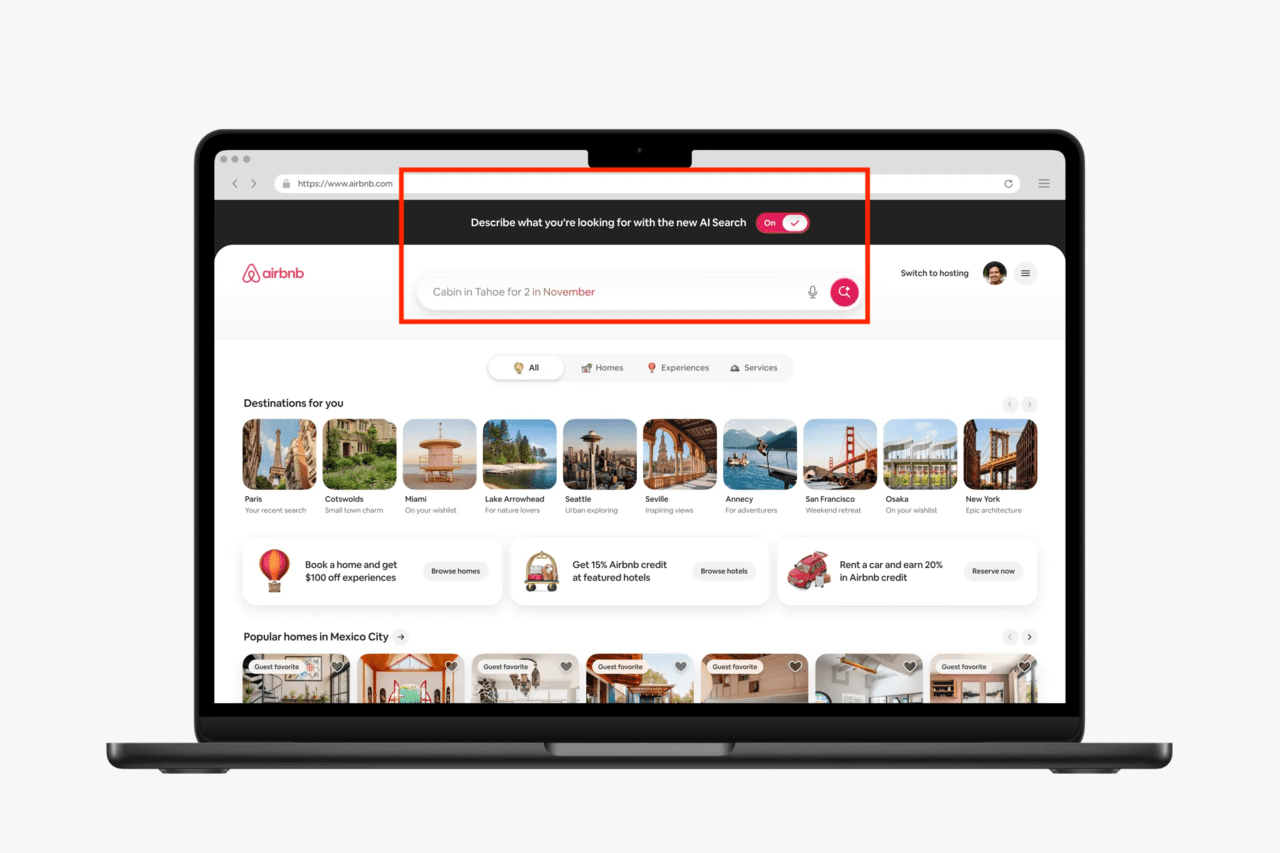
Airbnb has brought AI to accommodation search for the first time. In its fall product update on Sept. 30 (local time), the company announced AI search that lets users find places to stay by text or voice, an expansion of local services such as meal delivery and laundry, and a social feature that maps friends’ trips.
The AI feature will launch first in the United States, with no domestic launch date announced yet. A separate AI tool for hosts is due out this fall.
Type “baby” and a crib filter appears
Users can access AI search by switching it on beside the search bar. When they describe the accommodation they want in writing or by voice, the system creates filters based on what they enter. For example, searching for “baby” will automatically bring up filters for cribs, playgrounds, children’s books, and toys. Until now, users had to choose from a fixed list of filters themselves.
AI also highlights notable features of each listing and lets users compare properties on their wish lists side by side, with AI-generated descriptions and reviews. Airbnb said these descriptions and comparisons will appear automatically in regular search results rather than in a separate chatbot.
CEO Brian Chesky has taken a cautious approach to introducing AI. The company avoided a chatbot-style interface and spent more than six months preparing after previewing AI-powered accommodation search early this year. In an interview with TechCrunch, Chesky said Airbnb was only now taking its first steps into AI search and would make rapid improvements over the coming months.
He said building AI search itself is not difficult, but doing so on an e-commerce platform where $100 billion is at stake is. Anyone can code a search feature, he said, but the key is ensuring it does not reduce conversion rates.
Conversion rate refers to the share of people who search and go on to make a booking. In other words, smarter search is of little use if it leads to fewer bookings.
Laundry, meals, and baby equipment
Airbnb brought services beyond accommodation into its app last year and has expanded the range this fall.
In some European cities, users can have meals from local restaurants delivered to their accommodation. Grocery delivery, which launched in the United States earlier this year, has also expanded to Europe.
In some U.S. cities, Airbnb has partnered with laundry service Rinse to offer pickup and delivery at no charge, including next-day express service.
Through a partnership with baby-equipment rental company BabyQuip, users can rent items such as cribs and strollers in more than 60 U.S. cities. Ski and snowboard equipment is available to rent in the French Alps, while boats can be rented in southern Florida.
Hotels typically offer restaurants, laundry, and concierge services. Airbnb, once primarily a platform for booking homes, is partnering with local businesses to bring services traditionally provided by hotels into its app.
The aim is to capture more of what travelers spend beyond their accommodation. But unlike booking software, laundry and delivery services require labor, logistics, and quality control. Some observers say the key question is how far Airbnb can expand these operationally demanding services while maintaining its asset-light marketplace model.
See where friends have stayed on a map
Airbnb has also expanded its social features. Since October last year, users have been able to connect with other travelers and friends through the app.
In its fall update, the company added a map showing the past and upcoming trips of connected users. Select a trip to see where someone stayed and which experiences they took part in.
The feature is intended to encourage more bookings of experiences such as food tastings and craft classes. Users concerned about privacy can choose not to share their trips.
Airbnb is also creating neighborhood guide pages based on guest reviews and other information, helping users find places to eat and things to do in specific areas.
Later than competitors
AI-powered search itself is not new. According to travel industry publication Skift, Priceline has offered natural-language search through its AI assistant Penny since 2023, and Kayak introduced an AI mode a year ago. Expedia has added natural-language search to Vrbo and AI comparison features to Hotels.com. Airbnb is positioning the automatic integration of AI into all search results, rather than a separate interface, as its differentiator.
At the Skift Global Forum this month, Chesky said Airbnb was being rebuilt as an AI-centered company and that it would launch agentic AI tools in 2027. Agentic AI would let users describe their travel requirements and have the system handle everything from finding accommodations and experiences to making bookings. Airbnb said in May that AI writes 60% of its new code.
The company has not announced when users in South Korea will be able to use AI search. The new services are also limited to the United States and select European cities.