
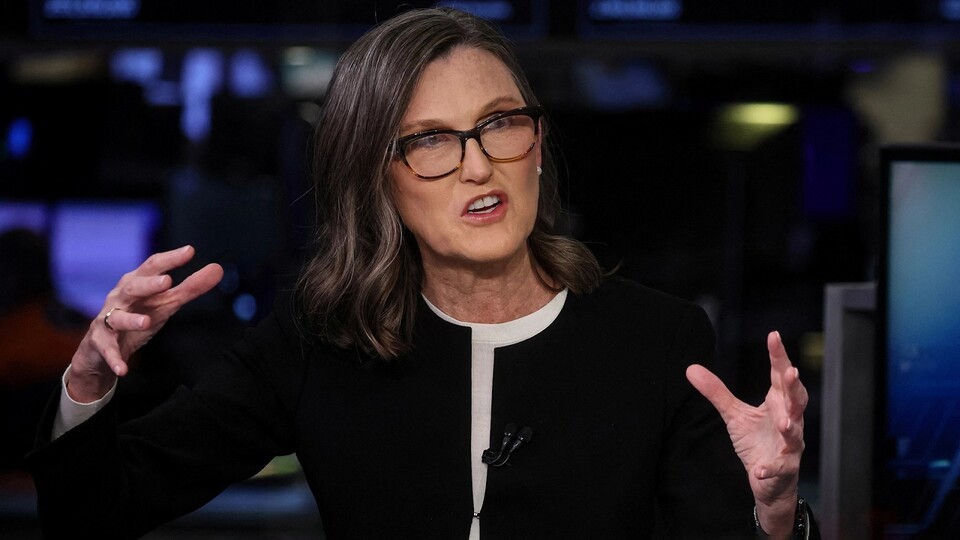
Ark Invest, the U.S. asset manager led by Cathie Wood, has once again raised its long-term outlook for Bitcoin.
The firm says Bitcoin’s market capitalization, currently around $1.5 trillion, could expand to as much as $16 trillion by 2030. That would represent a more than tenfold increase in value over the next four years.
The forecast was included in Ark Invest’s annual research report, “Big Ideas,” released on the 1st (local time). The report highlights that Bitcoin is evolving from a speculative asset into a legitimate asset class being added to institutional portfolios. Still, given market volatility, analysts say the key is to read the direction of the trend rather than the figures alone.
The core of Ark Invest’s argument is the assumption that Bitcoin will replace part of the role long occupied by gold. The report estimates that Bitcoin could absorb about 40% of the more than $24 trillion global gold market. This is not simply a price prediction, but a projection based on a shift in the asset’s function.
Behind that view is a change in perception. An asset once classified as a speculative tool for betting on price swings is now being revalued as a macro hedge and a store of value.
For institutional investors, the move is spreading to use Bitcoin as a tool that can hedge against both inflation and deflation.
In February, Cathie Wood said Bitcoin was attractive as a hedge against both inflation and deflation, thanks to technological acceleration.
In January, Ark Invest presented a wide Bitcoin price range for 2030, from $300,000 to $1.5 million. This latest $16 trillion market-cap forecast is an extension of that view.
Given Bitcoin’s fixed supply of 21 million coins, a $16 trillion market cap would imply a value of about $730,000 per coin. Because additional mining is effectively impossible from a supply standpoint, the report argues that rising demand would have to be reflected in price in a highly inelastic way.
The key variable determining how credible the forecast is will ultimately be the pace of institutional inflows. According to the report, Bitcoin held by U.S.-listed exchange-traded funds and listed companies accounted for about 12% of total supply at the end of last year, up quickly from around 9% a year earlier.
Ark Invest estimates the size of the global investment portfolio excluding gold at about $200 trillion. If just 2.5% of that were allocated to Bitcoin, it could create roughly $5 trillion in additional value.
From a monetary base perspective, the analysis is similar. If only 0.5% of the $68 trillion global money base shifts into Bitcoin, the company says that could generate about $339 billion in added value. If allocations by countries and corporate treasuries expand as well, additional demand could accumulate into the hundreds of billions of dollars.
The trend is already visible. Since the approval of spot Bitcoin ETFs, institutional money has flowed in in earnest, changing the market structure.
In the past, price swings were driven mainly by retail investors, but recently long-term demand through ETFs has been supporting the price floor.
Even if the numbers look enticing, the message for ordinary investors is different.
A $16 trillion market cap is not a guaranteed future, but a scenario built on certain assumptions. If the pace of institutional adoption slows or the regulatory environment changes suddenly, the numbers could shift significantly.
Bitcoin’s volatility remains a major variable as well. In the short term, prices are likely to swing depending on macroeconomic trends, the U.S. dollar, and interest-rate policy.
The wide range Ark Invest presented in January, from $300,000 to $1.5 million, already reflects future uncertainty. The gap between the bullish and bearish scenarios is as much as fivefold.
Even so, the implication of the trend is clear: Bitcoin is no longer a fringe asset, but is in the process of becoming part of global asset allocation. Just as gold secured its status as a safe-haven asset over decades, Bitcoin may follow a similar path, a view gaining traction in the market.
For individual investors, what matters most is not the price target itself but the asset-allocation perspective. The more fundamental question is whether to allocate a certain portion of total assets to digital assets, and if so, how to approach it. Choosing between direct ownership, ETFs, and funds in line with one’s risk tolerance is considered the wiser approach.
The outlook is still only an outlook. Ark Invest’s analysis shows one perspective on Bitcoin’s potential, not an absolute vision of the future. At the same time, conservative investors emphasize Bitcoin’s volatility and regulatory risks and urge caution.
According to CoinDesk data, the total digital asset market is currently worth about $2.7 trillion.
To reach the $28 trillion projected in the report, the market would need to expand more than tenfold over the next four years. That is by no means a small figure, and it would require a particularly favorable macro environment.
What investors need is balance between optimism and caution. The trend of Bitcoin being incorporated into asset classes is difficult to deny, but short-term volatility and policy risk remain constant.
What the report shows is not a price tag, but the possibility of a changing asset landscape, and in the end, each reader’s own judgment is what matters most.