
On the way home from work, you stop by a café. The hand that serves the latte you ordered is not human. A humanoid robot brews the coffee by hand drip and hands over the cup at the exact angle. As you take a sip while seated, the lights come up on a stage at one side of the shop. The same robot that was just making coffee dances to music. At the next table, someone is asking about the robot’s rental fee. This is the scene Korean consumers will soon face.
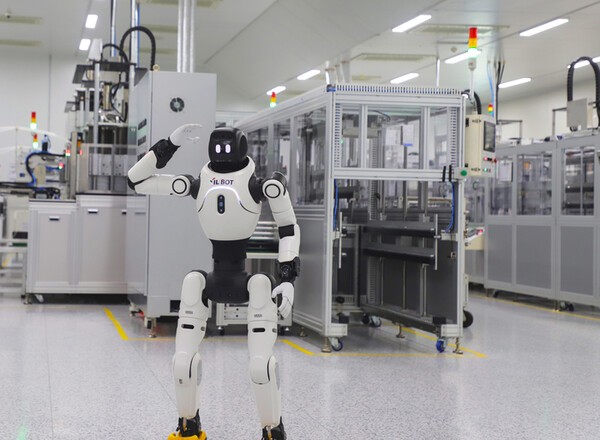
On the 3rd, IL and its subsidiary IL Robotics announced that they will make that scene a reality. Within the third quarter, they will open Korea’s first humanoid showroom in either Seongsu-dong or Cheongdam-dong in Seoul. Centered on the company’s own ILBOT, it will combine a café, pub, and experience space. It is not a simple exhibition hall. It is a testbed where robots work and customers come to accept them as part of everyday life.
The significance of this move becomes clearer when viewed against the current state of Korea’s humanoid industry. It was only with the launch of the K-Humanoid Alliance in April last year that Korean companies and the government began advancing on humanoids in earnest.
Since then, U.S. company Figure AI has begun mass production of home-use humanoids, and China has opened the world’s first robot-only shopping mall in Beijing. Korean consumers have had almost no chance to encounter humanoids up close.
Beijing is already a year ahead
What China is showing is both the benchmark Korea must follow and the gap it must confront. Beijing opened the world’s first humanoid-only shopping mall in August last year.
According to Reuters, more than 100 types of robots from about 200 brands are displayed in one place, along with robot-themed restaurants and entertainment zones. Visitors can touch and operate the robots on display. It is more like a playground than a showroom.
Around the same time, Beijing hosted the first World Humanoid Robot Games. A total of 500-plus humanoids from 16 countries competed across 538 events. On one side of the shopping mall, robots play soccer; on another, they run track events. It is a device that helps ordinary people see humanoids not as “strange machines” but as something close and familiar.
The reason this matters is data. In the end, humanoids learn by interacting with humans. Spaces where people’s movements are densely interwoven—such as cafés, restaurants, and performance venues—generate the most valuable training data.
China’s government also built a 10,000-square-meter humanoid training facility in Beijing’s Xijingshan district for the same reason. Two hundred instructors teach more than 100 robots, simultaneously simulating 16 scenarios across industrial, household, and service settings.
According to the World Regional Studies Institute, Korea has 368 humanoid patents. That is less than 7% of China’s 5,688. Of the world’s top 100 humanoid companies analyzed by Morgan Stanley, 73% are Asian companies and 56% are Chinese. The essence of the gap is not patents but data. The simple logic is that the more robots operate in everyday life, the more learning data they accumulate.
RaaS, a subscription economy starting from cafés
The business model IL wants to roll out through the showroom is Robotics as a Service, or RaaS. Rather than selling robots, it rents them out and provides operation, maintenance, and data updates as one package. Under this structure, cafés and stores can use humanoids by paying a fixed monthly fee.
The reason this model matters is the price barrier. Boston Dynamics’ humanoid Atlas is estimated to cost around $130,000, or about 180 million won, per unit. That is not a price a small café can afford. A subscription model lowers the entry barrier to the level of several million won per month. The leasing company collects operating data and improves software, while the tenant can run the robot without a heavy burden.
LG CNS is pursuing a similar model in the industrial sector. Through a joint fund with U.S. company Dexmate and Chinese firms Unitree and Agibot, it is preparing a full-stack RX (Robot Transformation) service. It is already conducting pilot projects at around 10 sites in shipbuilding, logistics, and manufacturing. LG CNS CEO Hyun Sin-kyun said in March that “given the pace of technological development, robots will be meaningfully deployed on production lines within two years.”
IL’s differentiator is that it starts at the consumer interface rather than the industrial site. The data collected in the showroom differs from that gathered through repetitive industrial tasks. It includes unstructured situations such as human facial expressions, unpredictable orders, and sudden changes in movement. Even for the same humanoid, data from moving boxes in a factory and data from making eye contact with customers in a café are valued differently.
Agibot, a double-edged sword
The hardware partner for the showroom is Chinese company Agibot. According to Omdia, it ranked first globally in humanoid shipments last year. It shipped 5,168 units, accounting for about 40% of the 13,000 humanoids shipped worldwide.
LG Electronics also made a strategic investment in Agibot last August through a joint fund with Mirae Asset. The partnership is deep enough that LG Electronics President Ryu Jae-cheol personally visited Agibot’s Shanghai headquarters in March.
This choice is rational, but it comes with risks. It is the quickest route for Korea’s robotics industry to enter everyday life. It reduces the time and capital needed to build proprietary hardware from scratch. However, it still leaves a burden of dependence on core components. In the context of intensifying U.S.-China tech rivalry, it is hard to say how dependence on Chinese components will play out as a variable.
The solution runs in two directions. One is to acknowledge hardware dependence but secure an edge in software and data. IL is already installing ILBOT on its own production line, which makes LED silicone lenses and automotive lamps, to accumulate data from repetitive tasks.
By combining that with service data from the showroom, the company plans to build a Korean-style humanoid operating model. IL CEO Song Seong-geun said, “We do not simply want to sell robots; we want to create robot culture,” adding that the goal is to build a space where humans and humanoids can coexist naturally.
The other direction is domestic parts localization at the national level. The Ministry of Trade, Industry and Energy’s K-Humanoid Alliance plans to invest 180 billion won over five years to support robotics manufacturers and parts suppliers. The goal is to mass-produce Korean-style humanoids by 2028 with a weight of 60 kg or less, 50 or more degrees of freedom, and a payload of at least 20 kg. Samsung SDI, SK On, and LG Energy Solution have begun developing batteries for humanoids.
Culture drives industry upward
The bigger question the showroom raises is the direction of industrial policy. Korea has long been raising humanoids inside factories and research labs. Industrial and research adoption has been fast, but ordinary people have had almost no chance to encounter them in daily life. Citizens who have never seen humanoids are unlikely to become consumers of the humanoid era.
China realized this point early. Wang Yifan, who runs the Beijing robot mall, told Reuters, “If robots are to enter countless households, robot companies alone are not enough.” He meant that exposure to everyday life and cultural familiarity determine industrial scale.
This is also why Agibot held a live gala show called “Agibot Night” in Shanghai shortly before Lunar New Year in February, deploying 200 humanoids. The one-hour live performance included boxing, spinning, and torch acrobatics. It was both a massive systems stress test and an advertisement to make humanoids more familiar to ordinary viewers.
The Korean government is also sending signals. The Ministry of Science and ICT has prepared a future-leading technology development strategy to prepare for the 2040 era of everyday general-purpose humanoids. Still, government policy is weighted toward technology development. The realm of everyday exposure and cultural formation must be filled by the private sector. That means initiatives like IL’s showroom need to spread across multiple cities.
A timetable to close a one-year gap
At the launch ceremony of the K-Humanoid Alliance in April last year, Industry Minister Ahn Duk-geun predicted that the global humanoid market would grow 25-fold over 10 years, from $1.5 billion last year to $38 billion, or about 53 trillion won, by 2035. It is a market Korea must seize as it faces demographic decline and labor shortages in manufacturing.
The problem is timing. China has already laid the market one year ahead, and the United States has begun mass production for home use. Korea does not have much time left. The message from IL’s showroom is ultimately about speed and method. Instead of the usual path from industrial use to home use, it is a reverse strategy: accumulate data in everyday service spaces and expand that data into industry and the home.
One showroom cannot close an industrial gap. But where the first button is fastened will determine the picture five years from now. Once Korean citizens naturally accept the sight of a humanoid making coffee, the decisions to design, invest in, and buy humanoids will also become natural. That is how the one-year gap will eventually be narrowed.