
Four unmanned collection machines for clear PET bottles introduced for the first time
Designed with accessibility for wheelchair users and people with visual impairments in mind
Earn 10 points for each bottle
₩100 million secured through Seoul’s recycling performance assessment invested in the project
◆ What’s happening
Recycling should be something everyone can take part in. How easy it is to use facilities such as unmanned collection machines depends on factors like the height of the opening and the way instructions are provided. For wheelchair users, it is important that the opening is within reach; people with visual impairments need instructions that let them operate the machine without looking at a screen.
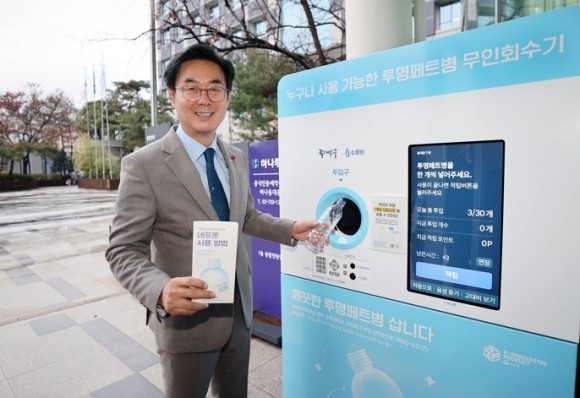
Dongdaemun-gu, Seoul, has introduced unmanned collection machines for clear PET bottles designed with accessibility in mind. The district has been operating four barrier-free machines since the 23rd. This is the first time unmanned collection machines for clear PET bottles have been installed in the area.
The machines are located at Dongdaemun-gu Office Plaza, Baebongsan Park, Imun Sports and Culture Center, and Dongdaemun-gu Residents’ Sports Center. One machine was installed at each of the four sites, selected with residents’ access and expected frequency of use in mind. All the machines have openings at a height suitable for wheelchair users, as well as Braille keypads and voice guidance for people with visual impairments.
To use a machine, residents should empty the bottle and remove its label before inserting it. An AI sensor identifies the material and level of contamination, then automatically compresses and collects eligible bottles. Users earn 10 points per bottle. Once they have accumulated at least 2,000 points, they can exchange them for cash through the dedicated Superbin app.
◆ Analysis
One notable aspect of the project is that it expands recycling facilities while also lowering barriers to their use. Residents must insert bottles and complete the points-collection process themselves. Even if a machine is nearby, it may be difficult for some residents to use if operating it is a challenge.
To address this issue, Dongdaemun-gu installed all four machines as barrier-free models. The openings are positioned with wheelchair users in mind, and the machines are equipped with Braille keypads and voice guidance. The project is significant because it considers accessibility at the facility-design stage, rather than leaving participation in recycling solely to individual effort.
The project’s funding is also worth noting. Dongdaemun-gu secured ₩100 million after being named an outstanding district in Seoul’s performance assessment of local governments’ waste reduction and recycling efforts, and invested the funds in this project. It is an example of using a budget earned through recycling results to expand resource-circulation infrastructure, turning past performance into a new initiative for resident participation.
Another feature is the combination of financial incentives with waste separation. Each clear PET bottle earns 10 points. Residents who recycle 200 bottles reach the 2,000-point threshold for cash conversion. The system is designed to encourage people to participate regularly in their everyday lives.
Collecting clear PET bottles separately may also help improve recycling quality. The bottles are kept separate from other recyclables, and the machines identify their material and level of contamination. If residents sort them properly, the program could help secure a reliable supply of recyclable materials.
It remains to be seen whether accessibility-focused design will prove effective in actual use. Whether residents can complete the process—from earning points to converting them into cash—without difficulty will also be an important measure of the program’s success.
◆ The solution
To fulfill the project’s barrier-free goals, the entire process—from using the machine to receiving rewards—needs to be assessed, not just the installation itself. The first priority is to find out how easily people with disabilities and older residents can actually use the machines.
On the first day of operation, Dongdaemun-gu tested the entire process at the machine in the district office plaza, from removing a label to earning points, and checked that it was working properly. Going forward, the district should consider ways for a diverse range of residents—including wheelchair users, people with visual impairments, and older adults—to try the machines and share their feedback. Real-world user experience can help identify improvements to the opening’s accessibility, the placement of the Braille keypad, and the speed and clarity of the voice guidance.
The points-redemption process also needs attention. Although the machines have barrier-free features, users must use a mobile app to convert their points into cash. This could create another barrier for older adults unfamiliar with smartphones and residents who have difficulty using digital devices.
The district could consider placing easy-to-follow instructions at each site explaining how to install the app and redeem points. It could also provide assistance through community centers or facility staff if needed. Such measures would help ensure that improved access to the machines extends to the use of the rewards.
Clear instructions on proper sorting are also important. Bottles with contents still inside or labels attached do not meet the machines’ requirements. Residents should be reminded to empty bottles and remove labels before inserting them. Clearly displaying sorting instructions at each location can help reduce incorrect deposits.
Operating data could also be analyzed and used to guide future installations. The district office plaza, park, and sports facilities differ in their purposes and peak usage times. Comparing collection volumes, frequency of use, and machine operating status by location would provide a clearer picture of residents’ needs. The district could use this information to identify high- and low-use sites and plan additional installations or operational improvements.
Dongdaemun-gu plans to continue expanding resource-circulation infrastructure that residents can experience in their daily lives. The four machines installed in this initiative are the first barrier-free unmanned collection machines for clear PET bottles to operate in the district.
To assess the project’s success as a local solution, the district must look not only at the number of bottles collected but also at who is using the machines and how easily they can do so. The work ahead is to improve the entire operation, from accessibility and sorting instructions to the process of redeeming points.