
The Ministry of SMEs and Startups (MSS) will accept applications from startups for its “Public Data Utilization Support” program from September 15 to October 6. The program supports proof-of-concept (PoC) development and commercialization using public data.
Approximately 20 startups will be selected to address projects proposed in advance by public institutions. Selected companies will receive up to 100 million won in collaborative commercialization funding, along with linkage to separate technology development programs.
In August, 22 projects proposed by 18 institutions were selected through a top-down process. They include an artificial intelligence model for predicting crowd density by the National Data Agency and technology to detect icy roads proposed by the Korea Expressway Corporation.
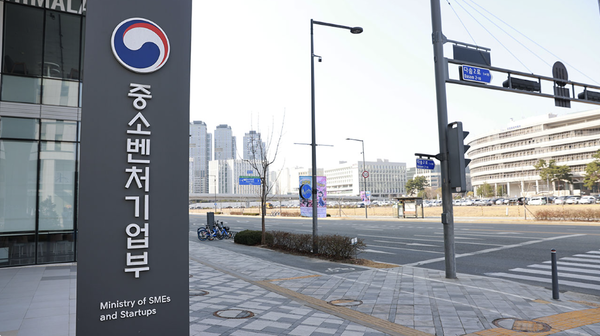
The Ministry of SMEs and Startups announced that it will accept applications from startups for its “Public Data Utilization Support” program from September 15 to October 6. The program supports startups in conducting proof-of-concept (PoC) projects and commercializing technologies using public data. Approximately 20 companies will be selected in this round.
What projects are available?
In August, the MSS solicited collaboration projects between public institutions and startups and selected 22 projects from 18 institutions. The two national agencies involved are the National Data Agency and the Defense Acquisition Program Administration. The two education administration institutions are the Gangnam-Seocho Office of Education and the Gangdong-Songpa Office of Education. Twelve public institutions, including Korea Airports Corporation, the Korea Expressway Corporation, and the Korea Institute of Energy Research, proposed 16 projects. The Yongsan-gu Facilities Management Corporation in Seoul and Seosan Medical Center in South Chungcheong Province each proposed one project.
The National Data Agency’s project involves developing an artificial intelligence (AI) model to predict population density in major areas during events such as festivals and holidays. The goal is to use the model to establish policies that prevent safety accidents caused by crowds and improve people’s mobility.
The Korea Expressway Corporation’s project involves developing and demonstrating technology that detects rain and snow conditions through closed-circuit television (CCTV) footage and provides advance warning of icy roads. The plan is to use real-time risk information for preventive measures, such as preemptively spreading deicing materials.
How much funding is available, and how will it be provided?
Selected startups will work with public institutions to conduct proof-of-concept projects and produce prototypes. Up to 100 million won in collaborative commercialization funding will be provided for these activities.
The program will also be linked to technology development programs run by the MSS. The Startup Growth Technology Development Program provides up to 200 million won for a period of up to 18 months, while the public-private joint technology commercialization program provides up to 600 million won for a period of up to two years. The MSS stated that eligibility and support details may vary depending on the requirements of each individual program.
How the program works
The program will operate through two tracks. In the public institution project proposal track, which is accepting applications in this round, public institutions propose collaboration projects to address their own challenges using data that can be disclosed, and startups apply to participate.
In the startup project proposal track, startups propose projects based on undisclosed public data they need from public institutions. Support is then provided to help secure the data and carry out the projects. A total of 63 companies applied through this track.
The MSS is working with the Korea Intelligent Information Society Promotion Agency’s Corporate Public Data Problem-Solving Support Center to secure the data. Selected companies will receive the same collaborative commercialization funding and linkage to technology development programs as those participating through the public institution proposal track.
The program originated from the “Measures to Create a Startup Boom in the Era of National Entrepreneurship,” announced by the government in April. The measures call for expanding open innovation among startups in national strategic industries, large and medium-sized companies, and public institutions, as well as opening public data in areas with strong demand from businesses, including healthcare and safety.
The MSS is identifying demand for open innovation in the defense industry in cooperation with the Ministry of National Defense and the Defense Acquisition Program Administration, and in the climate technology sector with the Ministry of Climate, Energy and Environment. It is also supporting startups’ proof-of-concept projects and prototype production by connecting them with the infrastructure of companies seeking such technologies.
Jo Kyung-won, director general for startup policy at the MSS, said, “Supporting startups so that they can use public data will provide a foundation for promoting the commercialization of innovative technologies and creating public services that people can experience directly. We will actively support startup growth by opening more public data that businesses strongly need and expanding open innovation, so that these achievements can lead to the spread of a startup boom.”