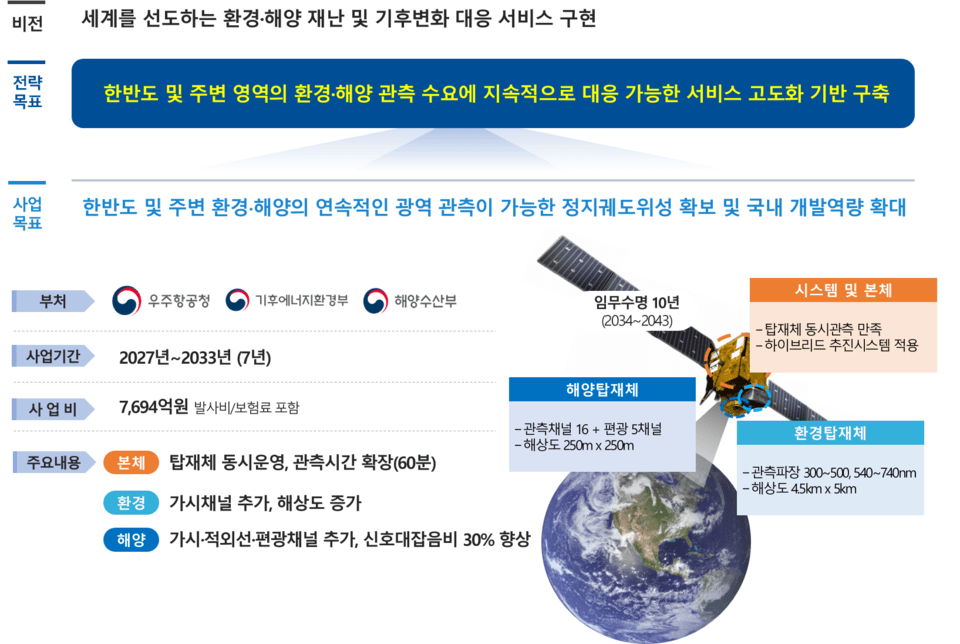
The development project for the geostationary environment and ocean satellite “Chollian Satellite 6” has passed the preliminary feasibility study for a national R&D project.
The project was jointly planned by the Korea AeroSpace Administration, the Ministry of Climate, Energy and Environment, and the Ministry of Oceans and Fisheries.
The total project cost is about 769.4 billion won. The plan is to develop the satellite over seven years starting in 2027 and launch it in 2033.
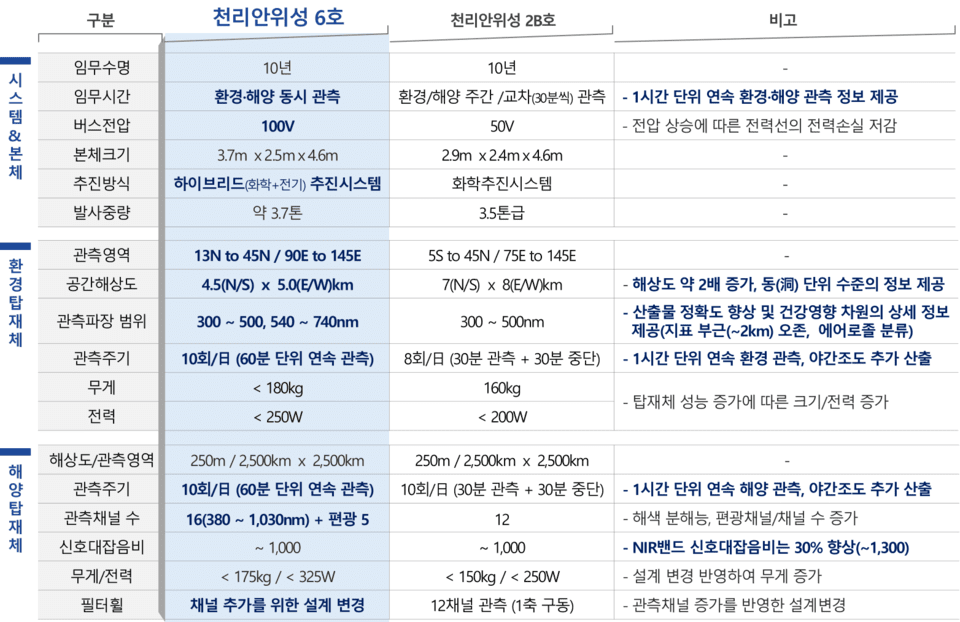
It will take over the mission of Chollian 2B, the world’s first geostationary environment and ocean satellite, launched in 2020.
A next-generation environmental monitoring satellite that will overlook the skies and seas around the Korean Peninsula 24 hours a day has cleared its first major hurdle.
The Korea AeroSpace Administration, the Ministry of Climate, Energy and Environment, and the Ministry of Oceans and Fisheries announced on the 25th that the jointly planned development project for the geostationary environment and ocean satellite “Chollian Satellite 6” had passed the preliminary feasibility study for a national R&D project. A preliminary feasibility study is a process that verifies the economic viability and feasibility of a large-scale national project in advance; only after passing it can full-scale budget投入 proceed.
A total of about 769.4 billion won will be invested in Chollian 6. The goal is to launch it in 2033 after seven years of development beginning in 2027. It will take over the mission carried out by Chollian 2B, the world’s first geostationary environment and ocean satellite, launched in 2020.
◆ Fine dust and red tides to be observed from space
The geostationary orbit in which Chollian satellites operate is an orbit about 36,000 kilometers above Earth that moves at the same speed as Earth’s rotation.
Because the satellite appears to hover over the Korean Peninsula, it can continuously observe the same region 24 hours a day. If ground observatories are point-based monitoring, a geostationary satellite is like a watchtower that monitors the entire Korean Peninsula in real-time imagery.
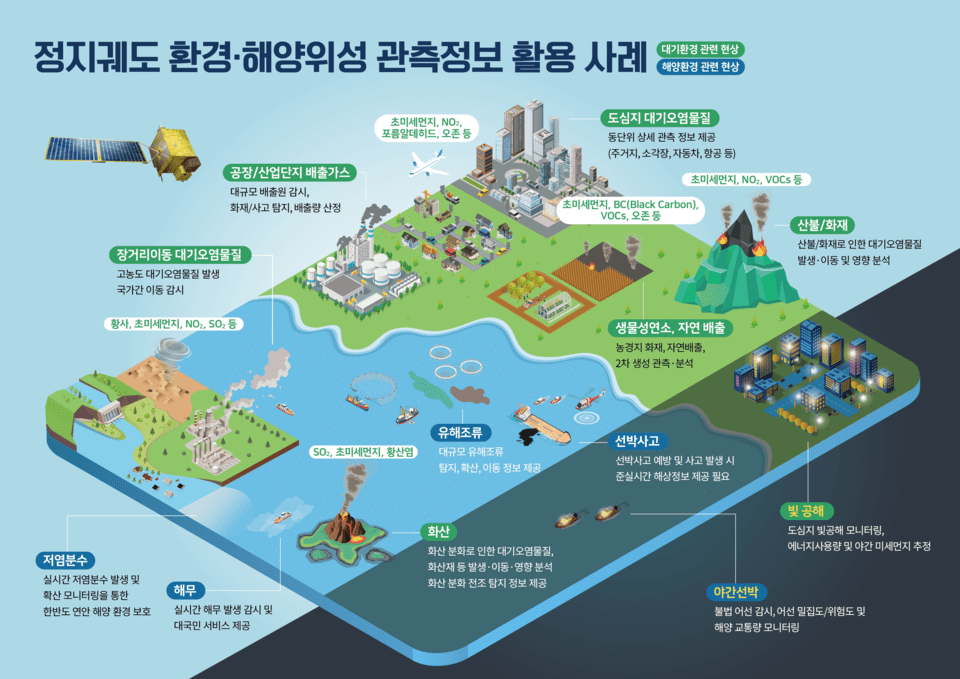
With improved performance, Chollian 6 will track how ultrafine dust, ground-level ozone, and disasters such as wildfires affect the atmosphere. At sea, it will monitor changes such as red tides that threaten aquaculture farms, oil spills from ships, and low-salinity water that drifts into Jeju waters in summer.
If it becomes possible to quickly determine where and how pollution starts and spreads, fine-dust forecasting and marine disaster response will improve. The observation data are also expected to be used for environmental information services that the public can directly experience.
◆ Domestic production of payloads, a bigger payoff than money
Chollian 6 is also a proving ground for technological self-reliance. For the first time, the payload—the satellite’s eyes—will be domestically produced for a geostationary satellite.
The hybrid propulsion system combining powerful chemical propulsion with fuel-saving electric propulsion, as well as the technology to have environmental and ocean payloads observe simultaneously, will also be developed with domestic technology. Securing core technologies previously dependent on overseas suppliers will also broaden the foundation for entering the global satellite market.
Kim Jin-hee, head of the Satellite Division at the Korea AeroSpace Administration, said, “Chollian 6 is a key national space asset that continuously observes the atmosphere and marine environment closely connected to people’s daily lives,” adding, “We will expand domestic development of core technologies by shifting to a private-sector-led satellite development system.”
Jang Myo-in, commissioner of the National Ocean Survey and Research Center, said, “Long-term continuous marine observation data spanning more than 30 years from Chollian 1 through Chollian 6 will become essential data for marine and fisheries policy and climate change response.”
The three ministries plan to set detailed implementation plans and prepare follow-up procedures such as securing the budget and selecting research and development institutions.
When Chollian 6 reaches orbit in 2033, South Korea will continue one of the world’s rare third-generation geostationary environment and ocean observation systems.