
The seven-year challenge of foldable phones has been the crease running down the center of the screen. Samsung Electronics has answered that long-standing problem with an aerospace material.
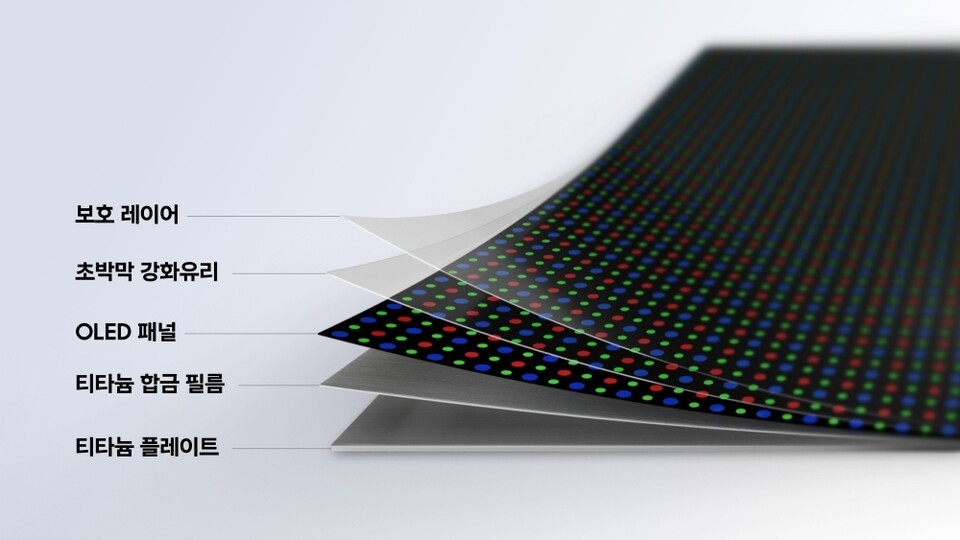
On the 15th, Samsung Electronics unveiled its “Flex Titanium” display technology, which will be applied to the next-generation Galaxy foldables. It replaces the plastic film under the OLED panel with a titanium alloy film, combined with a titanium plate that supports it in a dual-layer structure. According to the company, the result is a fundamental redesign of foldable engineering built up over seven generations.
◆ Bringing aerospace material into the screen
Titanium is a metal known for its strength and resilience, and it is used in aerospace parts. The problem was that very strength. With high elasticity and rigidity, it had actually been difficult to use in displays that must fold thinly and flexibly.
Samsung overcame that barrier through manufacturing. Using an ultra-precision rolling process that presses metal between rollers to thin it out, the company reduced the titanium alloy film to roughly one-third the thickness of a human hair. Its rigidity is about 20 times greater than that of conventional polymer film. The principle is to suppress deformation that occurs when the screen is folded and unfolded, reducing creases while improving durability.
The titanium plate beneath the film was also given micro-hole processing. By significantly reducing the size of the holes in the folding area, the structure firmly supports the screen when unfolded while allowing it to bend smoothly when folded. Vice President Yoo Kyung-jin, head of Samsung Display’s product development team, said this structure secures both flexibility and durability.
Samsung also lowered power consumption by adding a high-resolution design and new organic materials. Since thinner devices leave less room for batteries, display power efficiency is an important hidden requirement for slim designs.
◆ How Apple changed the terms of competition
The material change comes amid a shift in market dynamics. Apple is expected to launch its first foldable iPhone in September. Counterpoint Research forecasts this year’s foldable market share at around Samsung 31%, Apple 29%, and Huawei 24%, suggesting a drop from Samsung’s 40% share last year.
The nature of competition has also changed. As the foldable market enters a maturing stage seven years after its launch, analysts say the battleground has shifted from “first mover versus follower” to “technology completeness versus technology completeness.” As expectations grow that Apple’s first product will arrive with a highly refined, crease-minimized finish, Samsung’s need to demonstrate technological superiority before the Unpacked event has increased.
Creases are the frontline of that contest, because they are the first thing consumers check in stores. The adoption of titanium is being interpreted as a declaration that Samsung will compete not on specification numbers, but on the completeness users can see and feel.
There is also significance for Korea’s parts ecosystem. Foldable displays rely on Samsung Display for panels, while domestic parts suppliers handle hinges and reinforcement materials. As the race for refinement intensifies, material and component technology becomes, in effect, set competitiveness.
◆ The remaining questions: user perception and price
The success of the new technology will depend on two things.
First is the user experience. How the figure of 20 times greater rigidity translates into a different-looking crease at consumers’ fingertips will be confirmed in person at the Galaxy Unpacked event in London on the 22nd. The new technology will be applied first to the Galaxy Z8 series. Samsung is also expected to broaden its foldable lineup this year to include a wider model with a changed screen ratio in addition to the existing Fold and Flip lines.
Price is another variable. The average price of foldable phones is expected to rise by double digits this year. Since the adoption of new materials could add to production costs, how much the improvement in completeness offsets the higher price is likely to determine actual sales.
Foldable phones are no longer items sold for novelty. Consumers decide with their wallets based on whether the phone can be folded and unfolded hundreds of times a day without issue, and whether the unfolded screen lies flat. Titanium is Samsung’s answer to that question, and the grading begins next week in London.