
Bull and bear markets are representative terms that capture the rise and fall of financial markets.
A bull market refers to a market in which asset prices such as stocks, bonds, real estate, and commodities rise over a long period of time. It often appears when expectations for economic growth, improving corporate earnings, and hopes for interest-rate cuts overlap. As investors believe prices will rise further, they buy, and that buying pressure in turn drives prices higher.
A bear market, by contrast, refers to a market in which asset prices fall for a considerable period. Economic slowdown, declining corporate profits, high interest rates, financial instability, and geopolitical risks all intensify downward pressure. As investors worry about bigger losses, they sell assets and increase their holdings of cash and safe assets. As selling pressure grows, prices can fall even further.
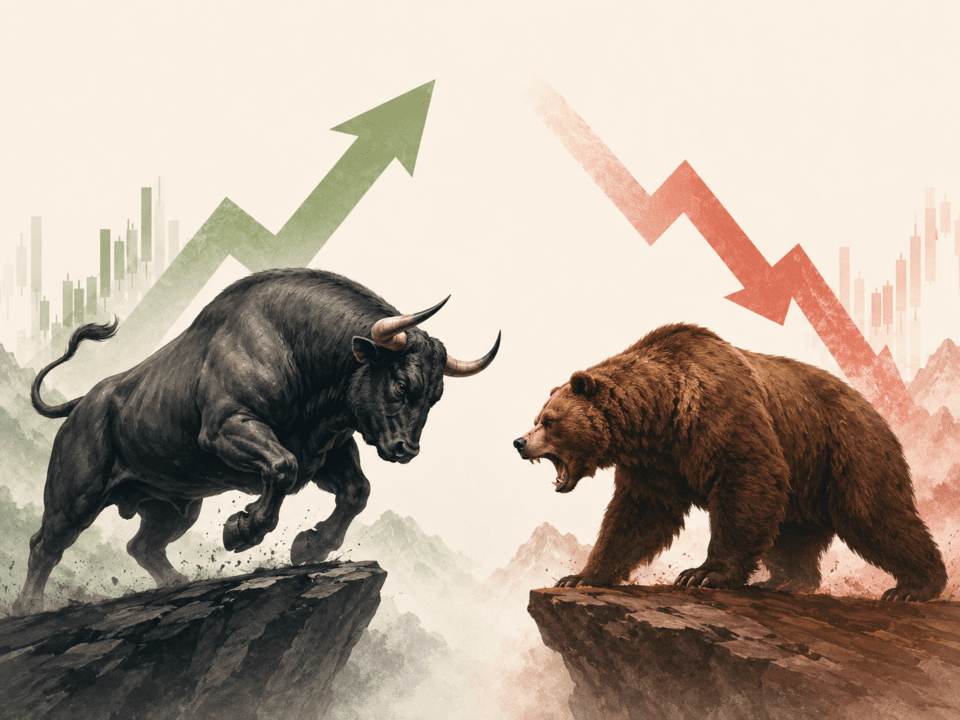
The two terms are widely used market symbols derived from the movements of animals. A bull thrusts its horns upward from below, symbolizing rising prices. A bear strikes downward with its front paws, representing falling prices. In financial markets, these terms have become expressions used to explain investors’ expectations and behavior rather than the animals themselves.
Market participants generally use the term bear market when a major stock index has fallen more than 20% from a recent peak. However, 20% is not a fixed standard set by law or international regulation. The judgment can vary depending on which index is used and how long the decline is considered to have lasted. A bull market is also not defined by a single rate of increase. It broadly refers to a phase in which prices continue rising from a low point and investor sentiment and economic outlook improve.
In a bull market, it is necessary to distinguish whether stock prices are rising because of improving corporate fundamentals or because of increased liquidity. If prices rise on the back of higher sales and profits, it can be seen as a gain supported by the real economy. On the other hand, if prices jump rapidly only on expectations of lower interest rates or abundant cash, the market may need to watch for overheating. As expectations grow that prices will keep rising, the tendency to downplay risk also increases.
For example, suppose a stock index rises from 1,000 to 1,300. The increase is 30%. If corporate earnings outlooks also improve and consumption and employment indicators remain stable, that would strengthen the case for calling it a bull market. But if buying is concentrated in only a few sectors without improvements in earnings, the sustainability of the rally should be examined separately.
In a bear market, falling prices do not necessarily mean that the value of every company has declined. When the market as a whole becomes anxious, even companies with stable earnings can be sold off together. That is because investors reduce risk assets and move to secure cash. The same reason explains why high-quality stocks and growth stocks can fall together during a financial crisis or a sharp rise in interest rates.
If a stock index falls from 1,000 to 800, the decline is 20%. In markets, that is generally the level at which people discuss whether a bear market has begun. If an investment of 10 million won shrinks to 8 million won, the loss rate is 20%. To recover the original principal, you need a gain of 25%, not 20%. The larger the decline, the higher the return needed for recovery.
Bull and bear markets are related to the state of the broader economy, but they are not the same as a recession. Even while the economy is growing, the stock market may weaken due to rising interest rates or concerns that stocks are overvalued. Conversely, even if economic data remain sluggish, the stock market can rise if expectations of a recovery are reflected first. Financial markets tend to price in future prospects before the present.
Asset trends can also differ from one another. Even if the stock market enters a bear market, safe-haven assets such as gold, government bonds, and the dollar may strengthen. Commodity markets can also move in directions different from the stock market depending on supply disruptions, weather, war, or policies of producing countries. When talking about bull and bear markets, it is important to check which asset and which index is being used as the reference.
For individual investors, the key standard is not the market name but capital management. In a bull market, as optimism grows, the risk of buying at high prices also rises. In a bear market, as fear deepens, the chance of hastily selling long-term investment assets also increases. Investors should first assess their investment horizon, their ability to tolerate losses, and the nature of the assets they hold.
A bull market is a phase in which optimism pushes prices higher. A bear market is a phase in which anxiety pushes prices lower. Upward and downward moves repeat. Rather than judging the market’s direction by its name alone, it is necessary to look at the causes of price changes and the level of risk together.
Copyright © Solution News. All rights reserved. Reproduction or redistribution without permission is prohibited.