
Samsung Electronics and SK Hynix, the two semiconductor giants, rebounded sharply the day after a market plunge. The stock market is once again seeing fierce competition for the top spot between the two industry leaders.
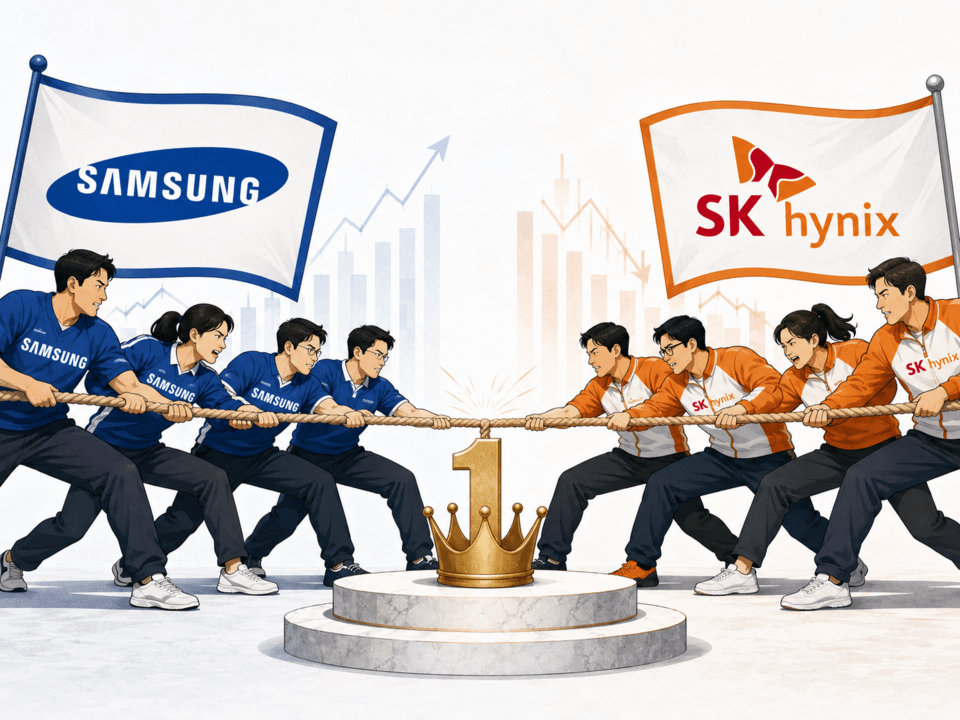
Korea’s top-listed company changed hands twice in three days. As SK Hynix took the crown from Samsung Electronics, which had held it for more than 25 years, the Kospi tumbled nearly 10%, only for Samsung Electronics to reclaim the throne a day later.
On the 24th, the Kospi closed at 8,471.02, up 3.26% from the previous trading day. It was a partial recovery from the shock of the previous day, when 910 points had evaporated. The index opened up 1.86% at 8,356.79, dropped to the 8,080 range during the session, then surged back to the 8,577 range, swinging violently throughout the day.
The rebound was led by the same two semiconductor heavyweights that had suffered the steepest losses the day before. Samsung Electronics jumped 9.84% to finish at 340,500 won. Expectations of a 90 trillion won share buyback, combined with bargain hunting, drove the rally. As a result, Samsung Electronics’ common shares market capitalization rose to 1,990 trillion won, reclaiming first place from SK Hynix, which it had ceded two days earlier. SK Hynix rose only 0.98%, leaving its market cap at 1,838 trillion won and pushing it back to second place.
The previous day had been the exact opposite. On the 23rd, the Kospi plunged 9.99% to 8,203.84, erasing 910 points in a single day. A sell-side sidecar was triggered at 11:40 a.m., and at 2:33 p.m. a circuit breaker was activated, halting trading for 20 minutes. It was the fourth circuit breaker this year. Samsung Electronics and SK Hynix fell 12.31% and 12.47%, respectively, marking the worst day since the global financial crisis.
Sidecars and circuit breakers are safeguards that temporarily stop trading to let the market catch its breath when prices collapse all at once. A record-scale rebound immediately following such a crash is why analysts say the market is being tossed violently in both directions without finding a clear path.
The latest turmoil began on the 22nd, when SK Hynix’s market capitalization surpassed Samsung Electronics’ common shares. Market capitalization is the value a market assigns to a company, calculated by multiplying the stock price by the number of outstanding shares. The stock with the largest market cap is called the market leader.
SK Hynix’s rise to the top marked the first such event in 25 years and 7 months, since November 2000. It was the moment the long-standing market equation that “semiconductors mean Samsung Electronics” was broken. For the first time in a generation, the No. 1 signboard changed hands.
The celebration at the top did not last long. On the very next trading day, selling for profit-taking flooded in on stocks that had risen too sharply in a short time. Profit-taking means selling shares that have risen in order to lock in gains. Foreign investors were particularly aggressive sellers. Nervousness also increased because Wall Street had been volatile overnight and because SK Hynix had just crossed the 2.9 million won level for the first time.
Han Ji-young, a researcher at Kiwoom Securities, said, “The short-term side effects of semiconductor concentration have appeared again. Because the concentration was especially severe in the battle for market-capitalization No. 1 between Samsung Electronics and SK Hynix, the pressure for profit-taking came out even more strongly.”
One day after the collapse, the pendulum swung the other way. Bargain hunting poured in, and Samsung Electronics benefited from expectations of a share buyback, allowing its market cap to pull about 152 trillion won ahead of SK Hynix. It was a reclamation of the throne in just two days. Over the span of three days, the No. 1 position changed twice, and what the market held onto was not direction but volatility.
After the crash, one report published a month earlier began circulating again in the brokerage community. It was a report by Lee Jae-man, a researcher at Hana Securities, released last month. He stated flatly, “The signal that this bull market, driven by corporate earnings growth, is ending is the moment SK Hynix’s market cap overtakes Samsung Electronics’.” He presented the reversal between the two stocks as a key gauge of overheating in the Kospi.
The logic is this: if there is no major change in actual profits but stock prices surge enough to flip the ranking, it means expectations have raced far ahead of fundamentals. Fundamentals are the true underlying strength of a company. If fundamentals remain unchanged but the ranks of market value shift, that can be read as a sign that the bubble has reached its peak.
Figures also support this view. According to estimates compiled by FnGuide, brokerages expect Samsung Electronics to post operating profit of around 36.3 trillion won next year, while SK Hynix is projected at around 26.3 trillion won. Operating profit refers to earnings from the core business. Samsung Electronics is still expected to earn nearly 10 trillion won more. Yet if SK Hynix has the higher market value, that suggests the difference is being driven by expectations rather than earnings.
The researcher also drew on an example from the U.S. market 26 years ago. In the spring of 2000, Cisco Systems briefly overtook Microsoft and General Electric to become the largest company in the S&P 500 by market cap. But Cisco’s net profit at the time was $2.7 billion, only about one-fifth of GE’s and just over one-fourth of Microsoft’s. In other words, its valuation had been inflated not by earnings but by expectations about the future.
The consequences are well known. Not long after, the dot-com bubble burst. The U.S. market entered a long decline, and stocks that had risen on expectations alone gradually returned to earth. The memory is that a change in the market-capitalization leader was not the peak of the party, but the beginning of the aftershock.
Of course, the U.S. market 26 years ago and Korea today cannot be compared directly. Still, the reason the market has brought up this report again is clear: the conditions behind the warning were fulfilled exactly one month later.
Behind this was a steep rally that had continued for more than a year. Fueled by the AI investment boom, Samsung Electronics shares had risen about 490% over the past year, while SK Hynix had soared 1,030%. The Kospi had crossed 8,000 for the first time, giving rise to the phrase “the Kospi 8,000 era.” So-called emperor stocks, or stocks trading above 1 million won per share, also multiplied into double digits. Along with the rapid gains came growing warnings of overheating.
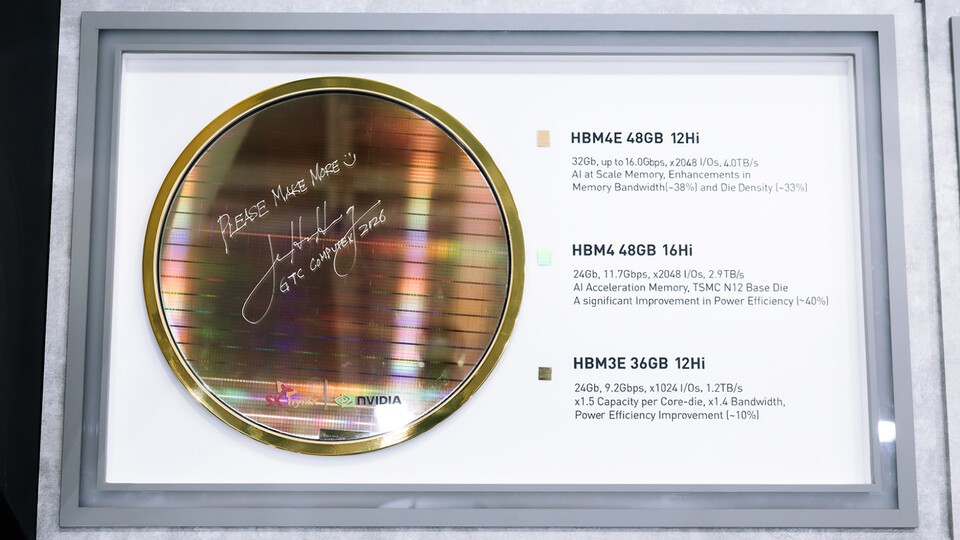
The force that lifted SK Hynix to the top is clear: high-bandwidth memory, or HBM. HBM is ultra-fast memory paired with AI semiconductor chips, a component that enables the rapid exchange of massive amounts of data. It has become an indispensable part of Nvidia chips, the brains of the AI era.
SK Hynix has supplied this HBM to Nvidia almost as if on an exclusive basis. Last year it held the No. 1 spot in the HBM market with a 61% share. The hotter AI investment became, the more directly the benefits flowed to this company. A business structure concentrated in one memory segment became its strongest weapon during the boom.
That strength is also a weakness. Because sales are concentrated in a single product, HBM, and a small number of customers, especially Nvidia, any slowdown in AI investment would also hit hard. A structure that absorbs the boom most quickly could become the first to falter in a slowdown.
On the other side, Samsung Electronics was held back by its foundry business, or semiconductor contract manufacturing. This is the business of making chips designed by other companies, but the gap with Taiwan’s TSMC, the industry leader, has not narrowed; it has widened. Even with solid businesses such as smartphones and home appliances, it has been difficult to offset the losses from foundry operations.
Concentration was a double-edged sword. The combined market capitalization of the two companies has long exceeded 30% of the entire Kospi. Two semiconductor stocks support nearly one-third of the index. When they rise, they lift the index together; when they turn down, they drag the whole market down with them. The nearly 10% Kospi plunge on the 23rd was driven in part by this distorted weighting.
Another factor amplifying volatility was leveraged exchange-traded funds, or ETFs. These products are designed so that if a specific stock or index rises 1%, the ETF rises 2%, and if it falls 1%, the ETF falls 2%. The reward is doubled, but so is the loss. What feels sweet on the way up becomes a weapon on the way down.
Scale made the problem worse. On the 23rd local time, Bloomberg reported that the global leveraged ETF market had swelled to $290 billion, or about 446 trillion won. Because these products mechanically buy and sell according to stock movements, small swings became large waves. Bloomberg described the situation as “the tail wagging the dog.” Single-stock products that bet two times on Samsung Electronics and SK Hynix were cited as a factor that amplified the day’s losses.
The damage fell squarely on individual investors. Those who had jumped into 2x products were forced to absorb losses that erased a substantial portion of their principal in just one day. The cost of choosing the fast lane was steep.
Market opinion is now focused on one question: was this reversal the peak of a bubble, or was it a fair revaluation of semiconductors? On the same event, analysts are split cleanly into two camps.
Those warning of a bubble see concentration itself as the risk. When too much market capitalization is concentrated in just two stocks, the entire market wobbles whenever those stocks do. The 23rd’s crash exposed exactly that vulnerability, and the Hana Securities warning identified that weak point.
The opposing camp has a strong counterargument: Cisco and SK Hynix are fundamentally different. Cisco in 2000 rose on hope without profits, while SK Hynix earned 37 trillion won in operating profit in the first quarter alone this year. The view is that it is being supported not by empty expectations, but by real earnings.
Park Joon-young, a researcher at Hanwha Investment & Securities, said, “SK Hynix is no longer a company with volatile earnings; it is a company that consistently generates high profits. There is no reason for it to be undervalued without justification among global technology companies.” In other words, given the changed status of the semiconductor industry in the AI era, this move should be seen not as a bubble but as a revaluation of corporate value.
The brokerage community expects the combined operating profit of the two companies to exceed 60 trillion won next year. Those are numbers created by the AI boom. In the end, the core of the debate is how much of that expectation has already been priced into stocks. If the expectations are reasonable, the sharp drop on the 23rd is only a temporary swing; if they were excessive, it is the entrance to a longer correction.
The two interpretations read the same scene in opposite ways. One sees the signal of a party ending; the other sees the beginning of a new order. Neither has been proven yet.
One thing is clear: the No. 1 spot in Korea’s stock market, which had not wavered for nearly a generation, changed hands twice in three days, and the market swung from crash to rebound in a matter of a day. Whether this was the peak of a bubble or a turning point in revaluation will ultimately be decided by the next quarterly results from the two companies.