
Bee farming in Korea decides its fate in mid-May, when the white blossoms of the acacia tree bloom. The flowers last only about two weeks. If heavy rain falls or the temperature suddenly drops during that period, the blossoms fall. When that happens, bees cannot collect nectar, and beekeeping farms lose their entire year’s harvest.
In this way, the fate of Korean apiculture is determined in just a few days. About 70 to 80 percent of the natural honey produced in Korea comes from a single species, the acacia tree. This kind of dependence is rare anywhere else in the world. Even New Zealand, famous for manuka honey, relies on manuka for only 30 to 40 percent of its production. Korea’s dependence is more than twice as high.
This precarious structure began with the reforestation projects of the 1970s. By the 2020s, it has reached its limit.
The hero of reforestation became a trap for beekeeping.
The acacia tree is not native to Korea. It is a leguminous plant originally from the United States. After the Korean War, it was planted on a massive scale during the 1970s reforestation campaign to quickly green the devastated mountains.
Because it grows well even in poor soil and enriches the land as a legume, it was ideal for reforestation.
But there was an unintended side effect: the acacia tree produces enormous amounts of nectar.
It spread naturally along roadsides, mountain slopes, and riverbanks, with no pesticide concerns. Beekeepers naturally came to depend on acacia blossoms, and Korea’s honey industry grew rapidly.
The problem became clear over time. Trees planted in the 1970s aged after 50 to 60 years. The average lifespan of an acacia tree is about 30 to 40 years, so many have already exceeded their life expectancy.
Since the 2000s, acacia trees have been dying across the country from unexplained yellowing, with leaves turning yellow and the trees failing to bloom.
The flower fields are disappearing: 320,000 hectares lost.
The overall area has also been shrinking rapidly. According to Korea Forest Service statistics, the area of nectar-producing plants in Korea fell from 478,000 hectares in the 1970s to 146,000 hectares in 2020. Over 50 years, about 70 percent, or 325,000 hectares, disappeared. That is equivalent to losing more than five times the area of Seoul in flower fields.
Meanwhile, almost no new acacia trees are being planted. After the reforestation campaign ended, the government shifted policy toward species better suited for carbon absorption and timber production. Trees such as tulip trees, Korean pine, and hinoki cypress took their place. The concerns of beekeepers were not taken into account.
When nectar sources decline, bees suffer from malnutrition. Bees weakened by malnutrition become more vulnerable to Varroa mites, pesticides, and climate change. At the deepest root of mass bee deaths is the disappearance of flower fields.
Everything is decided in one month of May.
Another problem created by dependence on a single acacia bloom is the concentration of harvesting time. Korean beekeepers make most of their annual income in May. To match the acacia bloom, they move their hives across the country, following the flowers from the south to the center and then to the north.
The scene may look cinematic, but for farmers it is a desperate race. If May brings too much rain or sudden temperature swings, the year’s harvest is lost.
Korea’s natural honey output once plunged from about 29,785 tons in 2016 to about 4,643 tons in 2019. In just four years, production fell to one-sixth of its previous level. The main cause was poor spring weather that prevented acacia blossoms from blooming properly.
Beekeeping industries in New Zealand and Australia are different. Because a variety of flowers bloom throughout the year, everything does not depend on a single season. In Korea, where beekeeping hinges on a single month in May, there is almost no way to spread the risk.
The next-generation nectar trees identified by the Forest Science Institute.
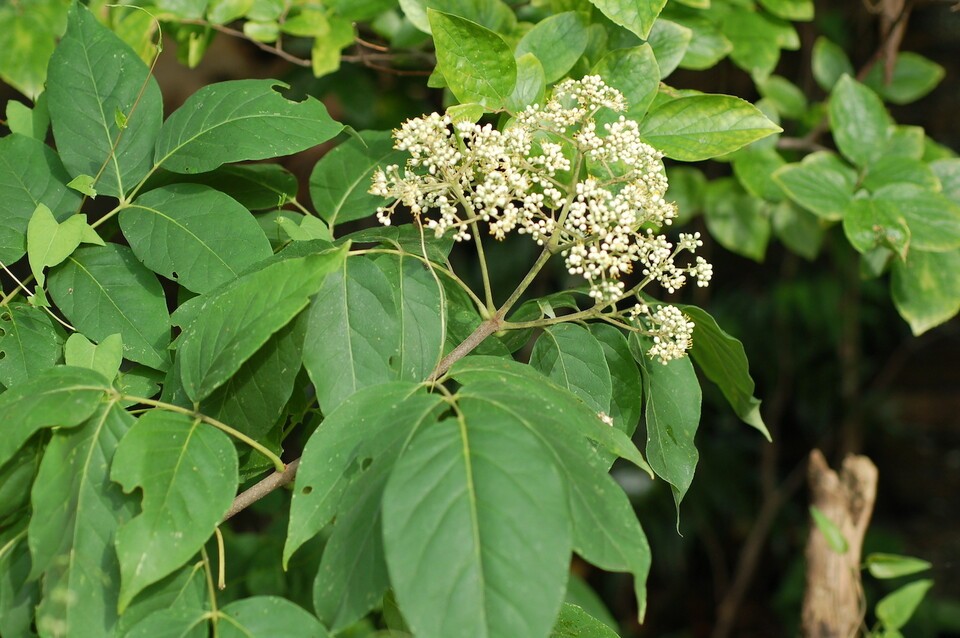
The solution was unexpectedly close at hand. There were already excellent nectar-producing trees native to Korea or suitable for cultivation here.
The National Institute of Forest Science analyzed about 260 nectar-producing tree species distributed across the country and identified species with outstanding honey production per hectare. The results were striking.
A single hovenia tree produces 1,857 grams of honey, about 35 times more than the 52 grams produced by an acacia tree. Converted to honey output per hectare, hovenia trees produce 400 kilograms, compared with 38 kilograms for acacia trees. That means 10.5 times more honey can be obtained from the same area.
In the beekeeping industry, hovenia is nicknamed the “bee bee tree,” meaning honey pours out like water. What is especially interesting is that its flowers bloom from mid-July to early August. Hovenia flowers during the nectar gap after acacia blossoms finish in May. Planting the two together can extend the harvesting season from May to August.
Hovenia is not the only promising species. Japanese raisin tree yields 301 kilograms per hectare, 7.9 times more than acacia. It blooms from mid- to late June, filling the gap between acacia and hovenia.
In addition, many species were identified with much higher honey yields per hectare than acacia, including Ligustrum japonicum at 146 kilograms, Ina tree at 128 kilograms, fragrant water jasmine at 110 kilograms, Korean snowbell at 107 kilograms, and linden at 95 kilograms. In April 2026, the Korea Forest Service additionally announced 24 more excellent nectar trees. Soapberry, ivy, and evergreen holly were newly included.
Domestic native honey beats manuka.
There is an even more interesting finding: research shows that honey from the Japanese raisin tree is superior to manuka honey.
The National Institute of Forest Science compared honey from the Japanese raisin tree, manuka honey, and acacia honey. The results showed that Japanese raisin tree honey outperformed both manuka and acacia honey in antioxidant activity, skin-whitening effects, and uric acid production suppression. Considering that the Japanese raisin tree is a native nectar source in Korea, the findings are significant.
Manuka honey built a global premium market on the strength of a single feature: antibacterial power. Japanese raisin tree honey showed potential to surpass manuka in antioxidant and beauty-related benefits. This offers Korea a starting point for creating a new premium category.
Of course, much remains to be done. It will take time for Japanese raisin tree honey to be widely distributed. It takes years from planting seedlings until flowers bloom. Still, the direction is clear: Korea must move away from dependence on a single acacia species and toward a diverse range of native nectar trees.
Is policy keeping up?
Under its five-year comprehensive plan to foster the beekeeping industry, the Korea Forest Service is planting 3,000 hectares of nectar trees each year. It has also introduced new varieties, including Hungarian acacia. Policies are also being promoted to prioritize nectar trees in restoration efforts after wildfires.
But the pace is the problem. Even if 3,000 hectares are planted each year, it would take 100 years to restore the 325,000 hectares lost over the past 50 years. Beekeepers do not have that much time.
Local governments are also stepping up. North Gyeongsang Province has been planting 600 hectares of nectar trees annually on land damaged by the 2022 Uljin wildfire.
Boryeong in South Chungcheong Province has separately created an acacia nectar forest. Across the country, events planting hovenia, Japanese raisin tree, and varnish tree are being held.
The key is the participation of forest owners. More than 65 percent of Korea’s forest land is privately owned. Without incentives for landowners to plant and maintain nectar trees, government policy alone has its limits.
The Korea Forest Service covers 90 percent of the cost of planting nectar trees, but forest owners are still reluctant to plant trees that do not generate short-term income.
A new path for beekeepers.
By diversifying native nectar trees, the harvesting season should be extended from just May to the period from May through August. The flower fields lost to aging acacia trees must be replaced with other excellent nectar sources.
Honey from native Korean nectar trees, such as Japanese raisin tree honey, should be developed into premium products just like manuka honey. These three measures must work together for beekeepers to have a future.
If farm income rises, investment in eco-friendly beekeeping, precision control of Varroa mites, and digital beehives becomes possible. Bees survive, farmers survive, and the food table becomes more stable.
The problem is time. A structure that has collapsed over 50 years cannot be reversed overnight. But being late is no reason to stop. The survival of Korean beekeeping ultimately depends on how quickly the lost flower fields can be brought back.