
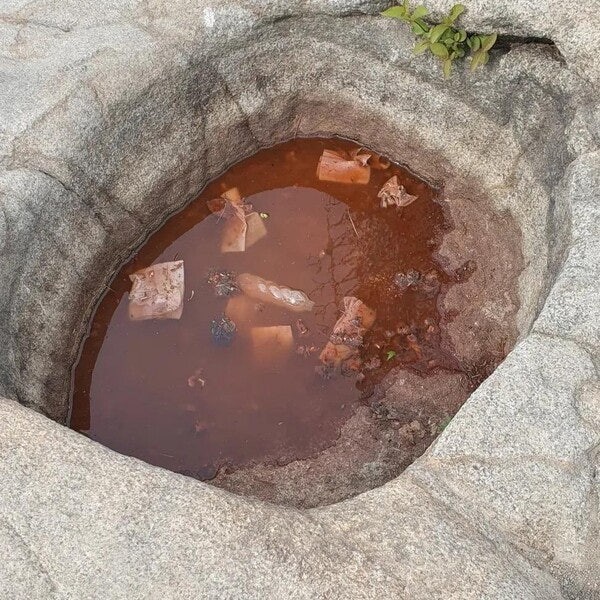
A single photo of a red-stained puddle shook the internet. The landscape in a photo posted on an online community on the 2nd was far from an ordinary mountain summit.
Near the summit of Yeonjudae on Seoul’s Gwanaksan, a small puddle had sunk into ramyeon broth and turned the color of blood. Ice cream wrappers floated in it, and wads of toilet paper were mixed in. The person who posted the photo wrote briefly: “It’s water for birds, cats, and other wild animals to drink.”
The weight of this one image goes beyond a simple environmental damage incident. To understand how Gwanaksan became a mountain where ramyeon broth flows down, one must trace the flow backward. The starting point was a variety program four months earlier.
The crowd created by a fortune teller’s remark
In January, a fortune teller who appeared on tvN’s variety show “You Quiz on the Block” introduced a method for improving one’s luck when fortune is not going well and singled out one mountain as a recommendation: Gwanaksan. Feng shui interpretations were added, saying it has strong fire energy and gathers positive qi.
Right after that comment aired, the internet buzzed. A short clip was repackaged into YouTube Shorts and Instagram Reels, and “how to get Gwanaksan’s energy” spread almost like a hashtag.
After the broadcast, searches related to Gwanaksan surged several times above normal. On weekends, the line for photos in front of the Yeonjudae summit marker stretched 80 to 100 meters. Even on weekday afternoons, waiting an hour was standard.
People in their 20s and 30s came in a line, praying for jobs, exam success, and business prosperity. One later account posted on social media said someone even set a specific target profit amount to pray for, following the superstition that one should not make vague wishes.
The backdrop to Gwanaksan’s rise as a “lucky energy spot” lies in digital-era crowd psychology. It was not the mountain itself that was newly discovered.
It was not Gwanaksan’s natural scenery, like the breathtaking views of Bukhansan or Seoraksan, that became content, but the story of Gwanaksan’s “energy.”
The symbol layered onto the mountain spread through social media algorithms. With no need to visit a fortune teller and no need to pay a consultation fee, it became an easily accessible, participatory ritual. In effect, it turned into a light ritual that people could join even in training clothes rather than hiking gear.
At the same time, another factor was at work: a generational shift in Korea’s hiking population. Hiking had long been seen as a hobby of middle-aged and older adults. After COVID-19, however, solo hiking, hiking crews, and hiking vlogs took root, reversing the trend.
Young people in their 20s and 30s, dressed casually and carrying backpacks, became the new owners of the mountains. A merchant who has sold drinks near Yeonjudae for 15 years said there had never been this many people on weekdays. Waiting lines for weekend photo spots exceeding an hour became an everyday spectacle.
What disappears before luck does
The problem is that the crowd grew faster than the mountain could handle. Gwanaksan is not a national park but an urban natural park managed by the Seoul Metropolitan Government. Under the Natural Parks Act, damaging facilities or causing pollution can result in a fine or administrative penalty of up to 3 million won. However, there are clear limits to enforcement personnel and systems.
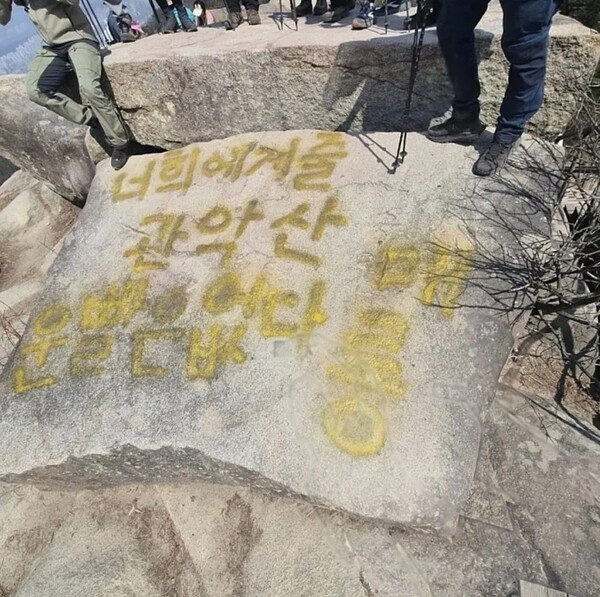
The damage was not limited to ramyeon broth. Last month, graffiti appeared on Mardangbawi along the first hiking trail, reading, “There’s no Gwanaksan luck for you, nyah-nyah,” sparking controversy.
Coins were wedged into cracks in rocks near Eungjinjeon at Yeonjudae, and stone towers piled up along the trails. All are material fit for social media posts, but from the mountain’s perspective, they are traces and wounds.
According to data from the Korea National Park Service, waste generated in Korea’s national parks reached 5,180 tons over the 5 years and 8 months from 2019 to August 2024. The number of illegal dumping cases recorded during the same period increased 27-fold.
The mountain that produces the most trash is Jirisan, with 734 tons, followed by Bukhansan at 526 tons. Gwanaksan is not included in this statistic because it is an urban natural park, but with its population surge over just one year, separate monitoring is needed.
Damage does not end with trash. Among the types of damaged areas in national parks analyzed by the Korea Society of Landscape Architecture, the most common were informal trails, or side paths. As people step off designated routes and create new footprints, soil erodes and vegetation dies. The desire for better spots for photos, avoiding lines, and seeking better angles all create these side paths. The more people come, the more side paths appear, and the more the mountain collapses.
The reason the red puddle is so shocking is not merely because it is a piece of food waste. It means the drinking water for wild animals disappears. The mountain’s water-source function is damaged. When ramen broth mixed with rainwater runs through the soil, the balance of soil microbes is disrupted. A casual gesture by one hiker empties out a section of the ecosystem.
The mountain is only borrowed for a while
One phrase is repeated in unison by veteran mountaineers: a mountain is not a tool, but a place one temporarily borrows. It is short and simple, but it is the starting point of all hiking ethics. A mountain is not a device that creates something for hikers.
It does not create luck, nor does it serve as a backdrop for photos. The mountain simply exists, and people borrow that space for a while. The most basic promise is for the borrower to leave without leaving traces, passing the mountain on to the next generation.
The most well-known form of this principle is Leave No Trace, or LNT. LNT is an outdoor ethics guideline established in 1991 by the U.S. Forest Service and the National Outdoor Leadership School (NOLS). Over the past 35 years it has spread around the world, and Korea’s Forest Service has officially adopted it and recommends it to citizens. The seven principles are simple but powerful.
First, plan ahead and prepare. Learn the mountain’s rules and the weather in advance, move in groups of four to six rather than large groups, and avoid peak crowd times. The scene of waiting an hour in line for photos at Yeonjudae is exactly the opposite of this principle.
Second and third: travel on designated paths and take everything you brought back with you. If you boiled ramyeon, even the broth should be carried back down in a thermos. Toilet paper, hygiene products, and food scraps must not be left behind, not even a single grain. The moment you step into a grassy area beside the trail, a side path begins. Walking in the center of the designated trail helps save the mountain.
Fourth, leave natural objects as they are. Do not build stone towers, do not wedge in coins, do not write graffiti on rocks, and do not break grass, flowers, or branches. A stone tower built by one person invites imitation from the next, and one person’s graffiti invites another, as seen in the Mardangbawi incident. Traces call forth more traces.
Fifth and sixth: minimize campfires and never feed wildlife. Lighting a fire directly on the mountain to boil ramyeon violates the Forest Protection Act. Even if a portable gas burner is used, all embers and residual gas must be fully cleared afterward. Throwing food to animals harms their natural instincts and ultimately makes them unafraid of people. That leads to accidents.
The final, seventh principle is to be considerate of other visitors. Do not play loud music, yield the way to people coming uphill on narrow paths, and when taking photos at the summit, make room quickly for those behind you. Korea’s mountains are narrow and densely visited. Without consideration, everyone becomes uncomfortable.
Luck exists only while the mountain is alive
In January 2024, the Seoraksan Alpine Association launched a campaign called “LNP”: Leave No Poop. It distributes portable feces bags to hikers.
The movement asks hikers to carry out any excrement produced during early-morning climbs instead of leaving it on the mountain. The fact that a civic group moved before the government speaks volumes. Protecting the mountain ultimately begins with the voluntary commitments of the people who love it.
Everyone waiting in line at Yeonjudae came to receive luck: luck for jobs, exams, love, and business. But the luck they seek can exist only if the mountain remains alive.
If the mountain is soaked in ramyeon broth and covered in plastic bags, the positive energy it once held disappears as well. Whether spoken in the language of feng shui or ecology, the conclusion is the same.
The graffiti on Mardangbawi reads again like a warning: “There’s no Gwanaksan luck for you, nyah-nyah.” After seeing the ramyeon broth incident, that graffiti feels less like a joke and more like a warning. If the mountain turns its back first, luck will turn away too. If you want to receive luck, the first thing to take with you is not energy but your own trash.
The bigger question Gwanaksan raises
The Gwanaksan case asks a broader question about how Korean society treats nature. It reflects a progression: from an era when hiking was exercise, to an era when hiking became content for photos, and now to an era in which hiking is becoming a digital ritual combining superstition, anxiety, and narrative. That change itself cannot be stopped. What matters is whether citizens make the mountain able to endure that change.
The Seoul Metropolitan Government is reviewing partial trail closures and measures to disperse crowds on Gwanaksan. But administration is slow, and enforcement has limits.
In the end, the last line of defense is the one person climbing the mountain with a backpack. That small act of pouring the ramyeon broth back into a thermos is what passes a mountain on to the next generation.
A mountain does not create a person’s luck. It is only how people treat the mountain that determines its fate. The red puddle at Yeonjudae on Gwanaksan tells that story in the coldest possible way.