
Employment indicators have maintained an increase of about 200,000 people for two consecutive months, appearing stable on the surface. However, a closer look reveals diverging trends within these numbers. While the health and welfare sectors are supporting employment, the youth and professional job markets are heading in the opposite direction.
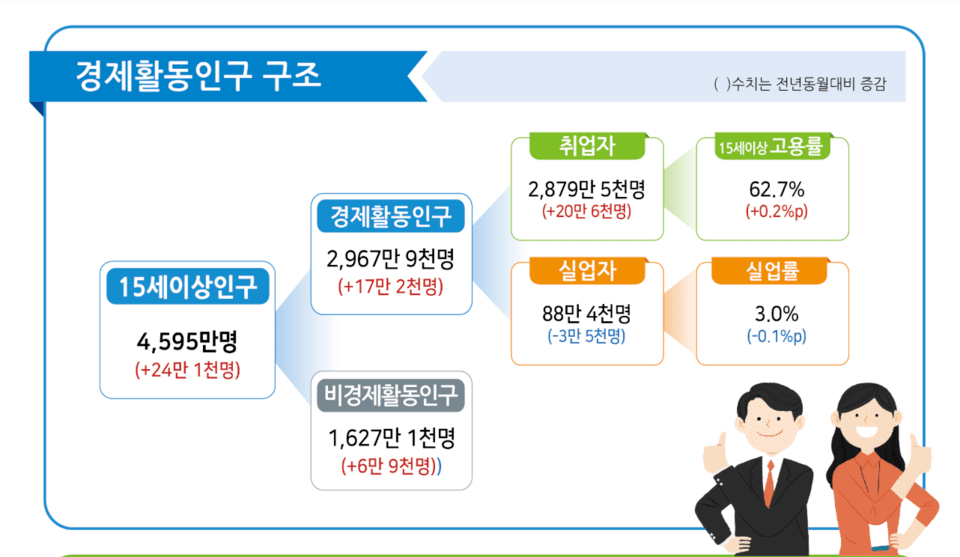
According to the ‘March 2026 Employment Trends’ released by the National Data Office on the 15th, the total number of employed persons last month was 28,705,000, an increase of 206,000 (0.7%) compared to the same month last year. The growth in employment numbers has continued for 15 consecutive months. The employment rate was 62.7%, up 0.2 percentage points, which is the highest March figure since the monthly statistics began in 1982.
The sectors driving this increase were healthcare and social welfare services, which grew by 294,000 (9.4%) from the same month last year, effectively pulling up the overall increase in the number of employed. The transportation and warehousing sector (75,000, 4.5%) and the arts, sports, and leisure-related services (44,000, 8.4%) also contributed to the growth.
This structure merits attention. The expansion of employment in the health and welfare sectors is a result of increased demand due to aging and expanded government spending, differing in nature from the self-sustaining recovery of the private market. Although the numbers appear solid externally, they cannot be read purely positively in terms of the quality and sustainability of employment.
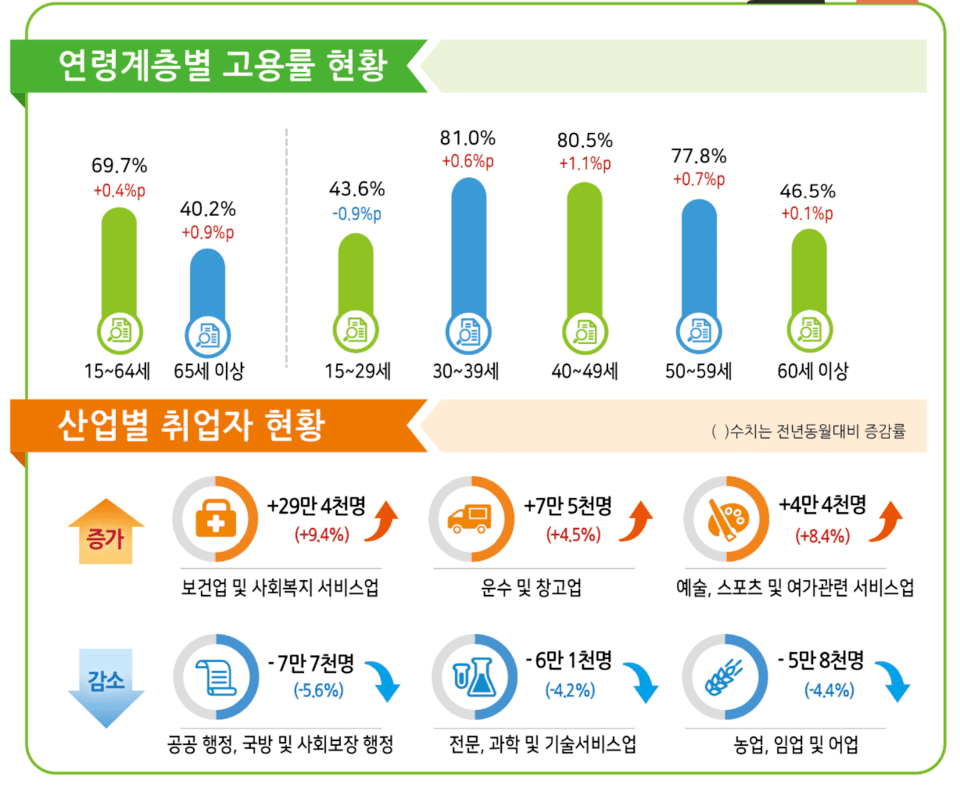
Conversely, the sectors that saw a decline are also noteworthy. Employment in the professional, scientific, and technical services sector fell by 61,000 (-4.2%). Public administration, defense, and social security administration (-77,000, -5.6%) and agriculture, forestry, and fisheries (-58,000, -4.4%) also saw significant decreases.
The decline in professional and scientific jobs is not easily attributed to mere economic fluctuations. It signals a restructuring in demand within certain professional areas due to the accelerated adoption of artificial intelligence (AI). Continued declines in employment within high-value-added industries could mask structural vulnerabilities in overall employment improvement, raising concerns.
Youth employment, in particular, is telling a different story than the numbers might suggest. The employment rate for the youth (aged 15 to 29) was 43.6%, a decline of 0.9 percentage points compared to the same month last year, running counter to the 0.4 percentage point increase in the overall employment rate for those aged 15 to 64. The youth unemployment rate was 7.6%, more than double the overall unemployment rate of 3.0%.
The number of those ‘resting’ without specific reasons increased by 31,000 (1.2%) to 2,548,000 compared to the same month last year. Although there was a slight decrease in job seekers who gave up entirely to 354,000, the absolute number remains substantial. This indicates a vast population remaining outside the official labor market, not classified as unemployed, yet not participating in the workforce.
While the total number of employed persons has risen for 15 consecutive months and the employment rate marked a historical high, the labor market that the youth experiences is different from what the numbers might imply. It is crucial to consider which generation and sectors are accumulating the increasing employment numbers.