
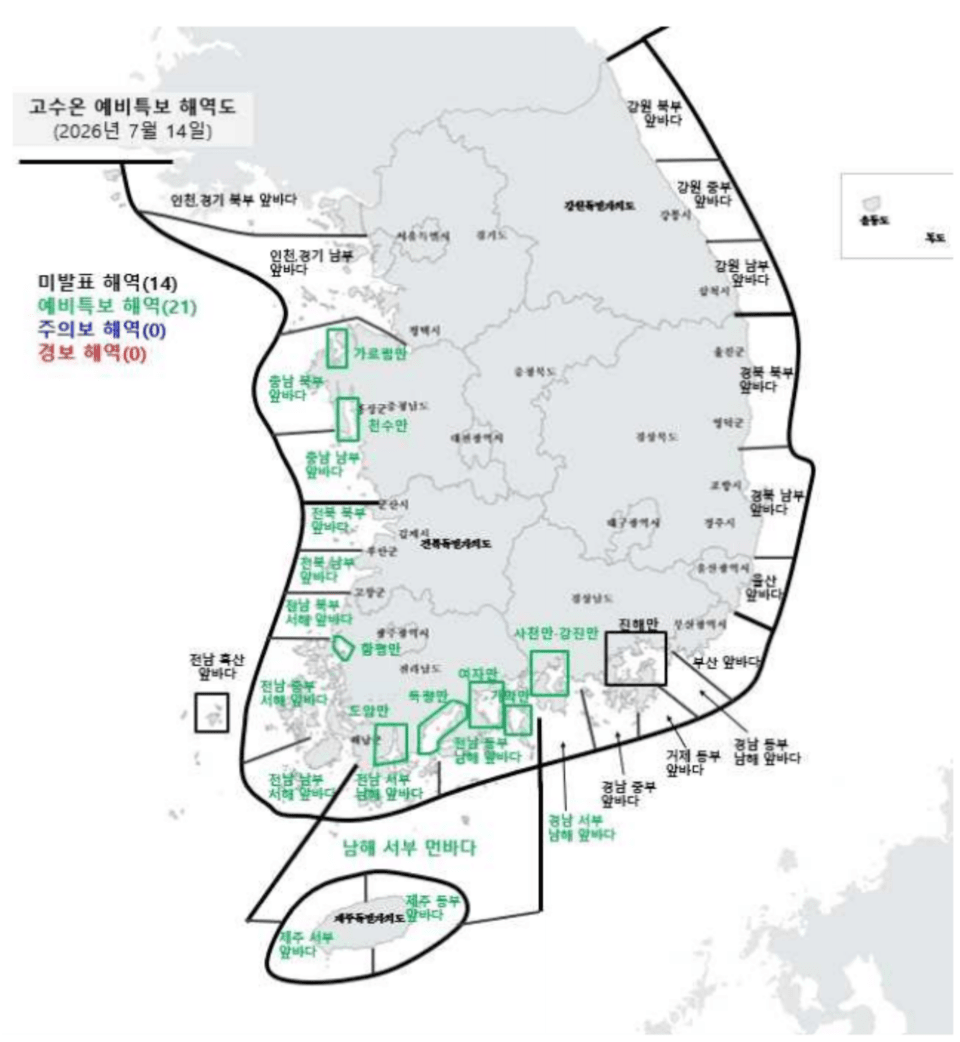
The Ministry of Oceans and Fisheries issued a “caution” level high-water-temperature crisis alert at 6 p.m. on July 14. The move followed the National Institute of Fisheries Science’s announcement of a preliminary high-water-temperature advisory at 4 p.m. the same day for 21 coastal zones along the West Sea, South Sea, and Jeju.
High-water-temperature crisis alerts are raised in the order of watch, caution, warning, severe level 1, and severe level 2. A preliminary advisory is issued when seawater temperatures reach or are expected to reach 25 degrees Celsius. At 25 degrees, farmed fish begin to experience stress. It is roughly equivalent to a heat advisory for people. Once temperatures exceed 28 degrees, aquaculture species can no longer withstand the heat, leading to mass die-offs.
The numbers have already crossed the danger line. As of 1 p.m. on July 13, coastal waters near Hampyeong and Boseong in South Jeolla recorded 27.6 degrees Celsius. Seosan in South Chungcheong recorded 26.7 degrees, Sinwol in Yeosu 26.0 degrees, and Namhae in South Gyeongsang 26.2 degrees. Although some areas, such as Haean in South Jeolla (23.9 degrees) and West Jeju (24.3 degrees), remain below the threshold, the gap is not large. Many waters have already passed the 25-degree mark.
When water temperatures rise, fish suffer a double burden. Warm water holds less oxygen. Fish, meanwhile, are ectothermic animals whose body temperature follows the water temperature, so rising temperatures speed up their metabolism and increase their oxygen demand. Supply falls while demand rises. Caged fish trapped in net pens cannot move to cooler waters.
This year’s advisory came 11 days later than last year’s, when it was issued on July 3. The reason was the stalled monsoon front near the Korean Peninsula, which brought frequent rainfall and delayed the warming of seawater. But a later warning does not mean safety. Once the monsoon front moves away and heat waves take over, water temperatures can surge in a short period. Recent observations by the Jeju Provincial Institute of Ocean Science show that the average surface temperature off Jeju was about 1.3 degrees higher than the same period last year.
At the same time it raised the alert level, the ministry set up an emergency response team and said it would strengthen field inspections and training. It is measuring sea temperatures in real time at 210 observation stations nationwide and sending the data to local governments and fishermen by text message and on its website. Response equipment such as liquid oxygen supply units has already been distributed to 10 metropolitan and provincial governments. Management guidelines in English and Indonesian have also been distributed for foreign workers at aquaculture sites.
Minister of Oceans and Fisheries Hwang Jong-wu said, “With the current heat wave continuing, a full-scale rise in sea temperatures is expected,” adding that the ministry is inspecting aquaculture sites on location together with local governments. He urged fishermen to harvest early, adjust stocking density, and check response equipment.
◆ Korean seas are heating up twice as fast as the global average

The alert is only the visible symptom. The root cause is that the ocean itself is structurally warming.
The ocean is at the front line of global warming. More than 90 percent of the heat trapped by greenhouse gases is absorbed by the ocean. Heat accumulates first and more heavily in the sea than in the atmosphere. Because water holds far more heat than air, a 1-degree rise in sea temperature represents a vastly larger amount of heat than a 1-degree rise in air temperature.
According to an analysis by the National Institute of Fisheries Science, the average surface temperature of Korea’s coastal waters rose by about 1.58 degrees from 1968 to 2024. Over the same period, the global average surface temperature rose by 0.74 degrees. That means Korean seas have warmed more than twice as fast as the world average. In 2024, the annual average surface temperature of Korean waters reached 18.74 degrees, the highest in 57 years of observation.
This mirrors what was discussed in the previous installment on Europe. The European continent is heating up twice as fast as the global average, resulting in heat-related deaths. In Korea, it is not the land but the sea that is heating up at the same pace. Global warming does not rise evenly across the planet. It hits the most vulnerable places first and twice as hard.
Among the reasons cited for the unusually rapid warming of Korean waters are the expansion of the North Pacific High and the Tsushima Current. When high pressure blankets the Korean Peninsula in summer, both air and sea temperatures rise. The Tsushima Current, which flows through the Korea Strait into the East Sea, carries warm water from the western Pacific. When this current strengthens, it pushes up coastal sea temperatures.
If land has heat waves, the ocean has “marine heat waves.” These are periods when seawater remains far warmer than normal for several days, and their frequency is rising worldwide. The seas around the Korean Peninsula are no exception.
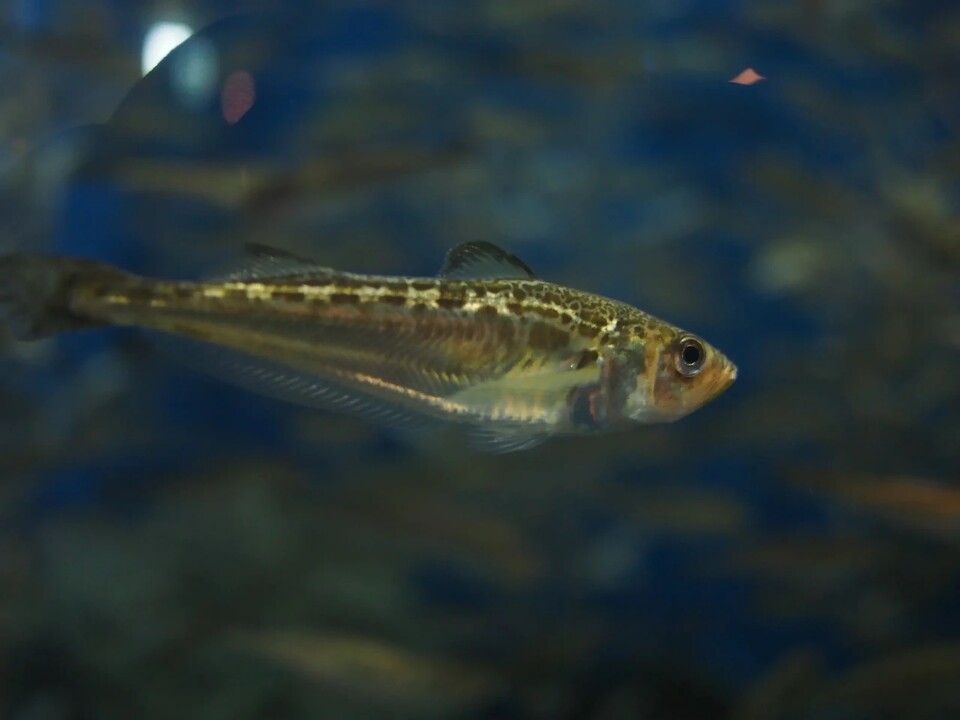
As the ocean warms, it is reshaping fishery maps. Pollock and small yellow croaker in the East Sea have been pushed north into Russian waters. Yellowtail, once considered a specialty of Jeju, is now caught in the East Sea. Squid, once a staple fish for Koreans, has seen catches plunge since the 2010s. The space left by temperate species is increasingly being filled by warm-water and subtropical species.
The changing sea is also affecting food prices. Coastal fishery production has been on a downward trend, averaging around 930,000 tons from 2020 to 2023. In 2024, worse kelp harvests caused by high water temperatures pushed kelp prices up, and auction volumes of West Sea flower crab fell by more than 30 percent as fishing grounds dispersed, driving prices higher. As the sea warms, seafood supply becomes unstable and consumer burdens rise.
For aquaculture farms, it arrives as a disaster. High water temperature, along with red tide, is classified as one of the summer’s major fishery disasters. According to the National Institute of Fisheries Science, from 2011 to 2023, aquaculture losses caused by natural disasters such as high water temperatures, low-oxygen water masses, and jellyfish outbreaks totaled 326 billion won. Of that, high-water-temperature losses alone accounted for 194.7 billion won, or 60 percent.
◆ 143 billion won and 9.5 billion won: It was not the water temperature that made the difference
The summer of 2024 was recorded as the worst in the history of Korea’s aquaculture industry. High-water-temperature losses that year reached 143 billion won, the largest on record. That was twice the previous high of 71.3 billion won in 2018. More than 26.4 million farmed fish died in the southern coastal region alone. In South Gyeongsang, 925 fish farms suffered damage worth 65.9 billion won.
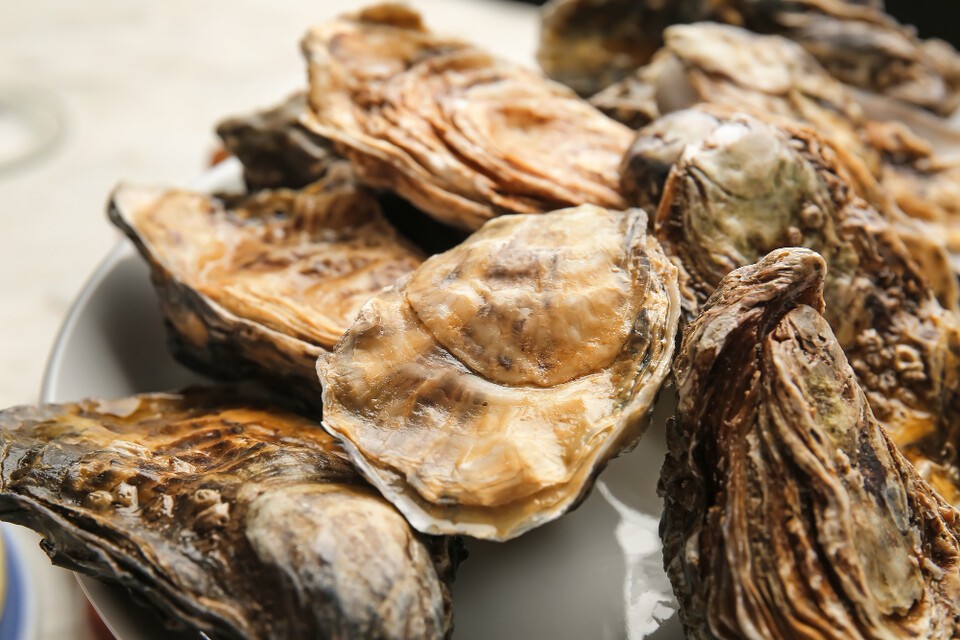
For sea squirts, which are highly sensitive to temperature, the officially recorded mortality rate reached 97 percent. Oysters were no exception. As long-heated seawater was compounded by low-oxygen water masses, 1,130 hectares of oyster farms in South Gyeongsang—about one-third of the province’s total—were damaged.
The losses were not confined to one region. In Jeju, high-water-temperature damage to aquaculture farms rose from 170 million won in 2020 to 2.04 billion won in 2023 and 5.34 billion won in 2024, more than 30 times higher in four years.
The figures for 2025 tell a different story. That year’s high-water-temperature advisory lasted 85 days, the longest ever recorded. The sea stayed hot for even longer. Yet total nationwide damage came to just 9.5 billion won. In just one year, losses fell to one-fifteenth of the previous level.
There were still regional differences. Jeju continued to diverge from the downward trend, posting 5.2 billion won in losses in 2025. The island’s subtropical-leaning waters are believed to warm earlier and for longer than other regions.
What made the difference was response. South Jeolla Province urgently released 3.73 million farmed fish before they died and injected an additional 900 million won in state funds when high water temperatures struck. As a result, even during the longest advisory on record, damage fell by 89 percent from 2024. Allowing fish that would otherwise die to be sold early or released into the sea proved effective in preventing losses.
Government response systems were built on this experience. In June, the Ministry of Oceans and Fisheries drew up a comprehensive 2026 plan for high water temperatures and red tides. The budget for distributing response equipment such as liquid oxygen supply units rose 31 percent from 5.8 billion won last year to 7.6 billion won this year, the largest amount ever. The real-time temperature monitoring network was expanded from 200 to 210 stations.
Species sensitive to high temperatures, such as rockfish, flatfish, and abalone, are being guided toward early harvest before the heat intensifies, while discount events are being used to support consumption. The emergency release system, which lets farmed seafood be quickly released into the sea if death is feared, is also being activated. Recovery support has been broadened from juvenile stocking costs to cover production expenses such as feed, fuel, and labor.
◆ Insurance still does not protect fishermen
Even as the response system has improved, gaps remain in the safety net. Aquaculture disaster insurance is the clearest example.
The insurance has an out-of-pocket rate of 10 to 40 percent, and to cover high-water-temperature damage, farmers must separately purchase riders that cost two to three times more than the main policy. Because it is a term policy that disappears after one year, many fishermen avoid enrolling. There has also been criticism that compensation is small relative to actual losses because claims are based on lower wholesale prices rather than market-side prices.
The compensation rules for young fish have created contradictions. Even if fry die, only individual fish weighing 40 grams or more are recognized as losses. To meet that threshold, farmers may feed more, which in turn raises mortality during periods of high water temperature.
Fishermen say the structure creates a paradox in which efforts to save fish end up worsening losses. They are calling for the weight threshold to be lowered to 20 grams. For insurance to function as a true safety net, the entry barrier must be lowered first.
There are also regions where location worsens the damage. In the Cheonsu Bay area of South Chungcheong, fishermen say aquaculture farms are crowded together and that nearby thermal power plants release heated cooling water, leaving surrounding waters warmer than elsewhere. During summer downpours, when large amounts of freshwater flow in, adult fish can die from high water temperatures while juveniles, which are sensitive to freshwater, die from the influx of fresh water—creating a double hit.
Equipment and emergency releases also have limits as fundamental solutions. Liquid oxygen and shading nets are only stopgap measures to get through a few critical days. The long-term warming trend itself is not reversing. The National Institute of Fisheries Science expects the surface temperature of Korean waters to keep rising. This summer’s coastal waters are also forecast to be more than 1 degree warmer than normal.
That is why structural reform is also seen as necessary. This includes switching aquaculture species to those more tolerant of high temperatures, increasing immune-boosting agents and vaccines, and shifting to farming methods that can withstand temperature fluctuations. South Jeolla Province has included the restructuring of a climate-adaptive aquaculture industry among its four major policy directions for this year. South Gyeongsang Province has more than doubled the amount of immune-boosting agents supplied in a year.
Because high water temperatures have become a recurring summer disaster, experts say the focus must shift from one-time recovery aid to a year-round response system and a transition that strengthens the industry’s underlying resilience.
The alert is on. One fact proven by last summer is that even in the same sea, losses depend on how well one is prepared. Now that high water temperatures have become a recurring annual reality, the remaining question is how tightly the safety net can be woven.