
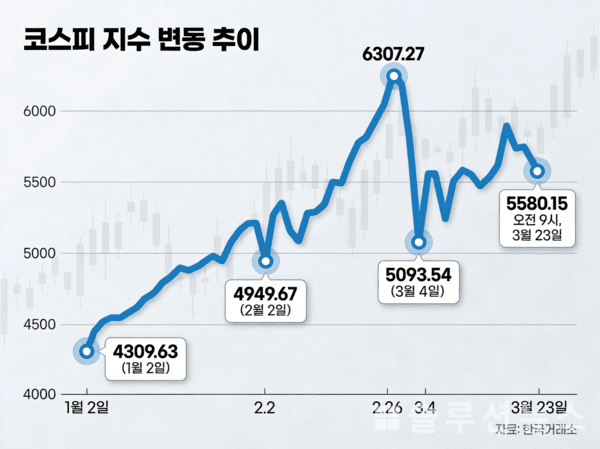
The KOSPI shook again. On the 23rd, according to the Korea Exchange, the KOSPI started the day at 5,580.15, down 3.48% from the previous trading day. This comes five trading days after recovering the 5,900 mark on the 18th. The trigger was the Middle East.
U.S. President Donald Trump issued an ultimatum to Iran via his social media platform, Truth Social, on the 21st local time. The message: “If the Strait of Hormuz is not fully opened within 48 hours from now, we will attack and devastate Iran’s power plants.” Iran’s central military command immediately responded, warning that if the power plants were attacked, they would close the Strait of Hormuz completely and not reopen it until the power plants were rebuilt. The fear of escalation has engulfed the market.
A sidecar was also activated.
The steep drop of the KOSPI is evident in the numbers alone. At 9:18 a.m., just nine minutes after the market opened, the Korea Exchange activated a KOSPI sell-side car. This measure is triggered when the KOSPI200 futures index falls more than 5% compared to the previous day. It is the sixth sell-side car activated in the Korean stock market this year. This number highlights how tumultuous the domestic stock market has been over the past month.
Major semiconductor stocks also took a direct hit. As of 9:05 a.m., Samsung Electronics fell 4.61% compared to the previous trading day, marking 190,200 won. The ‘200,000 Won Samsung’ was breached. SK Hynix also dropped 5.36% to 953,000 won, relinquishing the ‘1 Million Won Hynix’ mark.
Foreign investors poured out net sales amounting to 3.357 trillion won from the start of the trading session. Meanwhile, individual investors supported the index’s downside by net buying 5.351 trillion won. The KOSDAQ also started 2.73% lower at 1,129.86, while the won-to-dollar exchange rate rose by 4.3 won, opening at 1,504.9 won.
Why is Korea more affected?
The domestic stock market is particularly sensitive to shocks from the Middle East due to structural reasons. South Korea is an energy-vulnerable country that heavily relies on the Middle East for its oil imports. The Strait of Hormuz is a key shipping route through which about 20% of global oil and liquefied natural gas (LNG) supply passes. Even the mere threat of Iran closing it can cause international oil prices to fluctuate, directly correlating to increased corporate costs and inflation pressures.
This situation is compounded by the fluctuating won-to-dollar exchange rate around the 1,500 won mark. A scenario where oil prices, interest rates, and the dollar all rise simultaneously is the most unfavorable for Korea’s import-dependent economy. This structure makes the Korean market the first to be sold off by foreign investors. It also explains why large-cap stocks with abundant liquidity, like Samsung Electronics, become primary targets for massive sell-offs.
The uncertainty is not over yet.
It is still uncertain whether this steep drop will remain a short-term shock or mark the start of further declines. The key variable is whether Trump’s ultimatum will lead to actual military actions. The U.S. Central Command has already struck underground missile facilities along Iran’s coastline with 5,000-pound bombs. Iran remains steadfast in not retreating an inch.
There’s an analysis circulating in the securities market that expecting a short-term V-shaped rebound is difficult given the current situation of unresolved geopolitical uncertainties. Experts suggest more time is needed until the fear is organized in a specific direction. The fact that the KOSPI recovered the 5,900 mark just five days ago paradoxically highlights the current volatility.