
The Gulf region, which has dominated Iran’s oil exports, is still under pressure, and now a second warning has sounded at the entrance of the Red Sea.
[Key Points of this Article]
▶ Iranian Parliamentary Speaker Ghalibaf indirectly indicated on social media the blockade of the Bab el-Mandeb Strait.
▶ A strategic point where more than 10% of the world’s maritime crude oil flow passes through.
▶ If the ‘double bottleneck’ scenario of Hormuz and Bab el-Mandeb is realized, it is projected that South Korea’s GDP could suffer a shock of up to -6%.
▶ The Houthi rebels also warned of a blockade if the Gulf states intervene, raising concerns about the expansion of proxy forces connected to Iran.
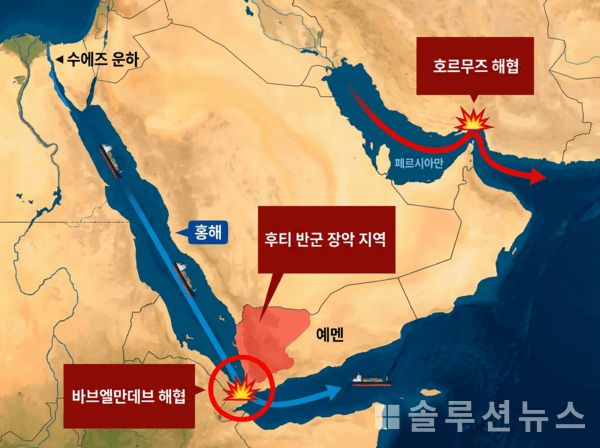
The straits of Hormuz and Bab el-Mandeb are included in Middle Eastern maritime supply routes. Should a blockade scenario become real, it is expected that energy-importing countries, including South Korea, will inevitably face a supply shock.
The Weight of a Single Question
On April 3 (local time), Mohammad Bagher Ghalibaf, the Speaker of the Iranian Parliament, posted a short message on X (formerly known as Twitter). “What percentage of the world’s oil, liquefied natural gas, wheat, rice, and fertilizer shipping volume passes through the Bab el-Mandeb Strait? Which countries and companies have the largest flow of goods?”
It was neither a declaration nor a threat. However, Iranian semi-official Tasnim News Agency interpreted this statement as “hinting at potential transit interference similar to the Hormuz Strait.” A single sentence was enough to shake the global maritime and energy markets.
Ghalibaf was personally appointed as the communication channel between the U.S. and Iran by President Trump. That he directed a question toward the southern entrance of the Red Sea itself was interpreted as a diplomatic signal.
If the ‘Gate of Tears’ Closes
The Bab el-Mandeb Strait, an Arabic term meaning ‘Gate of Tears’, lies between Yemen and Djibouti. This narrow waterway, 26 kilometers wide, is the southern entrance to the Red Sea and a gateway to the Suez Canal. Tankers departing from the Persian Gulf must pass through the Hormuz Strait, cross this strait, and travel up the Red Sea to reach Europe.
Over 10% of the world’s maritime crude oil flow passes through this strait. Iran’s Revolutionary Guard Corps (IRGC) has effectively blocked the Hormuz, which accounts for 20% of the oil shipping volume. If Bab el-Mandeb is also blocked, it would mean that two major routes from the Middle East to Europe are simultaneously disrupted.
Saudi Arabia is currently responding to the Hormuz blockade by exporting about 7 million barrels of oil a day via land pipelines to Yanbu port on the Red Sea. If even this bypass is threatened, there will be no alternatives. If the double bottleneck scenario becomes a reality, it is analyzed that about 30% of global container shipping could be blocked, and oil supplies from the Persian Gulf to Europe could effectively come to a complete halt.
Iran is Not Alone
Iran cannot directly control Bab el-Mandeb due to geographical limitations, as the strait is thousands of kilometers away from Iranian territory. However, it has the Houthi rebels as a proxy force.
The Iranian-linked Houthi rebels in Yemen declared participation on the 28th of last month and have already launched missiles toward Israel.
They directly warned that if Gulf countries support the U.S. and Israel, they might move to block the Bab el-Mandeb Strait. There has also been a precedent of attacks on merchant and military ships in the Red Sea. Some media reports suggest Iran is pressuring the Houthi rebels to attack ships passing through the Red Sea.
The Wall Street Journal analyzed that “Iran’s militia alliance can threaten other bottleneck points like Bab el-Mandeb, so there is still a risk that proxy forces might take different positions even if Iran decides to reopen Hormuz.” An agreement at the negotiating table does not necessarily guarantee the security of the strait.
South Korea’s Equation
Among the structurally most vulnerable countries in this crisis, South Korea has been singled out. According to CitiGroup’s analysis of net oil and LNG trade structures relative to GDP, South Korea is projected as the largest loss country among major nations. The Wall Street Journal reported on the 4th (local time) that South Korea’s GDP loss could reach up to 6%.
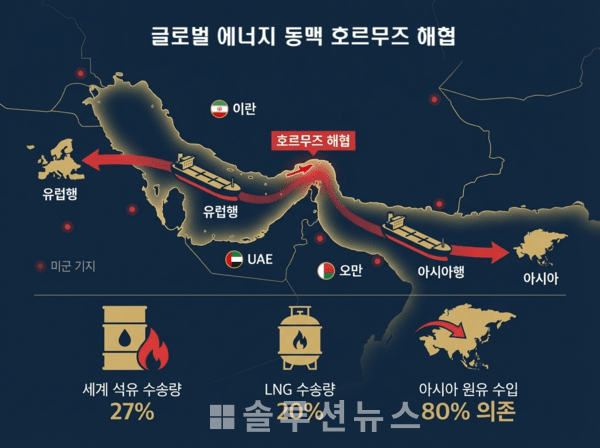
These figures explain the reason. South Korea sources more than 95% of its imported crude oil and over 20% of its LNG from the Middle East. There is virtually no alternative supply route bypassing Hormuz.
The International Energy Agency (IEA) has classified this Hormuz blockade as “the largest oil market supply shock in modern history.” The Korea Institute for International Economic Policy forecasts that even if the war ends early, international oil prices will find it hard to drop below $90 per barrel and could rise to $117 if the blockade is prolonged.
The Industrial Research Institute estimates that if the blockade persists for more than three months, the average production cost of South Korean manufacturing could rise by 11.8%. The South Korean government is already enforcing an oil price cap, limiting delivery prices to refineries and working on energy supply stabilization by restarting the Kori Nuclear Power Plant Unit 2, which has been dormant for three years.
Ghalibaf’s ‘question’ still awaits an answer. The world holds its breath, watching for what the answer will be and when it will come.