
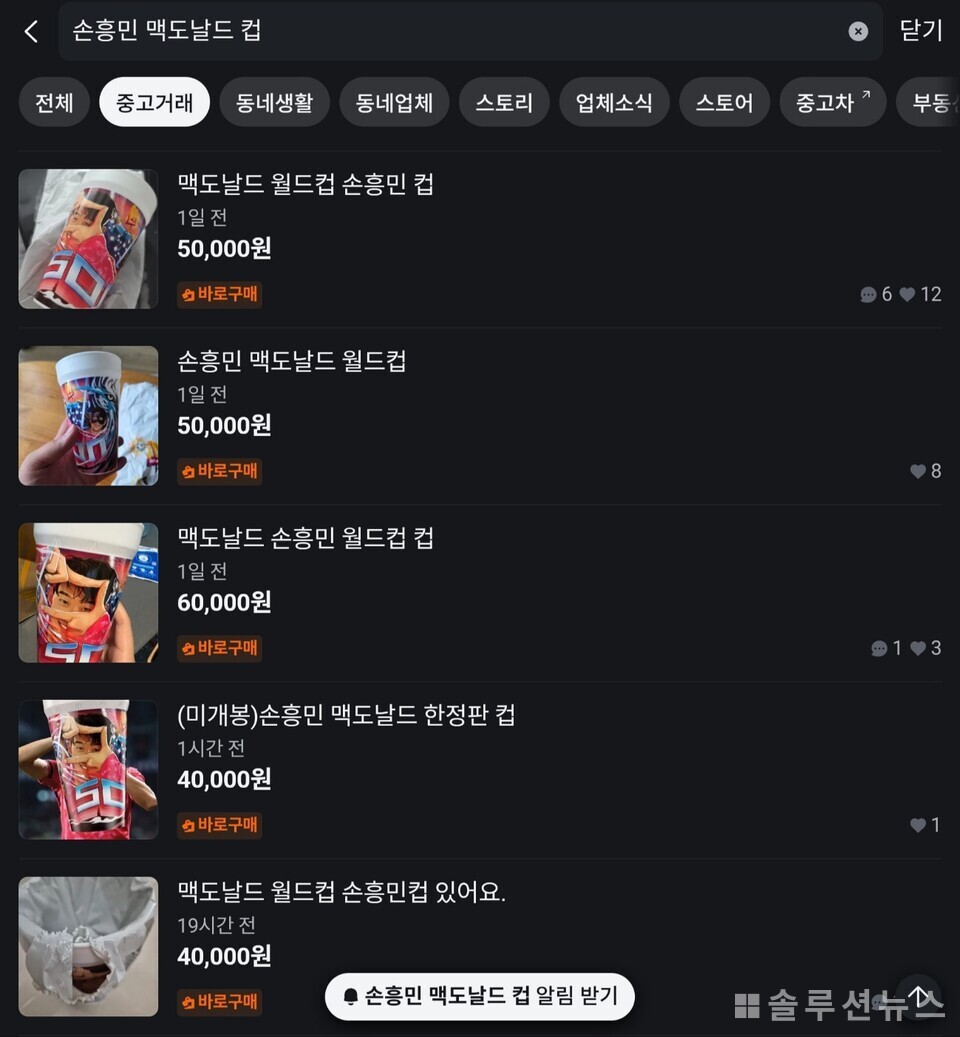
A limited-edition McDonald’s cup featuring the face of South Korean football star Son Heung-min is not being sold in Korea. Once it became known that the cup could not be obtained at domestic stores, secondhand market prices surged to nearly 10 times the original price.
According to the foodservice industry on the 22nd, McDonald’s Korea’s World Cup set, launched on the 11th, sold out nationwide in just five days. Sales of the set also stopped after all of the commemorative cups randomly included in the meals were exhausted. The set consisted of a Big Mac, French fries, a soft drink, and one reusable cup distributed at random. The price was 8,900 won.
The cup is a piece of merchandise released to commemorate the 2026 FIFA World Cup in North America. As an official sponsor of the tournament, McDonald’s rolled out the same concept across stores worldwide. There were nine cup designs in total. But the first batch in Korea included only five: Lamine Yamal, Ronaldinho, Thierry Henry, David Beckham, and the character Grimace.
Missing from that lineup was Son Heung-min. The cups for Christian Pulisic, Alphonso Davies, and Santiago Giménez were also not released in Korea.
◆ Cups sold out in five days, but Son Heung-min was left out
Demand was fueled by the result on the pitch. On the 12th, the national team overturned a 2-1 deficit to beat the Czech Republic, and support for the squad surged. The meal bundle, which paired a commemorative item with lunch, absorbed that excitement almost immediately.
Yet the cup people most wanted was not on the shelf. Even in Mexico, the host nation, Son Heung-min cups quickly sold out as Korean fans flocked to stores. For fans trying to support him at home, there was no way to get one.
The gap was filled by the secondhand market. Posts offering to sell the Son Heung-min cup for between 50,000 won and 90,000 won appeared repeatedly on Danggeun, a local resale app. On Bunjang, listings reached as high as 110,000 won. That is more than 10 times the set’s original price. Requests also appeared asking for overseas purchase代理 help from foreign stores.
◆ A gap created by an exclusive advertising contract
The reason Son Heung-min was left out lies off the pitch. He is currently the model for several domestic food and beverage and restaurant brands, including Domino’s Pizza, Lotte Wellfood’s World Cone, Hite Jinro’s Terra, and Mega Coffee.
Advertising model contracts often include clauses preventing a celebrity from serving as the face of another brand in the same industry. McDonald’s is also in the restaurant business. As long as those contracts remain active, it is difficult to place his image on burger-chain merchandise in Korea, analysts said.
Global marketing that worked on the world stage stalled in front of a domestic contract clause. Even if an international sponsor pushes out the same campaign worldwide, the final product differs when each market is bound by different contracts. This cup exposed that gap to consumers.
Such conflicts are not unusual in sports marketing. When the rights of a sponsor, a club, and a personal advertiser overlap around one athlete, determining whose priority comes first becomes complicated. These unseen contract structures determine what appears on store shelves.
◆ Premiums driven by limited editions, turning merchandise into an investment
This case shows how limited-edition merchandise gains value. Restrict supply, and scarcity emerges. When desire and unavailability overlap, premiums rise even more sharply. The Son Heung-min cup embodied both conditions at once.
A 8,900-won meal bundle changing hands for as much as 90,000 won reflects a broader trend of viewing merchandise as a way to make money. Similar resale frenzies have previously erupted over character stickers inserted into convenience-store bread. When limited quantities meet a popular model, even a small souvenir can move like an investment product.
The resale market also has a dark side. It is difficult to verify authenticity, and there is little recourse if disputes arise during a transaction. The risk that a cup bought at a premium is not genuine remains entirely with the buyer.
The commemorative cup was originally intended as a reusable product to reduce single-use waste. A cup designed to be used again is instead headed to a display shelf, still unopened. A merchandise item promoted under an environmental rationale turning into a collectible and speculative asset shows how limited-edition marketing can distort its original purpose.
For McDonald’s, the immediate results look dazzling. Selling out in five days is proof of a marketing success. But because that success came without the most popular star, the aftertaste is not entirely pleasant. The headline of a sellout risks turning into complaints about what was missing.
The roots of collecting run deep. Owning merchandise from a favorite player is both an expression of support and a confirmation of belonging. When that object is out of reach, the craving only grows stronger. The overheating around the Son Heung-min cup appears to stem more from that psychology than from simple supply shortages.
Consumer frustration is also mounting. Online users continue to point out the irony that a Korean player’s cup cannot be bought in Korea. Many are also looking into overseas direct purchase options. The greater the passion for supporting him, the greater the sense of deprivation caused by the shortage.
McDonald’s Korea is preparing a second release of the World Cup set. Whether the Son Heung-min cup will be included has not been decided, and the company says it is unlikely to be released within this month. Unless the knot of advertising contracts is untied, the paradox of the most desired cup being the hardest to obtain is expected to continue for now.