
Key points
▶ At the 2026 CIRED Workshop held on Nov. 2 at the JW Marriott Dongdaemun Square in Seoul, LS ELECTRIC Chairman Koo Ja-kyun proposed an intelligent, direct-current (DC)-based power grid as a solution to meet the electricity demands of AI.
▶ “For power-hungry AI data centers to operate reliably, they must be fully supported by a dependable power grid,” Koo said. “We need to build a virtuous cycle in which advanced AI makes the grid smarter and more efficient by forecasting and managing it.”
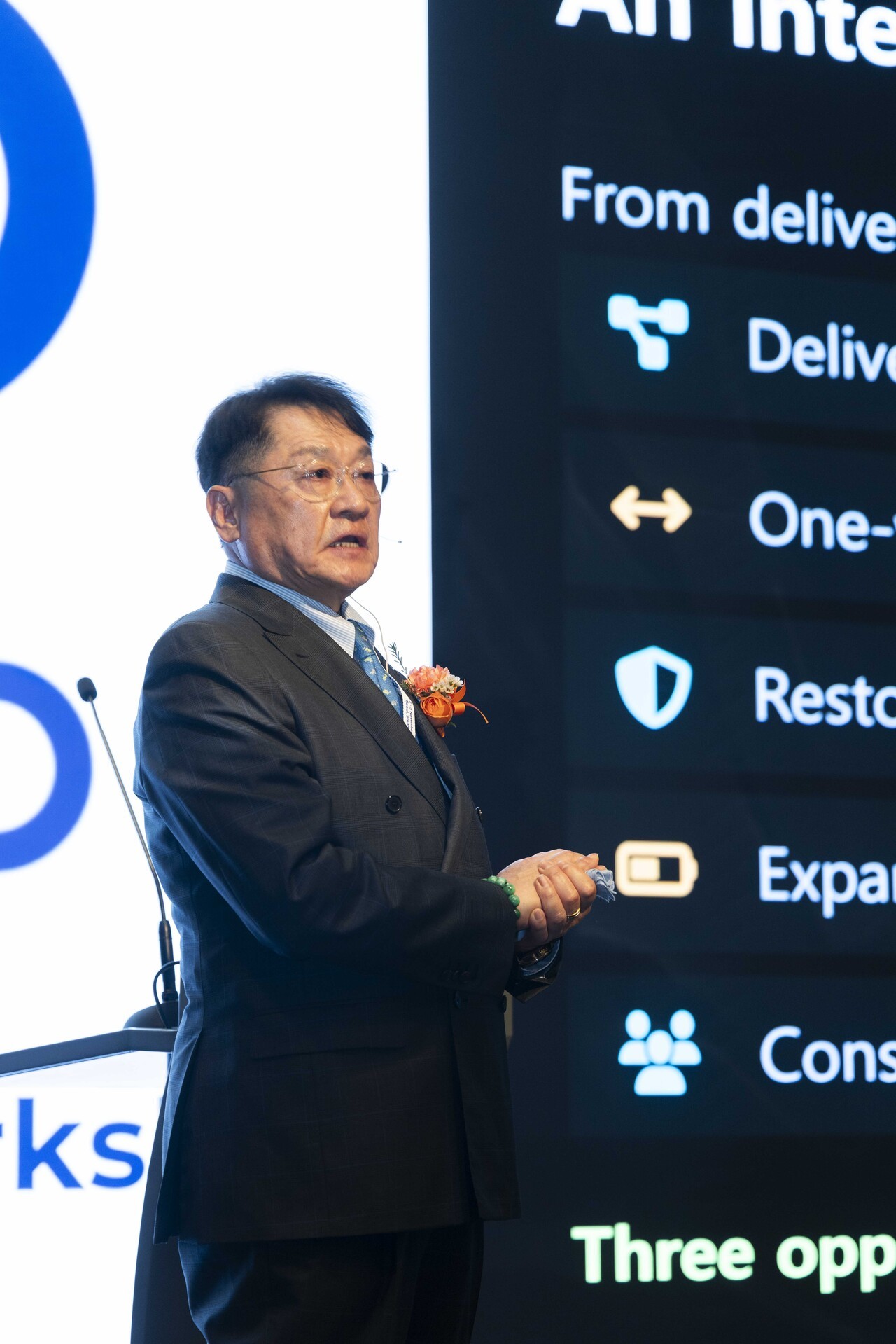
LS ELECTRIC Chairman Koo Ja-kyun has put forward DC power grids as a solution to the electricity challenges of the AI era. In a keynote address at the 2026 CIRED Workshop at the JW Marriott Dongdaemun Square in Seoul on Nov. 2, Koo said, “The clear solution to the surging power demand from AI is an intelligent power grid based on direct current (DC).”
CIRED is an international conference and exhibition covering technology and industry trends in electricity distribution. It was first held in Belgium in 1971, and holds its main conference every two years, with workshops on specific technologies in alternate years. The Seoul workshop is the first official CIRED event to be held in the Asia-Pacific region.
“The grid supports AI, and AI looks after the grid”
Koo described AI and the power grid as mutually supportive. “For power-hungry AI data centers to operate reliably, they must be fully supported by a dependable power grid,” he said. “We need to build a powerful virtuous cycle in which advanced AI makes the grid smarter and more efficient by forecasting and managing it.” The idea is for the grid to power AI data centers, while AI helps predict grid failures and manage loads.
DC and intelligent platforms form the foundation of this vision. “We must move beyond the old model of delivering electricity in one direction and provide customer-tailored power infrastructure for data centers and other users through a combination of DC and alternating current (AC),” Koo said. He added, “By combining data and AI with power equipment, we must evolve into an ‘intelligent, bidirectional energy platform’ that can detect anomalies early and flexibly exchange energy. The next chapter for the distribution industry is to go beyond simply delivering power and become a key platform driving explosive growth across global industries.”
DC product lineup
Electricity supplied from power plants to homes is AC. By contrast, servers, semiconductors, batteries and solar panels run on DC. Data centers currently receive AC and convert it to DC multiple times, with a small amount of power lost at each conversion. As the power consumption of a single server rack has climbed above hundreds of kilowatts, these losses and the burden of copper wiring have grown.
Nvidia announced in May last year that it would shift data center power systems to 800-volt DC starting in 2027 to support server racks rated at 1 megawatt. The company says the system can deliver 85% more power using wiring of the same gauge, reduce copper use by 45% and improve overall efficiency by up to 5%.
This shift is also behind industry projections that the market for the full range of infrastructure, including power distribution equipment, will exceed approximately $150 billion by 2030.
LS ELECTRIC has been building a lineup of DC products to keep pace with this trend. It offers low-voltage DC products including air circuit breakers (ACBs), molded-case circuit breakers (MCCBs), miniature circuit breakers (MCBs), relays and contactors. The company says it ranks among the world’s top three in low-voltage DC circuit breakers and switches rated up to 1,500 volts.
These products are already being supplied for renewable energy applications, including solar power, and for energy storage systems (ESS). The company expects the shift to 800-volt DC data center systems to open up new sales opportunities for the same product lineup.
Commercialization testing at the Cheonan “DC Factory”
The company is also preparing technologies for the next stage. LS ELECTRIC says it has completed validation of key DC technologies, including solid-state transformers (SSTs), high-capacity DC-DC converters and solid-state circuit breakers (SSCBs). A solid-state transformer uses power semiconductors to change voltage instead of a conventional iron-core transformer, while a solid-state circuit breaker interrupts current using semiconductors rather than mechanical contacts, enabling it to cut off faults much faster.
The company is testing actual equipment at its “DC Factory” at the Cheonan plant to verify its commercial viability. It said it is discussing the application and supply of these solutions with several global technology companies. In North America, it has also won successive orders for power conversion systems (PCS) and data center power solutions.
Koo has served as LS ELECTRIC’s CEO since 2008. The company says its revenue has grown approximately 3.5-fold during that time.
An LS ELECTRIC representative said, “With this keynote address, Chairman Koo Ja-kyun, representing South Korea’s power industry, officially declared on the global stage that the paradigm of future power grids has shifted completely to direct current (DC).”