
The Korea Disease Control and Prevention Agency said on September 9 that it had confirmed the year’s first Japanese encephalitis patient. The patient is a woman in her 60s who had no record of vaccination, and mosquito bites were confirmed during the epidemiological investigation.
The patient visited a medical institution on August 15 with fever, chills, and vomiting. Her body temperature was 39.1 degrees Celsius. She is currently receiving inpatient treatment due to underlying conditions such as chronic kidney failure.
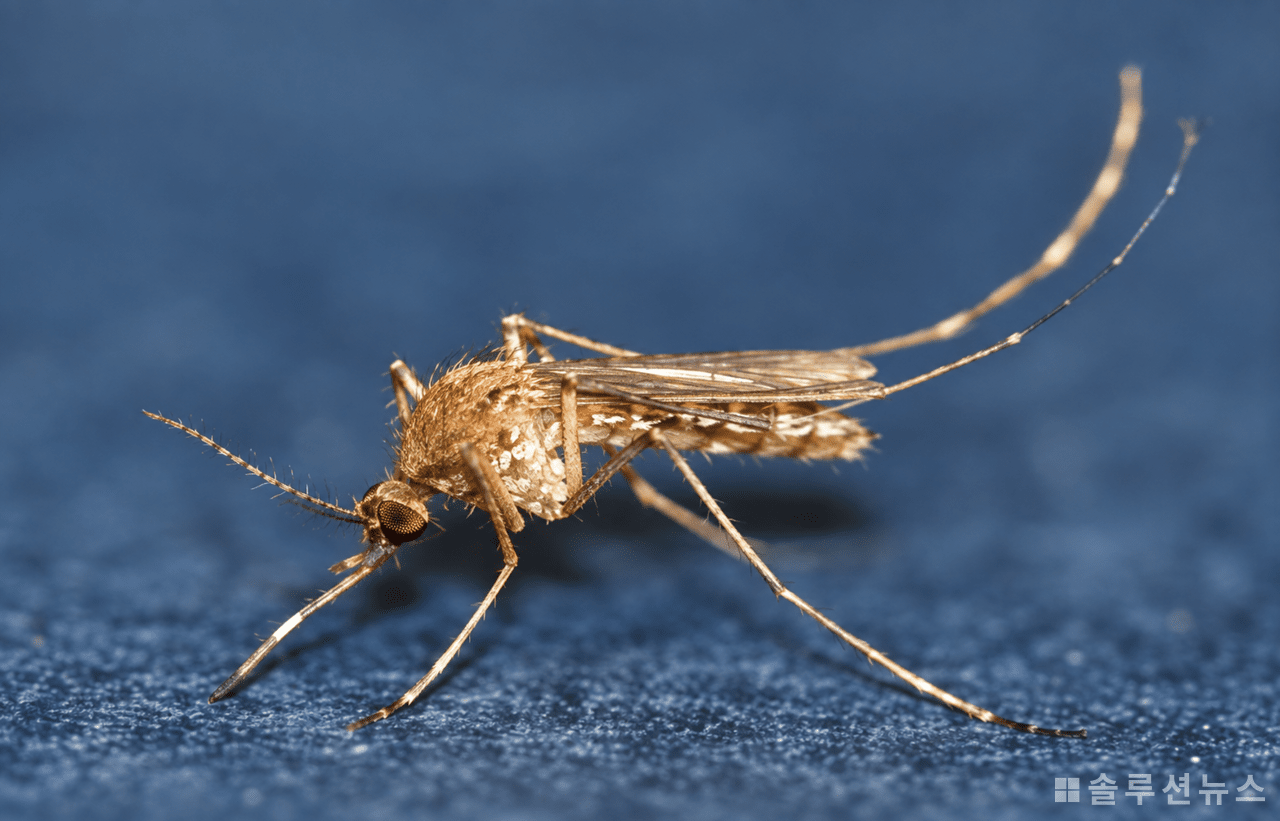
The first Japanese encephalitis patient of the year has been reported. The Korea Disease Control and Prevention Agency announced on September 9 that it had confirmed one woman in her 60s as a Japanese encephalitis patient. Mosquito bites were confirmed during the epidemiological investigation, and there was no record of vaccination.
The patient sought medical care on August 15 after developing fever, chills, and vomiting. Her temperature was 39.1 C. She is currently hospitalized and receiving treatment because of underlying diseases including chronic kidney failure.
◆ The alert was issued earlier than ever, and the patient appeared in September
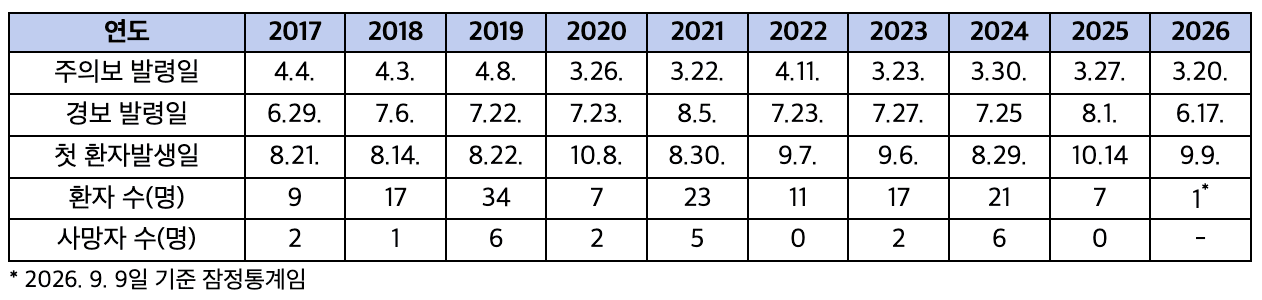
This year’s quarantine clock started running earlier than usual. The advisory was issued on March 20, and the alert on June 17. In the Korea Disease Control and Prevention Agency’s data from the past 10 years, both were the earliest on record. Before this year, the earliest alert had been June 29, 2017, while in 2021 and 2025 it was issued in August.
The alert was issued after the Japanese encephalitis virus gene was detected in mosquitoes collected in Daegu. There are two criteria for issuing an alert: if the average daily number of mosquitoes collected twice a week includes more than 500 small red house mosquitoes accounting for at least 50% of the total mosquito density, or if the pathogen is isolated or its genetic material is detected in collected mosquitoes.
The density of vector mosquitoes remains high. As of week 36 in early September, the average mosquito index was 121. Small red house mosquitoes are active nationwide from April through October.
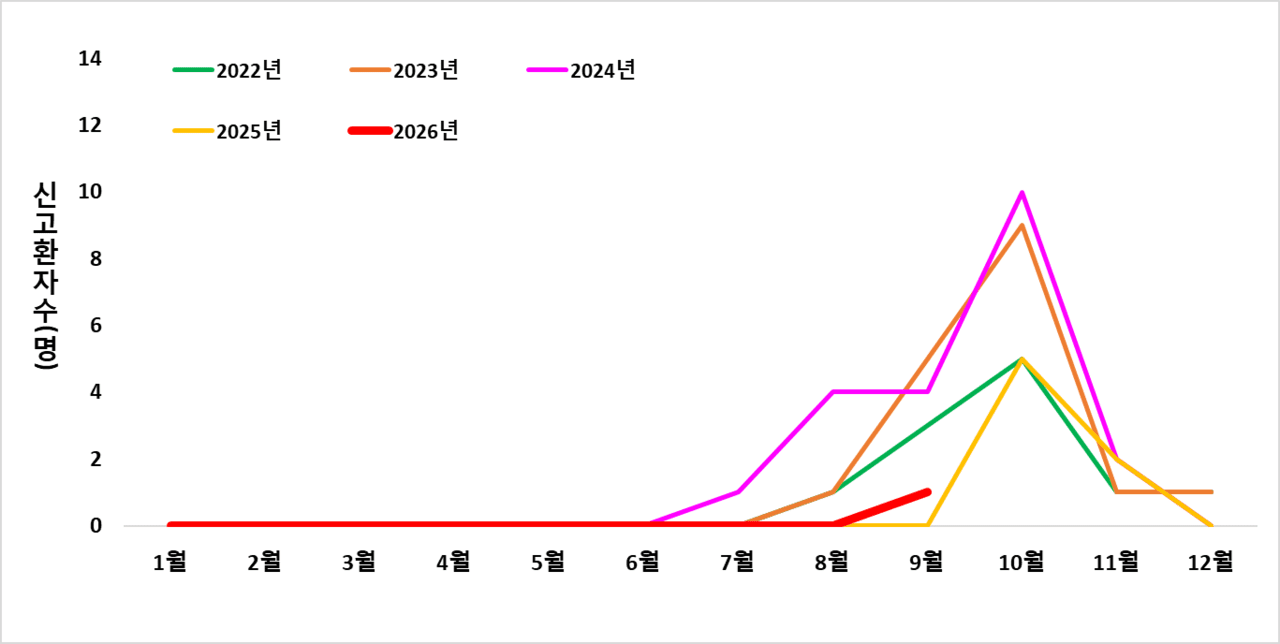
Patient occurrence is now entering its most critical period. In Korea, Japanese encephalitis cases appear between August and November, with 80% concentrated in September and October. The fact that the alert was issued in June means the period of exposure to vector mosquitoes has become that much longer.
◆ Free vaccinations are for children 12 and under, while patients are mostly in their 40s and older
There is a mismatch between the age groups affected and those eligible for vaccination support. In Korea, 65.9% of patients are over 50, and more than 90% of patients over the past 10 years have been 40 or older. By contrast, the state-supported national immunization program covers children 12 and under, specifically those born after January 2013.
Adults must pay for vaccination. The Korea Disease Control and Prevention Agency recommends vaccination for adults 18 and older with no prior vaccination history who fall into one of three groups: those living near rice paddies or pig farms, or those who will be active in such areas during the transmission season; foreigners who have moved from non-endemic areas and reside long-term in Korea; and travelers to countries where Japanese encephalitis is a risk. The vaccine type, dose, and schedule are determined after consulting a doctor at a medical institution.
The high-risk areas cited in the recommendation are those near rice paddies and livestock barns, which overlap with rural areas where older people live. The fact that this patient had no vaccination history points to the same issue.
The pediatric vaccination schedule differs depending on the vaccine type. The inactivated vaccine requires a total of five doses: two doses one month apart at 12 to 23 months of age, a third dose 11 months after the second, and booster doses at age 6 and 12. The live vaccine requires two doses: the first at 12 to 23 months of age and the second 12 months later. Cross-vaccination between the two vaccine types is not recognized.
◆ It took 25 days to confirm the diagnosis, showing why early response matters
This case also shows the diagnostic process. The patient visited the hospital on August 15, and the confirmatory diagnosis was made on September 9. It took 25 days.
That is because of the testing method. A confirmed diagnosis is made by isolating the virus or detecting a specific gene in blood or cerebrospinal fluid, or by confirming that antibody levels in convalescent serum have risen at least fourfold compared with the acute phase. In this case, the third method was used. Obtaining convalescent serum takes time, which is why the number of reported cases lags behind actual infections.
There is no treatment. Once infected, most cases pass with fever and headache, but if the illness progresses to encephalitis, symptoms such as high fever, seizures, stiff neck, confusion, convulsions, and paralysis may occur. The fatality rate among encephalitis patients is 20% to 30%, and even those who recover may suffer neurological complications in 30% to 50% of cases depending on the affected area. Of the 146 cases reported over the past 10 years, 24 were fatal.
At this point, the only immediately effective response is to prevent mosquito bites. The small red house mosquito feeds from evening until dawn. It is recommended to reduce outdoor activities from just after sunset until just before sunrise, and if going out is unavoidable, to wear light-colored long clothing with loose fits. Mosquito repellent should be applied to exposed skin, clothing, the tops of shoes, and socks. Strong perfumes and cosmetics attract mosquitoes.
Managing the area around the home is also important. Window screens should be maintained and mosquito nets used, but this must go hand in hand with eliminating places where water collects, such as puddles and clogged drains, because small red house mosquitoes breed in rice paddies, livestock barns, and stagnant water.
Korea Disease Control and Prevention Agency Commissioner Lim Seung-kwan said, “Mosquito vectors have recently been increasing, and September is the period when Japanese encephalitis cases concentrate,” adding, “Please follow preventive measures to avoid mosquito bites during outdoor activities, and those eligible for vaccination should receive it according to the schedule.”
If people delay visiting a hospital when fever or headache persists, the time available for response also shrinks. For diseases that take time to confirm, it is safer to seek medical care as early as possible when symptoms begin.