
Beyond the era of data centers, the “AI production factory” puts in electricity and data to output tokens. Korea’s first facility is slated to begin operating in 2027, and SK plans to enter Japan in 2028-2029, intensifying the race for “AI sovereignty.”
[1-minute summary]
▶ An “AI Factory” is a next-generation data center that mass-produces “tokens,” the outputs of AI, by feeding in power and data. It is a concept likened to a factory that turns raw materials into products.
▶ If traditional data centers were warehouses that stored and transmitted data, AI factories are digital production bases that use data to produce high-value “intelligence.”
▶ Because the surging demand for AI is difficult to handle with general-purpose data centers, facilities optimized for AI are needed, integrating GPUs, high-bandwidth memory, power, and networking into one system.
▶ The decisive factor is power. These are gigawatt-scale facilities that consume electricity on the scale of a city, and “token production efficiency per unit of power” determines competitiveness.
▶ AI factories are directly linked to “AI sovereignty.” SK, Samsung, Hyundai Motor, and Naver, among others, are building them in Korea together with Nvidia, and the first facility is targeted to start operating in 2027. SK also plans to build AI factories in Japan in 2028-2029.
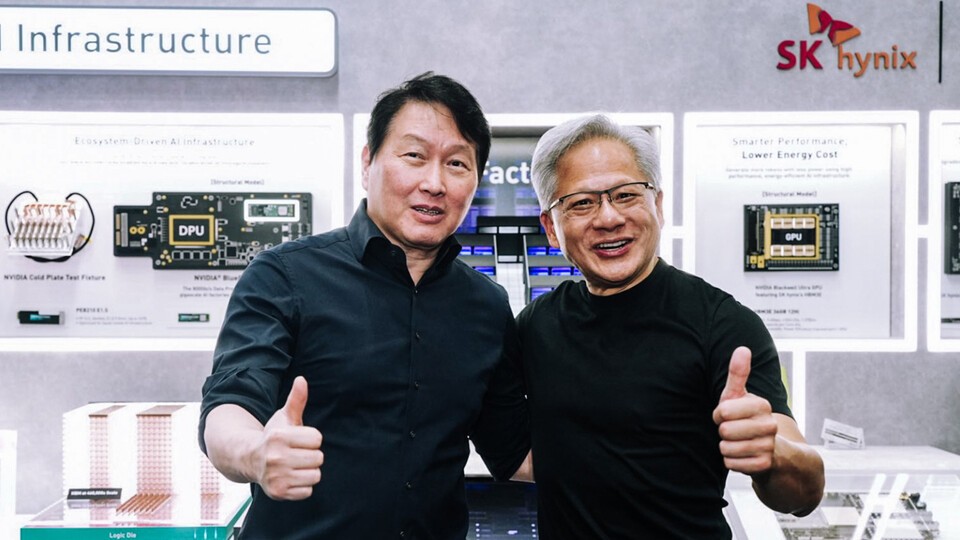
SK Group Chairman Chey Tae-won said he will build an “AI Factory” in Japan. He said so in an interview with Nihon Keizai Shimbun on the 11th. The facility, which SK plans to launch for the first time in Korea next year together with Nvidia, would also be built in Japan in 2028-2029, according to his vision.
The unfamiliar name stands out first. What exactly is an AI Factory, and why is SK talking about building one not only in Korea but also in Japan? Chairman Chey described it as “a factory that produces tokens, the core unit of AI.” In other words, it is a facility that combines SK’s memory semiconductors and Nvidia’s graphics processing units (GPUs) to efficiently compute massive amounts of data.
The person who spread the concept around the world is Jensen Huang, CEO of Nvidia. He has called the next-generation data center an “AI Factory,” emphasizing that the warehouse for storing data is being transformed into a factory that continuously produces high-value products called tokens. During his visit to Korea on the 8th, he also announced AI Factory cooperation plans with five domestic companies: SK, LG, Hyundai Motor, Naver, and Doosan.
So what exactly is an AI Factory, and why are companies trying to build these facilities now, whether in Korea or Japan? Let’s break it down step by step by comparing it to a factory.
From a data warehouse to a “token factory”
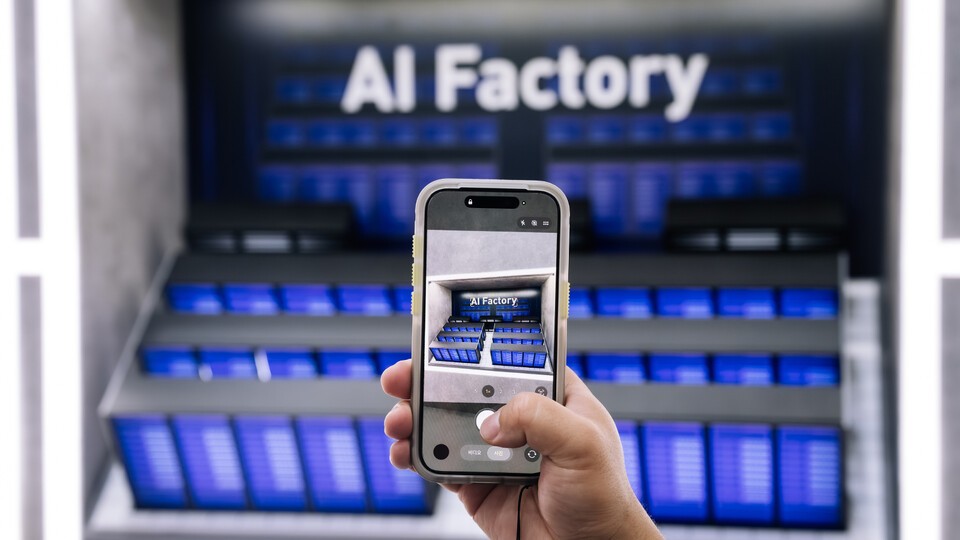
To understand AI factories, it helps to first look at traditional data centers. A data center is a giant warehouse that stores and transmits information such as photos, videos, and documents. The reason a photo sent through a messenger app is stored somewhere and search results appear instantly is thanks to these facilities.
An AI factory goes one step further. Rather than merely storing information, it uses data and electricity as raw materials to produce “intelligence” as an output. Jensen Huang has described this as the warehouse for storing data transforming into a factory that endlessly produces high-value products called tokens.
Here, tokens are the key. A token refers to the smallest unit that an AI uses to handle language. The sentence “I like you” is broken into tokens such as “I,” “you,” and “like” inside the AI. The AI constructs sentences by predicting each of these pieces one by one. The more tokens it produces, and the faster it does so, the more answers, analyses, images, and code it can generate.
The factory analogy makes the picture clearer. Just as a car factory takes in steel sheets and parts to produce finished vehicles, an AI factory takes in data and electricity to produce tokens. If the raw materials are data and power, the finished product is the intelligence the AI outputs.
The equipment that drives this factory is also different from that of a conventional data center. The core is the GPU. Originally used to render game graphics, this chip is strong at processing large numbers of identical calculations at once, making it the brain of AI.
Alongside it is high-bandwidth memory (HBM), which moves data at ultra-high speed. Power, cooling, networking, and operating software are all combined into one massive system that operates as a single unit.
The scale is also beyond imagination. Training advanced AI requires linking thousands of GPUs over a network and running them like one giant computer. This is why Nvidia, once a chip seller, has declared that it is transforming into an “infrastructure company” that designs the entire setup. An AI factory is not about a single chip; it is about designing an entire factory from the ground up.
The “product” coming out of the factory is invisible. The tokens produced by an AI factory become chatbot answers, foreign-language translations, analyses for discovering drug candidates, and the judgments that allow autonomous vehicles to read the road. In effect, one factory produces thousands of kinds of intelligence services at once. Just as steel mills became the foundation for everything from cars to building frames, intelligence produced in an AI factory becomes the raw material for nearly every industry.
Is a data center alone not enough?
The background to the rise of AI factories is exploding demand. As generative AI creates text, images, and code, and as AI agents capable of handling multiple steps on their own emerge, the amount of computation required has surged. Every moment people ask a chatbot a question and receive an answer consumes tokens.
Conventional data centers were not designed for this task. General-purpose data centers are built to handle a wide variety of workloads.
By contrast, AI workloads involve repeating the same computations on an enormous scale, which is why facilities must be designed from the outset with AI in mind to deliver full performance. That is why AI factories combine GPUs, memory, and power into a single system.
AI work is broadly divided into two stages: “training,” in which AI is taught, and “inference,” in which the trained AI actually produces answers. Training is a process that consumes massive resources all at once, while inference is repeated endlessly as the number of users grows. With chatbot usage now reaching hundreds of millions of users, lowering the cost of inference is what determines business success or failure.
At this point, electricity becomes the decisive factor. AI factories consume enough power to rival an entire city. The facilities being built by SK Telecom and Nvidia are also being discussed as gigawatt-scale projects. One gigawatt is roughly equivalent to the electricity consumption of a large city. Cooling the heat generated by GPUs running nonstop also requires enormous amounts of power and water.
That is why the industry is increasingly competing on “tokens per unit of power.” The side that can produce more tokens with the same electricity has the edge. In order to improve power efficiency, new chips specialized for inference are being released one after another, and software technologies that extract more tokens from the same facility are also advancing rapidly. In the end, an AI factory is a stage for competing over “how efficiently electricity can be turned into intelligence.”
A new infrastructure that determines “AI sovereignty”
The reason an AI factory is not just a large data center is that it is tied to “AI sovereignty.” AI that runs on a country’s own infrastructure, containing its language, data, and values, is often called “sovereign AI.” The foundation for making that possible is the AI factory.
Experts believe that once a country falls behind in the competition for AI infrastructure, it is difficult to catch up. That is because it requires massive amounts of power, semiconductors, and capital all at once. Taiwan’s national-level strategy with Nvidia is based on the same logic. Whether a country simply borrows AI or has the capability to build and supply it directly has become a measure of national competitiveness.
The competition is already taking place across borders. U.S. big tech companies are pouring in hundreds of trillions of won to build AI factories, and energy-rich Middle Eastern oil producers are also entering the race at the national level. AI factories have been elevated from “corporate computer rooms” to the “power plants and factories of a nation.” The structure is being set up in which the countries with more electricity will become the countries with more intelligence.
AI factories also serve as the brains of industry. AI reads and makes decisions based on data from factory sensors and production management systems. It also supplies intelligence to autonomous vehicles, robots, and communication networks. This is what Jensen Huang meant when he said the network of the future will not be a network that merely carries bits, but one combined with AI.
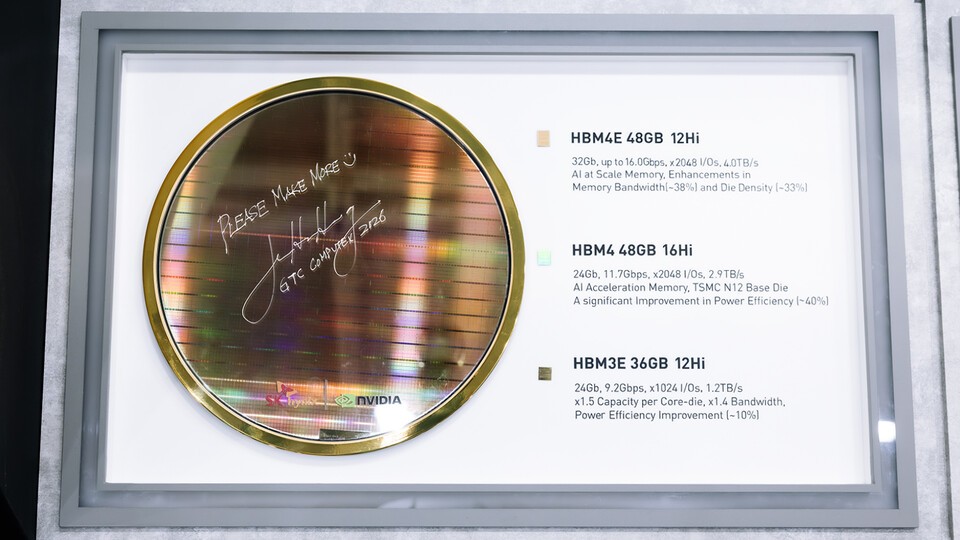
This is why Korea is so busy. SK, Samsung, Hyundai Motor, Naver, and Doosan are supplying core technologies to Nvidia while also serving as demand sources for using the completed AI factories.
SK Hynix and Samsung Electronics, which make memory semiconductors, are among the world’s leaders in HBM, the heart of AI factories. Naver has been building know-how by operating its own data center, “Gak Sejong,” and SK Telecom is leveraging its experience in network operations to secure a position at the gateway for supplying AI computing to domestic industries.
SK’s plan for an AI factory in Japan, mentioned at the start, is one example of this trend. Chairman Chey said he is considering a gigawatt-scale facility comparable to the power consumption of a large city and is looking for candidate sites that can provide ample land and electricity.
One reason for choosing Japan is its well-developed ecosystem for semiconductor materials and equipment. Alongside plans to use the facility as a showcase to help Japanese companies adopt AI and to promote its own semiconductor technologies, he also presented a vision of a “economic community” linking the economies of Korea and Japan.
The challenges ahead are clear. AI factories require enormous power, large tracts of land, stable cooling water, and specialized personnel all at once. In the capital region, power and land are already tight. The places that have electricity, semiconductors, land, and labor together will be the ones that can host the factory that produces the most tokens at the lowest cost.
This is an era in which intelligence becomes infrastructure. If the benchmarks of industrialization were once steel and electricity, then the benchmark of the AI era is the ability to produce tokens. Who builds AI factories first, and how efficiently, will redraw the industrial map of the next decade.