
On September 11, Hyundai Motor Group held an autonomous-driving media day at the 42dot headquarters in Seongnam, Gyeonggi Province, and released the first footage of a vehicle equipped with its proprietary autonomous-driving AI, Atria, navigating downtown Seoul.
Hyundai Motor Group is pursuing two production tracks. Level 2+ vehicles based on Nvidia solutions will enter mass production in the first half of 2028, followed by Level 2++ vehicles in the second half of 2028. Level 2++ vehicles based on the company’s proprietary Atria AI will enter mass production in the second half of 2029.
The foundation of the development system is a data flywheel: data is collected from vehicles, used to train and validate AI, and then improved models are deployed back to vehicles to generate new data.
More than 40 vehicles dedicated to data collection are currently operated day and night. Hyundai Motor Group said the more than seven million vehicles sold annually by Hyundai Motor Company and Kia represent a potential data foundation.
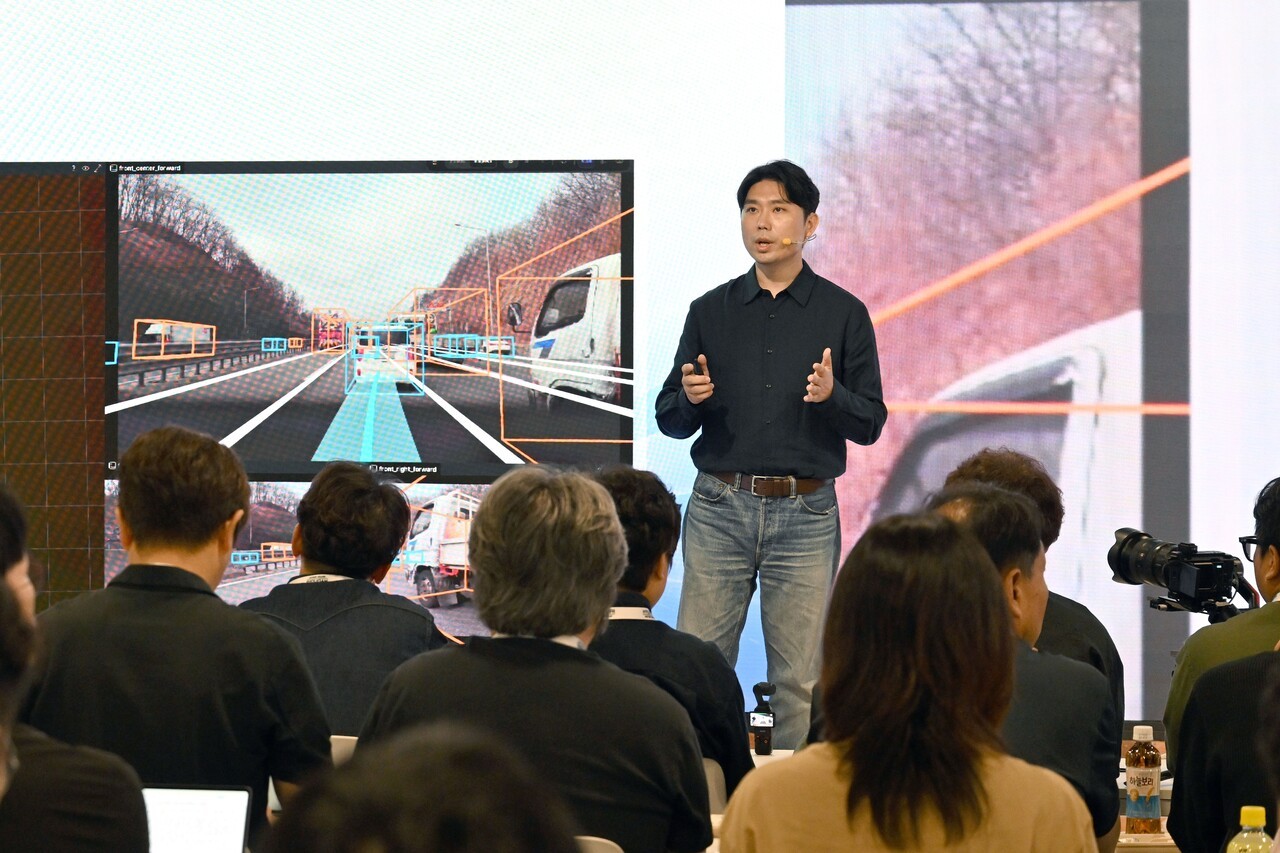
Hyundai Motor Group has released the first footage of a vehicle equipped with its proprietary autonomous-driving AI navigating downtown Seoul. It also announced its mass-production schedule.
Hyundai Motor Group held an autonomous-driving media day on September 11 at the 42dot headquarters in Seongnam, Gyeonggi Province. Park Min-woo, president of Hyundai Motor and Kia’s Autonomous Vehicle Platform (AVP) Division and CEO of 42dot, and Kwon Jung-hyun, executive vice president and head of Hyundai Motor and Kia’s Autonomous Driving Development Center, presented the company’s strategy and roadmap. 42dot Group Leads Jung Sung-kyun and Lee Hee-seok introduced the technology.
In March, Hyundai Motor Group announced a partnership with Nvidia and presented a two-track strategy. The plan is to accelerate mass production using Nvidia’s proven technology while also developing its own proprietary AI in-house.
First, the company will integrate Nvidia’s automotive AI computing platform and autonomous-driving software into its software-defined vehicle architecture. Level 2+ functions will be applied to mass-produced vehicles in the first half of 2028, followed by Level 2++ vehicles in the second half of 2028. The sensor systems used by the AVP Division, 42dot and Motional will be gradually standardized around Nvidia Drive Hyperion 10. The goal is to collect data from different vehicles in a common format.
The proprietary track centers on Atria AI. This is an end-to-end autonomous-driving system jointly developed by the AVP Division and 42dot. The two organizations have integrated their development environments, work procedures and information-sharing systems into a unified operation. Level 2++ vehicles based on Atria will enter mass production in the second half of 2029, one year later than the Nvidia-based vehicles.
The technology shown in the footage was at the Level 2++ stage. In the Level 2 series, the vehicle controls steering and acceleration and deceleration, while the driver remains responsible for supervising the system.
Hyundai Motor Group identifies the data flywheel as the foundation connecting the two tracks. Data is collected from vehicles and used for AI training and validation, while improved models are applied back to vehicles to obtain new data in a continuous cycle.
More than 40 vehicles dedicated to data collection currently perform this role. Operated around the clock, they gather data on road-construction zones, severe weather, sudden lane changes and parked vehicles on side streets, among other exceptional situations. Hyundai Motor Company and Kia sell more than seven million vehicles annually in over 190 countries worldwide, and Hyundai Motor Group described this fleet as a potential foundation for real-world driving data.
The company is emphasizing data selection over sheer volume. Through hard-example mining, situations that are difficult for the model are automatically identified, while a continuous training pipeline repeatedly incorporates them into the learning process. Vulnerable situations discovered during real-vehicle evaluations are fed back into data collection and model improvement.
Virtual validation has also been added. Real-world driving data is reconstructed in a three-dimensional environment, and 3D Gaussian splatting is used to recreate virtually situations that are difficult or dangerous to repeat on actual roads. The system verifies whether newly trained models maintain existing performance without degradation.
The company also operates a “follow the sun” system that links development centers in South Korea and the United States, enabling development around the clock. When working hours end in one region, the other takes over data collection, issue analysis and model improvement. A special event recorder that automatically logs situations such as sudden acceleration, sudden braking and system disengagement during autonomous driving is also being integrated in stages.
Hyundai Motor Group is building a “data union” system to expand data sharing within and beyond the group. Rather than exchanging raw data, the system allows data from multiple vehicles and organizations to be accumulated according to common standards and used for AI training. The initiative will initially begin within the group, including Hyundai Motor Company, Kia, 42dot and Motional.
Level 4 demonstrations are also being conducted in parallel. In cooperation with the Ministry of Land, Infrastructure and Transport, the company plans to deploy demonstration vehicles based on SDV pace cars equipped with Atria in the Jeonnam Gwangju Integrated Special City by the end of the year. Unexpected-event data obtained there will also feed back into the data flywheel.
Executive Vice President Kwon Jung-hyun said, “The competitiveness of autonomous driving depends less on how much data is secured than on how quickly that data can be connected to learning, validation and performance improvement.”
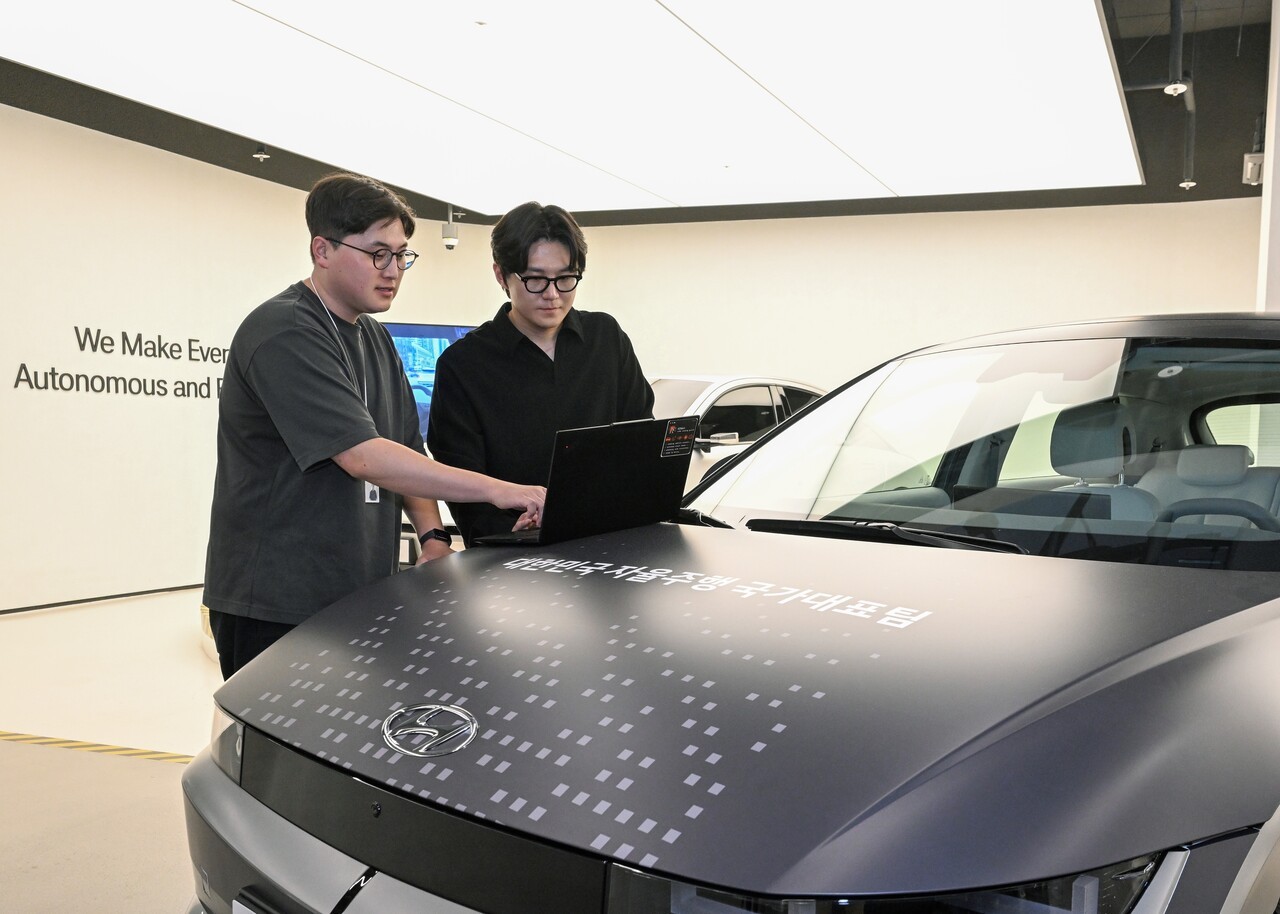
42dot said it has begun developing a VLA model as its next-generation technology. The approach combines visual-information recognition, language-based reasoning and action generation in a single model. While conventional end-to-end models directly connect driving inputs to vehicle actions, VLA adds language-based situational understanding, enabling the system to explain the reasoning behind its decisions. In a development video released that day, a sentence explaining why the vehicle changed lanes appeared on the screen.
VLA is currently at the simulation-validation stage. 42dot plans to launch a development process that includes real-vehicle testing from the end of this year through early next year. It will be developed in parallel with the existing end-to-end model.
Three types of footage were released. One shows President Park Min-woo and Group Lead Jung Sung-kyun traveling from Pangyo through the Gyeongbu Expressway, Olympic-daero, Dongjak Bridge and Sungnyemun to Gwanghwamun. Three one-take videos show the vehicle driving through Gangnam during the busy morning commute, Jamsil with many large vehicles and rainy Pangyo. A third set shows the vehicle responding to 10 exceptional situations, including avoiding vehicles parked on the shoulder, merging and making an unprotected left turn. The one-take videos run for two to four minutes and were not edited apart from playback speed.
President Park Min-woo said, “The essence of competition in autonomous driving ultimately comes down to a competition in learning speed. The speed of technology development and safety are not conflicting values. The more exceptional situations we discover and learn from, the safer autonomous driving can become. Under the principle that only sufficiently validated technology will be applied to vehicles, we will improve development speed and safety together.”