
If you are an electric vehicle driver, it may be worth scheduling a weekend lunch-hour charge this fall. The Ministry of Climate, Energy and Environment said on the 3rd that it will discount public EV charging fees for three hours, from 11 a.m. to 2 p.m., on weekends and public holidays from September 5 to October 31. There are 21 weekend and holiday days in that period.
The reason the discount window was set for 11 a.m. to 2 p.m. is clear. During the day, solar power generation is active and electricity supply is relatively abundant, while factories and offices are closed on weekends and holidays, leaving less demand. The idea is to use surplus electricity to charge EV batteries. Drivers save money, and the national power grid becomes easier to balance between supply and demand.
In April, the government revamped seasonal and time-based electricity pricing and introduced daytime discounts for spring and fall. EV charging fees were adjusted accordingly, and the first spring discount was implemented from April 18 to May 31. Charging sessions during the discount window rose by an average of 9.2 percent per day compared with before the discount. This confirmed that charging demand responds when prices move.
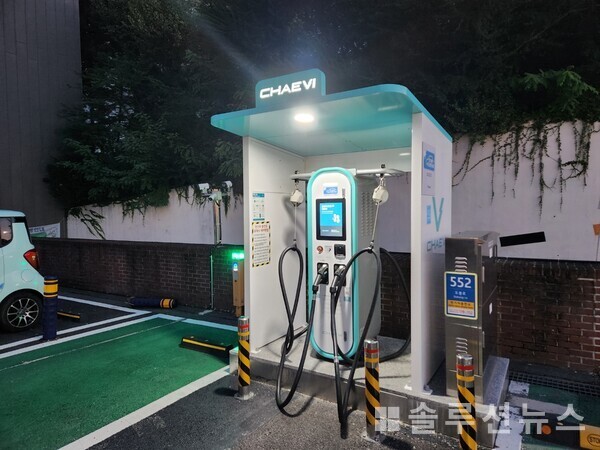
Charging fees have two layers: the electricity price that Korea Electric Power Corp. sells to charging operators, and the final price operators charge consumers after adding operating costs and other expenses. The electricity price KEPCO sells accounts for about 35 percent of the consumer charging fee. The basis of this discount is KEPCO cutting that electricity price by half, or 50 percent.
How the discount reaches consumers depends on the type of charger.
“Self-consumption” chargers installed at homes, workplaces, and some apartments will receive the discount immediately from September 5. As in the spring period, the price will be reduced by 40.1 to 48.6 won per kWh.
More than 14,000 public fast chargers operated by the ministry and KEPCO, accounting for about 24 percent of all fast chargers, and about 3,400 slow chargers operated by KEPCO will also begin offering discounts on the 5th. KEPCO-operated chargers will be discounted by 40.1 to 48.6 won per kWh.
The biggest benefit comes from about 9,600 public fast chargers directly operated by the ministry. In addition to KEPCO’s electricity price discount, the ministry will add its own discount, lowering consumer fees by up to 32 percent. That is more than twice the maximum 15 percent cut in the spring. The price will be reduced by 85.4 to 97.2 won per kWh. The current fee at ministry-operated fast chargers, which are 100 to 200 kW units, is 348.4 won per kWh, so charging 50 kWh would save roughly 4,300 to 4,900 won compared with the regular 17,400 won charge.
The additional discount will be offered only temporarily this fall. The purpose is to see how much charging demand shifts when prices are lowered more significantly.
Many private charging companies also plan to pass on discounts received during weekend and holiday daytime hours to consumers. However, the size and method of the discount will vary by company. Some will lower prices directly, while others will return the benefit as points. If you are using a nearby charger run by a private operator, it is best to check the operator’s app in advance to see whether and how the discount is applied.
You can tell whether a charger is operated by the ministry, KEPCO, or a private company by checking the charger itself, the Zero-Emission Vehicle Integrated Portal, or a charging app.
As EVs continue to grow rapidly in number, the government plans to adjust charging tariffs so that EVs use the solar power generated during the day more effectively. It will comprehensively analyze the results of the spring and fall discount periods to determine how much users shift charging times depending on price levels, and use that as basic data for designing a “time-of-use charging tariff” that is under review for introduction next year.
Time-of-use pricing is a system that sets different rates by time of day, reflecting the fact that electricity demand and supply vary throughout the day. If introduced, lower daytime charging rates and higher evening peak rates could become standard.
Jeong Sun-hwa, director of the Green Transition Policy Bureau at the ministry, said, “We expect the results confirmed in the spring period to be expanded further in the fall, and with many private companies participating, user benefits will grow. We will analyze the fall results closely and design the time-of-use charging tariff so that it can achieve both user convenience and grid stability.”