
The U.S. government has blocked foreign nationals from accessing Anthropic’s latest AI models, Fable 5 and Mythos 5, prompting allied countries such as the United Kingdom and Canada to demand exceptions and push back.
Mythos 5 can find security vulnerabilities faster than human experts. Because it can serve as both a defensive tool and a powerful hacking instrument, the U.S. moved to prevent its leakage.
Allies are asking for exemptions because they were already using the AI for security checks, their key tool came to a halt with a single notice, and they object to being treated the same as hostile states.
The episode has highlighted the issue of AI sovereignty: that one country’s decision can stop AI systems used around the world. For South Korea as well, which depends heavily on U.S. AI, developing sovereign AI and diversifying suppliers have emerged as major tasks.
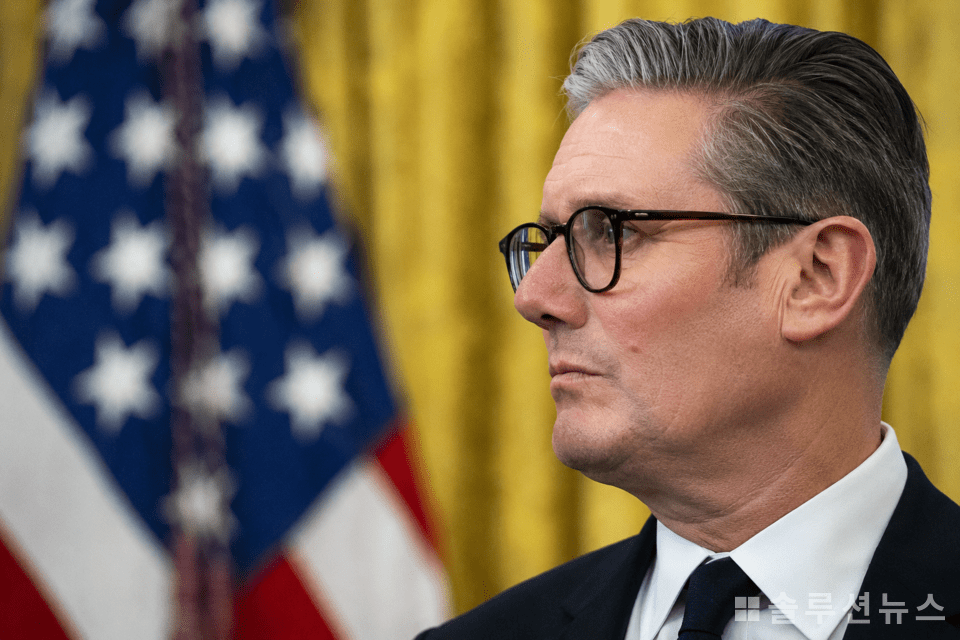
As the United States has blocked access to the latest models of its domestic AI company Anthropic for all foreign nationals, its closest allies are raising their voices and demanding, “Make an exception for us.”
The United Kingdom and Canada are leading the charge. This move, which lumped allies together with hostile states, instantly exposed how deeply the world depends on U.S. AI.
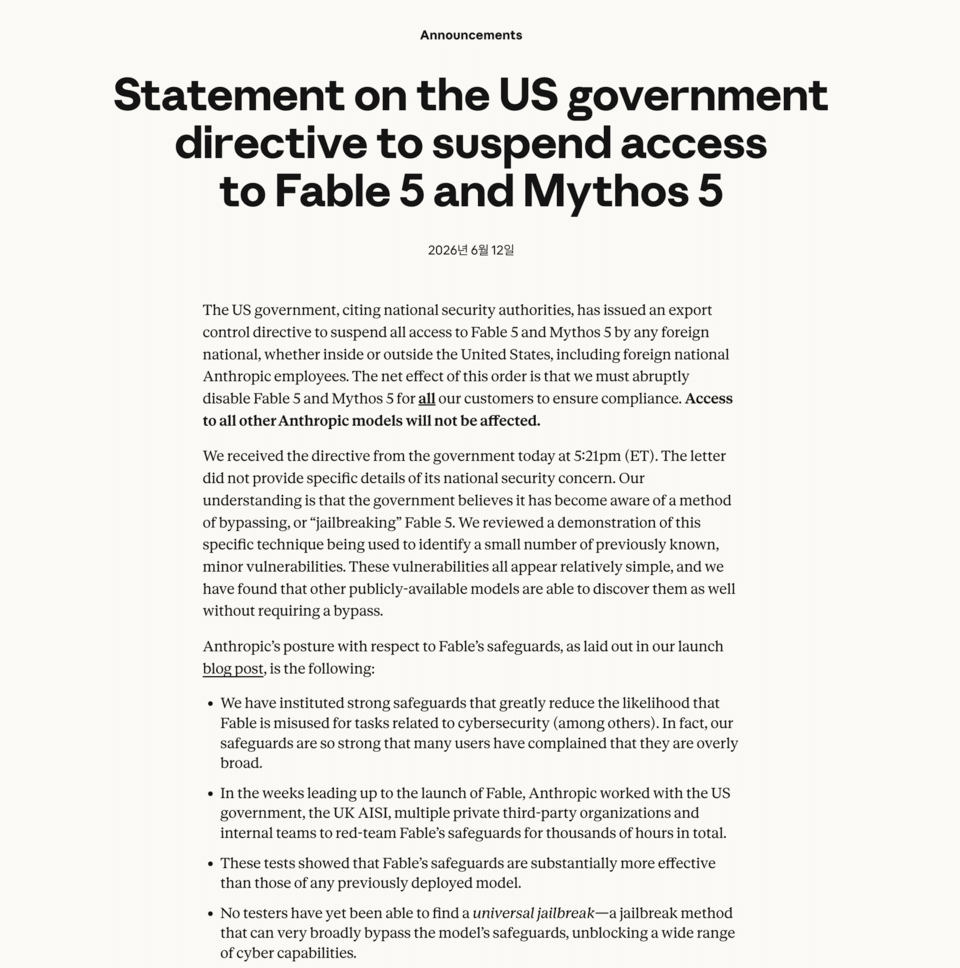
Anthropic is a San Francisco-based AI company that makes the chatbot Claude. On the 12th, the U.S. government barred foreign nationals from using the company’s new models, Fable 5 and Mythos 5.
Concluding that it would be difficult to filter access by nationality alone, the company suspended the two models for all customers worldwide starting on the 13th. This is the first time the United States has used export controls to block access to a large language model, or conversational AI like ChatGPT.
The problem is that the ban includes key allies such as the United Kingdom, Canada, Australia, and New Zealand. Their citizens were blocked regardless of whether they live in the United States or in their home countries. That is why allied countries have begun demanding exemptions for themselves. Canada has entered behind-the-scenes coordination with the United States, while Britain and Europe have openly voiced their dissatisfaction.
◆ An AI that finds flaws faster than humans… the two sides of Fable 5
The reason the United States has blocked AI from one of its own companies — even from allies — lies in Claude’s capabilities.
Mythos 5 is Anthropic’s most powerful model. One of its specialties is identifying weak points in computer systems, namely “security vulnerabilities.” Security vulnerabilities are flaws in software that hackers can exploit. Mythos 5 is said to pinpoint these weaknesses faster and more accurately than human security experts.
There are two sides to this. In the hands of defenders, it becomes a powerful shield that can patch system holes in advance. But if it falls into the hands of attackers, it turns into an automated hacking tool that can break into other people’s systems. It is like the same knife serving as a surgical scalpel or a weapon. What the United States feared was precisely the possibility of this knife ending up in the hands of hostile states or criminal organizations.
Fable 5 is the model that made Mythos 5 available to the public. It includes multiple layers of safeguards to block answers in dangerous areas. Before launch, Anthropic said it spent thousands of hours stress-testing those safeguards with the U.S. government, the UK AI Safety Institute, and outside organizations, and that no universal bypass capable of defeating all protections at once was found.
The spark came from those safeguards. Researchers at Amazon reportedly found a way to partially bypass Fable 5’s defenses. According to the report, they had the AI read the code of a specific program and then asked it to “fix the flaws,” thereby drawing out some of the model’s blocked security capabilities.
This was reported to the White House, and President Trump is said to have personally ordered the export controls.
Anthropic strongly disputes this. It says the bypass in question is only a narrow flaw that works in specific situations and does not amount to breaking all of the safeguards, and that the same level of capability is already present in other models released to the public, such as OpenAI’s GPT-5.5.
The company says that recalling a commercial AI used by hundreds of millions of people over a narrow flaw is excessive. It has sent employees to Washington to lobby for the controls to be lifted.
◆ Why the UK and Canada are asking for exemptions
There are reasons allies are seeking waivers. Above all, they were already using the AI.
Many allied countries had been using Mythos to inspect security vulnerabilities in critical domestic facilities. If a tool that was being used as a shield suddenly disappears, gaps open up in security checks immediately. A measure intended to prevent danger can paradoxically increase it.
The suddenness is another hard pill to swallow. With a single directive from the U.S. government, the models stopped overnight. Companies and institutions that had entrusted work to this AI had no time to prepare. The fact that a core tool can be switched off with one notice itself is seen by allies as an unacceptable risk.
The allies’ status is also at stake. The United Kingdom, Canada, Australia, and New Zealand are members of the “Five Eyes” intelligence-sharing alliance with the United States. It is only natural that they are upset that the closest friends were lumped together with hostile states and blocked in the same way. Even a former AI adviser to the Trump administration criticized the move, saying it makes no sense to liberalize China’s exports of advanced semiconductors while blocking allies’ access to AI all at once.
Canada immediately opened contact with the United States. Prime Minister Carney said, “Information exchange between Canada and the United States is smooth,” and added that “it is understandable to take seriously the risks identified by the United States.”
That signals recognition of the risk, but also that exceptions for allies should be handled separately. British and European leaders are also publicly raising the risk of dependence, increasing pressure on Washington. What the allies are aiming for is to argue that “friendly countries are trustworthy users” and win themselves exemptions from the ban.
◆ AI stopped by a single switch… the essence of the sovereignty debate
The bigger question raised by this incident goes beyond whether exemptions will be granted. It is the fact that AI used around the world can be stopped all at once by a single decision from one country.
Prime Minister Carney compared it to the 2008 financial crisis. Just as the collapse of one major bank among several tightly interconnected institutions shook the entire global financial system, if everyone depends on a small number of AI platforms, the whole system can be shaken when one of them stops working. His remark that “having only one option is never a good idea” was made in this context.
The core issue is control. If the most advanced AI is built by an American company, and that company must obey orders from the U.S. government, then countries that rely on that AI for daily life, industry, and security are effectively tying their fate to U.S. decisions.
A prominent French politician said that a country dependent on others for technology is a country whose power can be cut off overnight. This time it took the form of export controls, but next time it could be something else, such as a corporate acquisition, a price increase, or a service shutdown.
Countries have already begun moving. Earlier this month, the EU unveiled a bundle of technology sovereignty policies aimed at reducing reliance on U.S. cloud services. Canada signed an AI cooperation agreement with Ireland to broaden partnerships beyond the United States. Governments are now treating AI as foundational infrastructure, like electricity or telecommunications, and are rethinking where that foundation should be placed.
◆ The task facing South Korea too: sovereign AI and diversification
South Korea is no exception to this picture. In fact, it is right in the middle of it. Many domestic companies and public institutions already use U.S. AI in their work. The areas relying on U.S. models have expanded rapidly, from customer support and document drafting to code development and data analysis. This incident has made it clear that these tools can be halted by a single U.S. policy decision.
Several responses are being discussed. One is to build an AI that can be controlled domestically, so-called “sovereign AI.” The idea is to grow Korean-made large language models and use models operating within the country for sensitive data and core tasks. That is why the state-backed and corporate efforts to develop domestic AI have become even more urgent.
Another alternative is diversification, so that no single model dominates. Instead of depending on one company’s AI, the idea is to use several suppliers and keep the path open to switch immediately if one side is blocked.
For core systems, another approach being discussed is installing AI directly on in-house infrastructure rather than relying on external servers, so they are not shaken by outside shutdown orders.
Still, the calculation is not simple. The most advanced AI is still in the hands of U.S. companies, and it is not easy for domestic models to catch up in the short term. Pursuing independence risks lagging in performance, while pursuing performance deepens dependence. What should come first — performance, safety, or self-reliance — remains a policy challenge.
One thing is clear: AI sovereignty is no longer a distant worry but an immediate risk. As allied countries spar with the United States while asking for exemptions, South Korea is also standing before the same question.