
One-minute news
▶ On November 25, the European Space Agency (ESA) released the first close-up images of the asteroid Dimorphos taken by its Hera probe.
▶ Dimorphos is the asteroid that NASA’s DART spacecraft deliberately struck on September 26, 2022.
▶ The images show the impact site flattened, with a stadium-sized crater extending across the asteroid’s width.
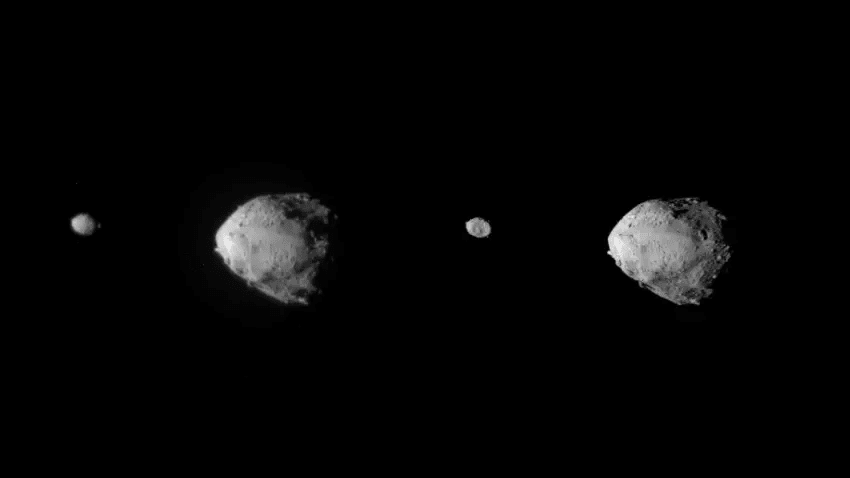
Four years after the first experiment to alter an asteroid’s orbit, the impact site has been revealed. On November 25, the European Space Agency (ESA) released the first close-up images of the asteroid Dimorphos, taken by its Hera probe, at the Museum für Naturkunde in Berlin, Germany.
Dimorphos is a small asteroid 151 meters in diameter. It orbits the 730-meter-wide asteroid Didymos, much like a moon. The two asteroids orbit the Sun together and are currently 193.5 million kilometers from Earth.
◆ What happened four years ago?
On September 26, 2022, the U.S. National Aeronautics and Space Administration (NASA) crashed its DART spacecraft into Dimorphos. The experiment was designed to test whether a spacecraft could alter the orbit of an asteroid approaching Earth. Dimorphos was selected because it posed no risk of colliding with Earth.
The results far exceeded initial predictions. Observations from ground-based telescopes showed that Dimorphos’s orbital period around Didymos had shortened by about 33 minutes. The DART spacecraft was destroyed on impact, and the specific changes to the asteroid’s surface and internal structure remained unknown.
◆ What Hera saw
Patrick Michel, principal investigator for the Hera mission and a research director at France’s National Centre for Scientific Research (CNRS), said scientists had debated whether Dimorphos had developed a crater, changed its overall shape, or retained its original form. Surprisingly, he said, all three things had happened. The side struck by DART had been flattened, and a crater the size of a stadium had formed across the asteroid’s width.
Little change was observed elsewhere. The rocky terrain covering other areas looks much as it did in images taken by DART just before the 2022 impact. Further observations also revealed new information. ESA Hera mission scientist Michael Küppers said that after the DART impact, Dimorphos began rotating irregularly as it orbited.
Hundreds of rocks several meters across were also found around the two asteroids. The rocks are orbiting the asteroids and were identified in long-exposure images taken by Hera. In the coming weeks, as Hera moves closer to the asteroids to take high-resolution images, it will need to account for the locations and movements of the surrounding rocks.
◆ More than just a change in orbit
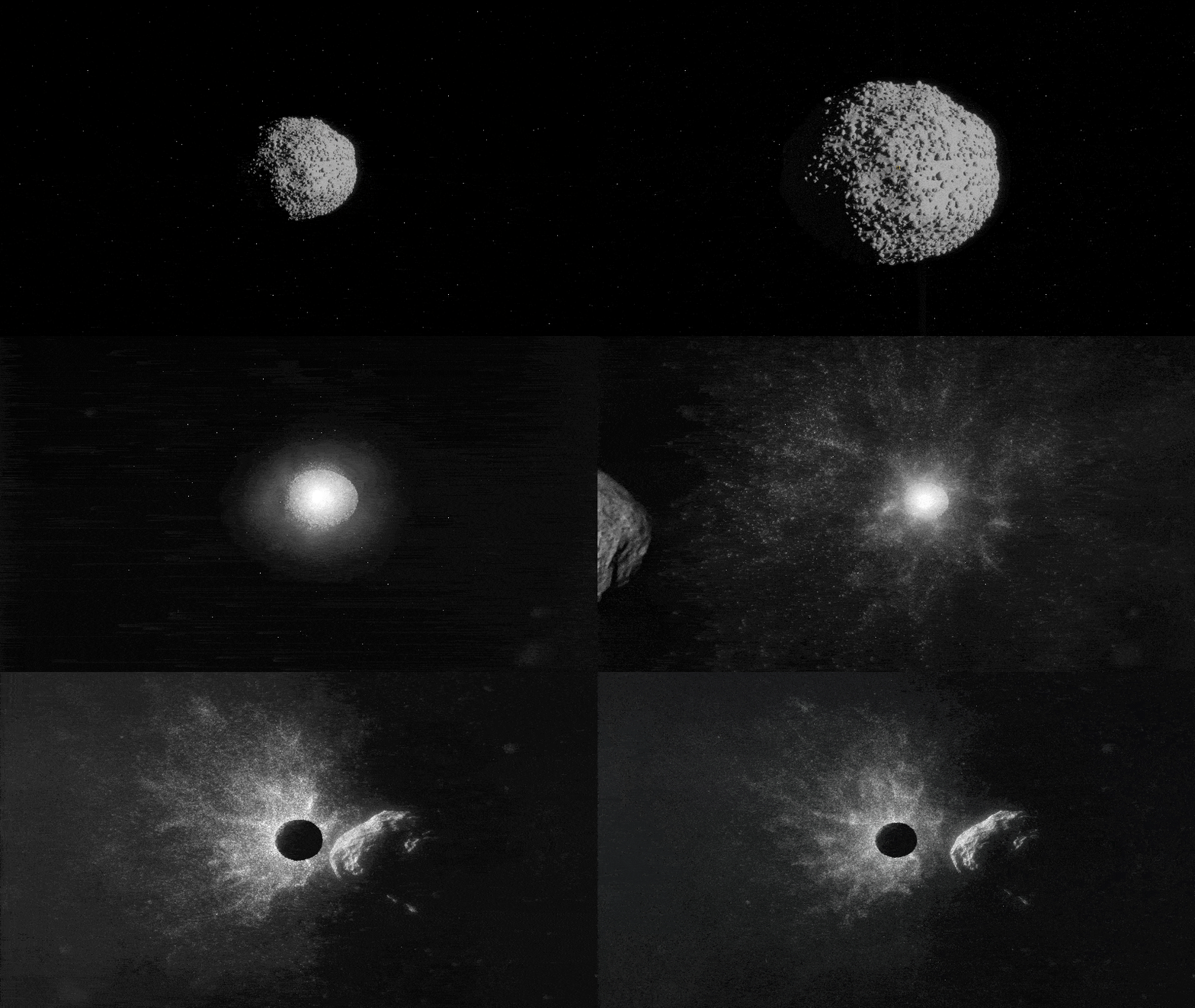
The observations are important because they provide data needed to put asteroid-impact defense technology to practical use. Scientists need to be able to calculate how fast a spacecraft must strike an asteroid to change its orbit by a given amount. The outcome can vary depending on whether an asteroid is a solid mass of rock or a loose collection of smaller rocks, even when struck by the same spacecraft. The crater’s size and shape, as well as debris ejected during the impact, provide data needed to calculate these effects.
Hera mission manager Ian Carnelli chose a dinosaur exhibit hall as the venue for the image release. He explained that an asteroid impact about 66 million years ago changed the history of life on Earth, and that humanity is now testing technology that could prevent such disasters. DART demonstrated that an asteroid’s orbit could be changed; Hera’s role is to investigate what happened to the asteroid itself after the impact.
ESA Director General Josef Aschbacher also said that NASA had demonstrated the possibility of changing an asteroid’s orbit, while ESA is carrying out the detailed investigations needed to understand how it works. He also highlighted the role of partner organizations, including the Japan Aerospace Exploration Agency (JAXA).
◆ Exploring the asteroid’s structure
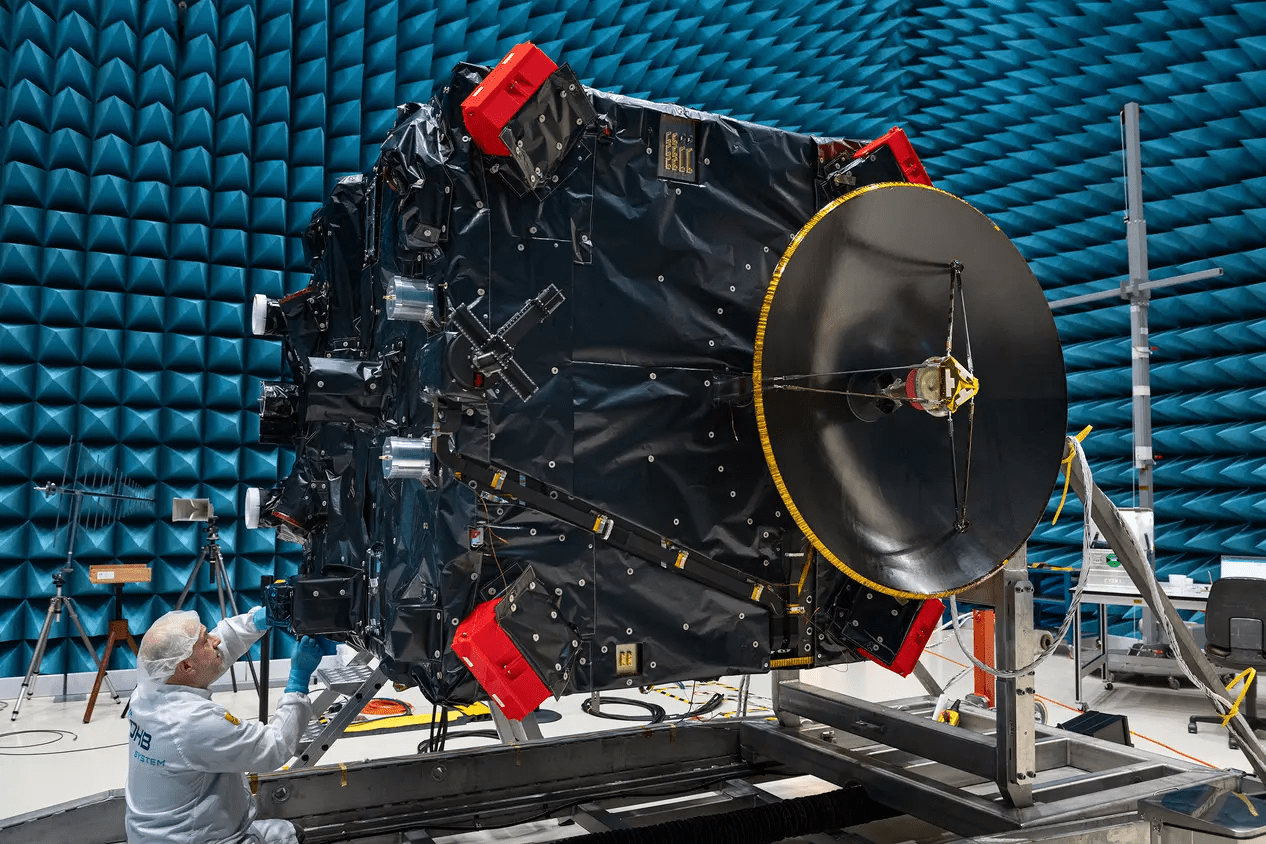
Hera is about the size of a small car. It is currently in the early observation phase, conducting operations about 25 to 30 kilometers from the two asteroids. Their gravitational pull is extremely weak. Using its thrusters, Hera follows a roughly square flight path at an average speed of 12 centimeters per second—far slower than a person walks.
The probe’s three main instruments are a black-and-white camera, a multispectral camera that observes 25 wavelength bands, and a thermal-infrared camera developed by JAXA. The thermal-infrared camera measures the surface temperature of the asteroids. Hera will approach to within about 13 kilometers of the two asteroids in December. In January next year, it is scheduled to deploy two shoebox-sized CubeSats.
Juventas, whose development was led by Luxembourg, will use low-frequency radar to investigate the asteroids’ internal structure. This will be the first attempt to examine an asteroid’s interior directly with radar. The mission will also attempt a landing in its later phase. Milani, whose development was led by Italy, will study the asteroids’ surface materials and surrounding dust. It will also be the first time that three spacecraft conduct exploration operations simultaneously around two asteroids.
Hera and the CubeSats were developed by a consortium involving 18 ESA member states, with German space company OHB leading development of Hera. Hera is ESA’s first planetary-defense mission.
ESA and JAXA are also preparing a follow-up mission, RAMSES. It is planned to observe the asteroid Apophis up close as it passes about 32,000 kilometers from Earth’s surface on April 13, 2029. ESA has said that Apophis poses no risk of colliding with Earth, even as it approaches. The mission’s main objective is to determine how Earth’s gravity affects the asteroid’s rotation, surface, and internal structure.