
Key points
▶ On Oct. 31 (local time), U.S. President Donald Trump responded to reports that Nvidia CEO Jensen Huang had been a target of Chinese intelligence gathering by saying, “I have great respect for Jensen. He is a great and brilliant person, and we have to protect brilliant people,” adding that he would “look into it very carefully.”
▶ Asked whether he would continue to keep Huang as an AI policy adviser, Trump said, “I would say yes, unless facts come out to the contrary,” adding that “Jensen Huang has always been an honorable person.”
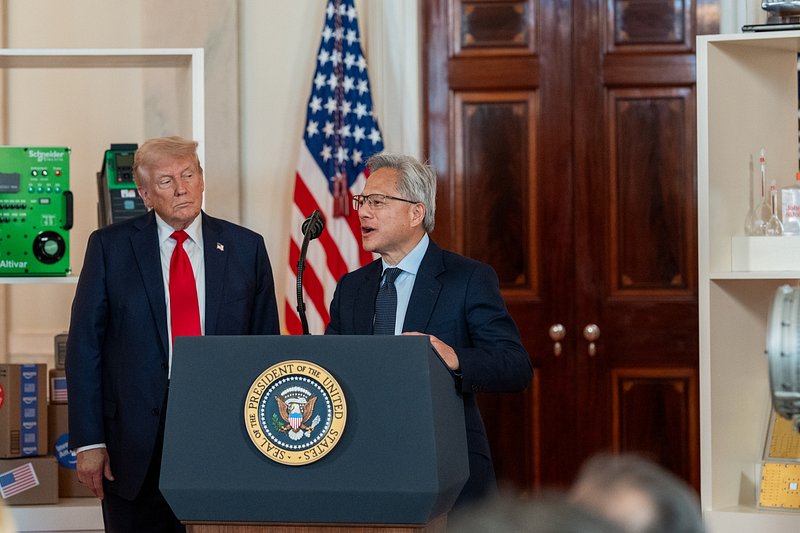
U.S. President Donald Trump defended Nvidia CEO Jensen Huang.
Speaking to reporters at his Florida residence on Oct. 31 (local time), Trump responded to reports that Huang had been a target of Chinese intelligence gathering, saying, “I have great respect for Jensen. I didn’t know the specifics, but I hope he’s all right. He is a great and brilliant person, and we have to protect brilliant people.” He added, “I’ll look into it very carefully.”
Asked whether Huang would remain an adviser on AI policy, Trump said, “I would like to say yes. Unless facts come out to the contrary, Jensen Huang has always been an honorable person,” while adding, “This is a very complicated issue.”
◆ ‘Alice Huang,’ as reported by The New York Times
The story began with an article published by The New York Times (NYT) on Oct. 29. The NYT reported that U.S. intelligence agencies had concluded that Alice Huang, an executive at Singaporean data center company Megaspeed, had developed a close relationship with Jensen Huang and passed information to Beijing.
The two share a surname but are not related. Alice Huang, whose Chinese name is Huang Le, was photographed sitting next to Jensen Huang and executives from other AI companies at a party in Taipei in June 2024.
Intelligence agencies electronically surveilled Alice Huang and concluded that Jensen Huang did not know she was gathering information for China. The NYT reported that officials briefed Trump on the matter last year, but he took no action.
Megaspeed itself is also under investigation. The NYT reported that Alice Huang arranged a deal last year for Megaspeed to purchase about $2 billion worth of Nvidia GPUs, which were sent to data centers in Malaysia and Indonesia that appeared to serve Chinese customers.
U.S. Commerce Department investigators found GPUs stacked in boxes at Megaspeed’s Malaysian data center rather than installed in server racks. The scene raised suspicions that the chips might be intended for diversion elsewhere. After the Commerce Department began investigating, Alice Huang’s name was removed as a managing director from Megaspeed’s corporate registry, and the Justice Department took over the case early this year. A director of Megaspeed’s Singapore entity lives in China.
◆ Nvidia: “Meeting customers is part of a CEO’s job”
Nvidia disputed the report. A company spokesperson said, “Jensen speaks with thousands of customer executives every year. His meeting with Ms. Huang was neither unusual nor unexpected. Meeting customers is part of a CEO’s job.”
The spokesperson also said that regional cloud customers receive general business information, not trade secrets or national security information. Nvidia said it was “confident that the U.S. government would inform us if it considered someone a threat to American industry,” adding that it regularly receives notifications from the government about parties of concern and takes action.
Nvidia said its own investigation last year into the allegations of chip diversion at Megaspeed had been thorough and confirmed they were untrue. At a regular briefing on Oct. 30, Chinese Foreign Ministry spokesperson Guo Jiakun said the reports were “groundless and a sheer smear against China.”
◆ Jensen Huang’s position
Huang is deeply involved in the Trump administration’s AI policy. He has advised Trump on AI policy and was among the tech company CEOs who accompanied Trump to a meeting with Chinese President Xi Jinping during Trump’s visit to China in May.
He also attended a state dinner for Xi at the White House in September. In January, he persuaded Trump to allow sales of advanced chips to China, in an arrangement under which the U.S. government would receive 25% of the sales proceeds.
Huang, who was born in Taiwan, has consistently argued that Nvidia should sell its chips to China as the country accelerates its own semiconductor development. President Trump personally owns Nvidia stock.
The NYT report touches on the policy landscape because it says that the person who secured permission for chip exports to China had been a target of Chinese intelligence gathering. However, the report does not say that Huang passed information or knew about the alleged activity, and intelligence agencies concluded that he was unaware of it.