
Key takeaways
▶ SpaceX CEO Elon Musk personally ordered speed limits on Starshield, the military satellite communications service used by Ukraine’s armed forces, beginning Oct. 14, the Wall Street Journal reported.
▶ Some attack and interceptor drones were effectively rendered unusable. Service returned to normal speed 10 days later, on Oct. 24. Musk said Ukraine had violated Starlink’s terms by using its civilian service for drone attacks.
▶ U.S. allies are accelerating plans for independent satellite networks. Finland and Ukraine announced a €300 million (about 500 billion won) support package on Oct. 22 that includes participation by ICEYE and Nokia in a satellite communications network. Canada’s Telesat plans to launch its first satellite in December and begin service in early 2028.
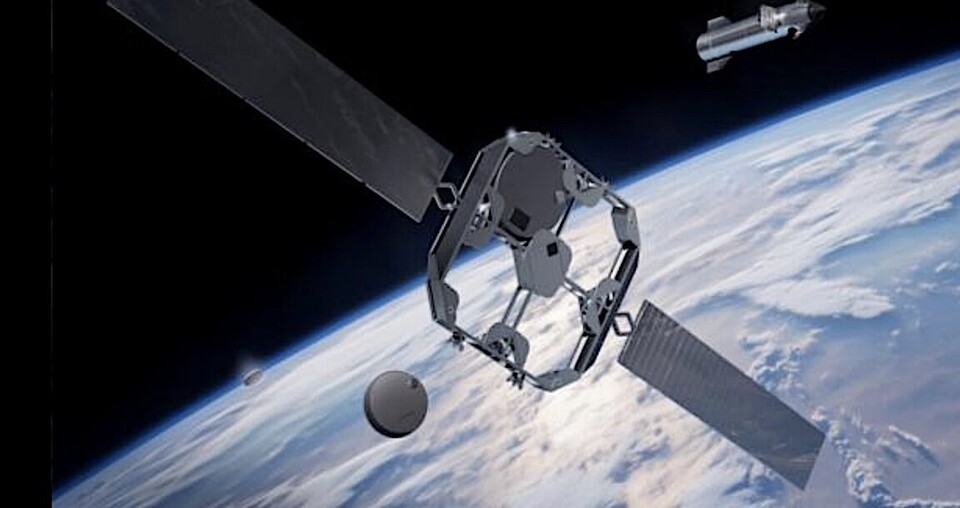
A private company restricted the military communications of a country at war for 10 days.
The Wall Street Journal reported on Oct. 24 (local time) that U.S. allies, including European countries and Canada, are speeding up efforts to build independent satellite communications networks following an incident in which SpaceX CEO Elon Musk personally ordered speed limits on satellite communications used by Ukraine’s armed forces.
The episode has heightened concerns that reliance on a particular company could become a national security vulnerability, after it brought home the reality that communications essential to military operations can be subject to the decisions of a single company and one person.
Speed limits imposed on Oct. 14, restored on Oct. 24
Ukraine’s Defense Ministry said military Starlink terminals operating on the Starshield service were subjected to speed limits without prior notice on Oct. 14.
Starshield is a service that SpaceX operates specifically for government and military customers. The WSJ reported that Musk personally ordered the restrictions. After they took effect, some attack and interceptor drones used by Ukraine’s military for communications and operations were effectively rendered unusable.
U.S. officials disagreed over whether President Donald Trump had been informed in advance, while the White House initially described the incident as a “technical malfunction.” Ukraine suspects it was connected to tensions between Trump and President Volodymyr Zelensky over attacks on Russian oil refineries.
Ukraine’s Defense Ministry said on Oct. 24 that military satellite connections had returned to normal speed. That same day, Musk wrote that Ukraine’s military had violated the terms of service by using civilian Starlink for attack drones, adding, “We merely enforced the terms that had been circumvented.”
Serhii Beskrestnov, an adviser on defense technology to Ukraine’s presidential office, countered that civilian Starlink terminals had been limited to speeds of 70 to 90 kilometers per hour since the winter, making them unsuitable for long-range attacks.
Criticism came from both allies and members of the U.S. ruling party. Polish Foreign Minister Radosław Sikorski told Musk, “The more you use your product for political purposes, the more damage you do to your brand.”
Poland pays about $50 million a year for Ukraine’s use of Starlink. Republican Senator Kevin Cramer said, “We should not be overly dependent on one system, one person, or one company.”
Finland, Canada and the EU are pursuing their own satellite networks
Finland and Ukraine announced a support package worth €300 million (about 500 billion won) on Oct. 22, saying Ukraine would participate in building a satellite communications network being developed by Finnish satellite company ICEYE and telecommunications equipment maker Nokia.
The project, announced by the two companies in early October, is designed so that customer countries directly own and operate the low-Earth-orbit communications satellites, ground infrastructure and military terminals. The aim is to avoid being subject to the terms of foreign private operators. The first satellite launch is planned for 2028.
Canada’s Telesat is building Lightspeed, a low-Earth-orbit communications network comprising 288 satellites. It aims to launch its first satellite in December and begin service in early 2028. The Canadian government has signed a C$2.3 billion contract with Telesat to provide military communications in the Arctic.
The European Union is spending about $17.5 billion (approximately 24 trillion won) to build IRIS², an independent communications network of 348 satellites. Its first launch is scheduled for 2029.
No immediate replacement, and launches still depend on SpaceX
The challenge is the time and scale involved. Starlink operates more than 11,000 satellites. OneWeb, Europe’s leading low-Earth-orbit satellite communications provider, has about 650.
Competitors such as OneWeb and Telesat also rely on SpaceX’s Falcon rockets to launch their satellites into orbit.
That means alternative satellite networks will, for the time being, have to be launched aboard SpaceX rockets. Tom Withington, a researcher at the Royal United Services Institute (RUSI), told the WSJ that “there will be no single technology that can replace Starlink,” and that combining multiple technologies is likely to take considerable time.
South Korea targets a homegrown low-Earth-orbit satellite network by 2035
South Korea does not yet have its own low-Earth-orbit communications satellites. At the 6G Satellite Communications Conference in July, the Ministry of Science and ICT outlined a plan to complete a homegrown low-Earth-orbit satellite network by 2035.
The ministry is considering three options: 128 satellites at an altitude of 1,280 kilometers, costing about 4 trillion won; 256 satellites at 888 kilometers, costing about 7.4 trillion won; or 512 satellites at 1,280 kilometers, costing about 14.3 trillion won.
By 2030, South Korea plans to invest about 300 billion won to place two test satellites in an 888-kilometer orbit and validate key technologies. The ministry has said the main reason for the project is the lack of alternatives if foreign networks are cut off by war or a major disaster. The 10-day disruption in Ukraine showed why.