
▶ Nvidia has officially launched its Arm platform for Windows PCs, RTX Spark. It uses the N1X system-on-a-chip, designed jointly with MediaTek, which combines a 20-core Grace CPU and a 6,144-core Blackwell GPU. Demonstrations and sales have begun in six cities: Seoul, San Francisco, Berlin, Taipei, Beijing and Istanbul.
▶ The key feature is the ability to run large AI models of more than 32GB locally on a laptop, without the cloud—models that GeForce RTX 50-series cards could not run. The platform supports CUDA, DLSS, Reflex and G-SYNC, and Nvidia says it can deliver more than 100 frames per second in 4K gaming.

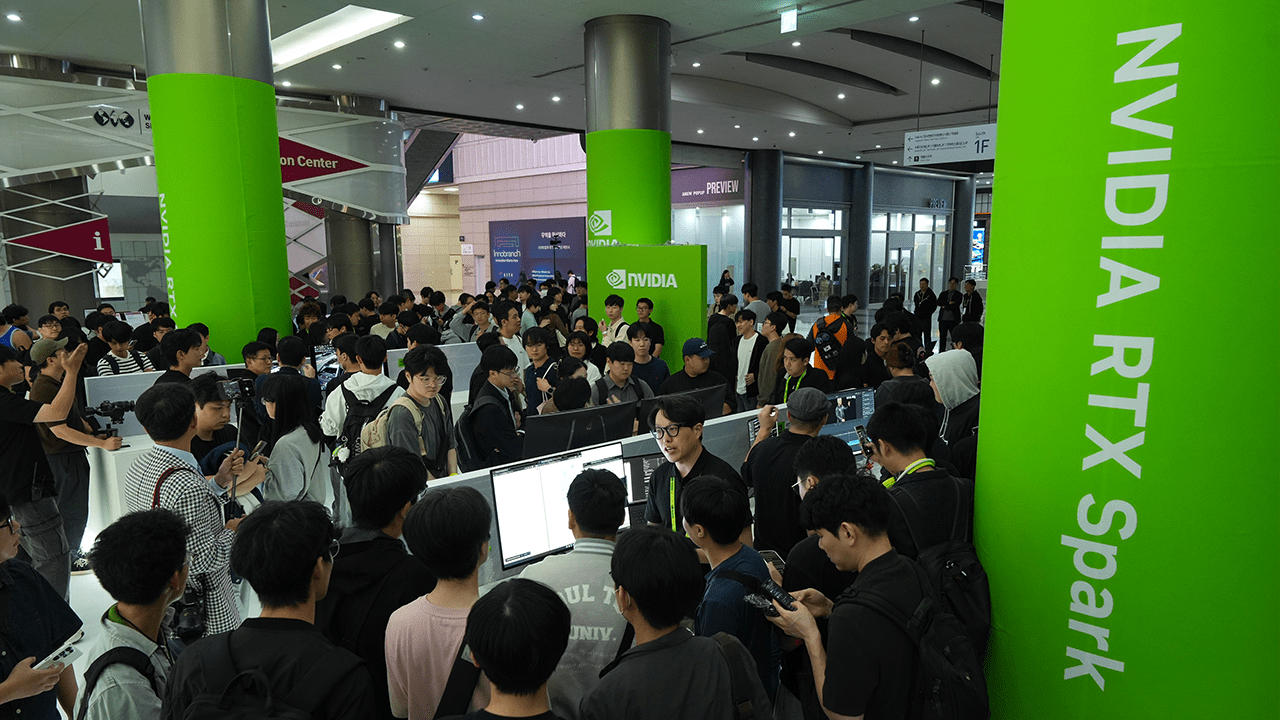
Nvidia has entered the Windows PC market directly. On the 16th, the company officially launched RTX Spark, its Arm platform for Windows PCs, and held demonstration and sales events in six cities: Seoul, San Francisco in the United States, Berlin in Germany, Taipei in Taiwan, Beijing in China and Istanbul in Türkiye.
The platform is aimed at demand from content creators and AI developers, and is built around the N1X system-on-a-chip (SoC), which combines a low-power Grace CPU with a Blackwell GPU.
◆ N1X, derived from GB10, targets Windows on Arm
RTX Spark is an Arm PC platform Nvidia developed to expand the use of large AI models of more than 32GB, inference and agentic AI in the Windows environment, which has more users than Linux.
N1X is based on GB10, an AI workstation chip released in 2025 that combines a 20-core Arm-based Grace CPU, co-designed by Nvidia and MediaTek, with a Blackwell GPU containing 6,144 cores. Nvidia modified aspects of the chip, including the number of GPU cores, for Windows on Arm.
It supports up to 128GB of unified memory and delivers AI performance of up to one petaflop using FP4 precision.
N1X was expected to be unveiled at Computex Taipei 2025 last year, but its actual debut came a year later. Nvidia CEO Jensen Huang first revealed RTX Spark in his Computex 2026 keynote in June, saying, “We’ll begin shipping actual products through major PC manufacturers this fall.”
◆ Develop with CUDA, then move directly to the cloud
RTX Spark supports Nvidia gaming technologies DLSS, OptiX, Reflex and G-SYNC, as well as CUDA, Nvidia’s AI development platform.
Nvidia says AI services developed with RTX Spark can be deployed directly to Nvidia-based cloud platforms.
Nvidia and Microsoft are providing, for the first time, PyTorch-CUDA and native Python builds for Windows on Arm, along with Conda installation tools. Nvidia said the platform supports 97% of the top 15,000 Python packages.
On the afternoon of the 16th, Nvidia Korea demonstrated AI performance and gaming on Asus and MSI products at an event at COEX in Samseong-dong, Seoul.
“The biggest advantage is that large AI models of more than 32GB—which could not be used with existing GeForce RTX 50-series GPUs—can run at high performance right on your desk, without the cloud,” a Nvidia Korea representative said.
On game compatibility, the representative said, “Compatibility with anti-cheat solutions such as Epic Games’ Easy Anti-Cheat has been secured, and compatibility with Riot Vanguard, used by League of Legends, is expected soon.”
◆ “More than 100 frames per second in 4K gaming”
Keita Iida, Nvidia vice president of global content management, said, “RTX Spark brings together the capabilities of gaming PCs and laptops, workstations and cloud supercomputers. Now you can do everything on a single device.”
“Gaming is an indispensable part of Nvidia. With RTX Spark, you can play games at more than 100 frames per second in 4K resolution, just as you would expect from the latest GeForce GPUs,” he said.
RTX Spark can use AI frame-generation features such as DLSS 5 in supported games. For Microsoft, which has relied on Qualcomm Adreno GPUs for gaming performance on Windows on Arm, this adds another option.
Bae Jae-hyun, NCSoft vice president and CEO of BigFire Games, which is developing the new game Cinder City, said, “RTX Spark-based laptops deliver high performance even on battery power. Cinder City also uses a range of technologies, including ray tracing, DLSS frame generation and Reflex.”
◆ 32GB models in the 5-million-won range; orders concentrated on 64GB and above
Manufacturers have priced the laptops according to memory capacity. In South Korea, models with 32GB of LPDDR5X memory are in the 5-million-won range, 64GB models in the 7-million-won range and 128GB models in the 9-million-won range.
In the United States, the Microsoft Surface Laptop Ultra and Asus ProArt P14 start at $2,599.99 (about 3.6 million won); the Dell XPS 16 starts at $3,799.99, while the top-spec Surface Laptop Ultra costs $5,999.
Other models include the HP OmniBook Ultra and OmniBook X 14, Lenovo Yoga Pro 9n, and MSI Prestige N16 Flip AI+.
At the event, a representative of an AI platform developer tried demonstrations of video generation using agentic AI and ComfyUI, then bought two units on the spot.
“We expect demand to concentrate on models with at least 64GB of memory, which can run large AI models. We’ve already received more than a three-digit number of orders, but we don’t expect supply to be ample enough to meet them,” an unnamed manufacturer representative said.