
Key points
▶ At 6 a.m. on Oct. 6, South Korea’s Nuri rocket left the launch vehicle assembly building at the Naro Space Center and was transported to Launch Pad 2. A launch preparation committee meeting held at 6:30 p.m. the previous day approved the move after reviewing technical readiness and weather conditions.
▶ After arriving at the launch pad, the rocket is raised into a vertical position, connected to umbilicals that supply power, fuel and oxidizer, and checked for leaks. If all stages proceed without problems, installation at the launch pad will be completed on Oct. 6.
▶ The Korea AeroSpace Administration will convene a Nuri launch management committee on the morning of Oct. 7 to review technical readiness, weather, space conditions and the risk of collisions with space objects before setting the final launch time. The launch window is from 12:23 p.m. to 1:23 p.m. on Oct. 7.
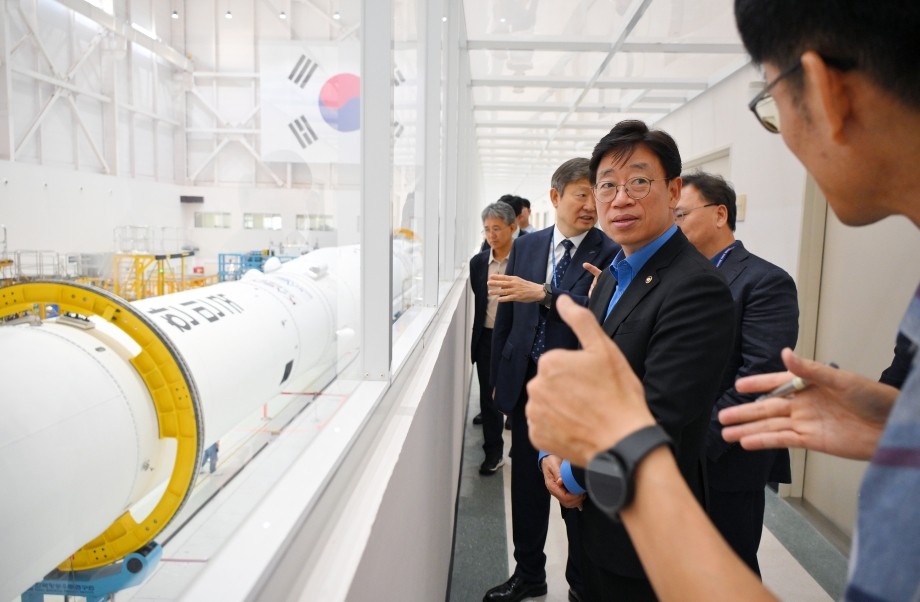
Nuri has been moved to the launch pad. The Korea AeroSpace Administration and the Korea Aerospace Research Institute said the transport of the Korean launch vehicle from the Naro Space Center’s launch vehicle assembly building to Launch Pad 2 began at 6 a.m. on Oct. 6.
The rocket is being carried on an unmanned transporter, a process expected to take about an hour and a half. The launch is scheduled to take place between 12:23 p.m. and 1:23 p.m. on Oct. 7. It will be South Korea’s first cluster launch, carrying 15 satellites at once.
◆ Move approved the previous evening; launch-pad installation to be completed today
The decision to transport the rocket was made the previous day. At a launch preparation committee meeting at 6:30 p.m. on Oct. 5, the Korea Aerospace Research Institute reviewed technical readiness and weather conditions before approving the move to the launch pad.
After reaching the pad, Nuri will undergo preparations and be raised upright. This is followed by connection of the umbilicals—the lines that supply the launch vehicle with power, fuel and oxidizer until just before liftoff. The name “umbilical” comes from the word for a biological umbilical cord. Once connected, the rocket will undergo a leak test to check that no propellant is escaping. If there are no problems during transport, raising the vehicle and connecting the umbilicals, installation at the launch pad will be completed on Oct. 6.
The final decision will be made on the morning of Oct. 7. The Korea AeroSpace Administration will convene a Nuri launch management committee to review technical readiness, weather, space conditions and the possibility of collisions with space objects before confirming the launch time. The collision-risk review checks whether other satellites or space debris will pass through Nuri’s flight path.
◆ 15 satellites to be deployed in sequence, starting 13 minutes and 30 seconds after launch
The fifth launch mission will place 15 satellites into a 570-kilometer sun-synchronous orbit. In this type of orbit, a satellite passes over any given point on Earth at the same local time, making it commonly used for observation satellites.
The primary payload consists of five satellites, Nos. 2 through 6, in the ultrasmall satellite cluster. Each weighs less than 100 kilograms and can photograph the ground at a resolution of 1 meter in black and white and 4 meters in color. The images will be used for security and disaster response. Ten CubeSats developed by domestic industry, academia and research institutions will also be carried.
These include the Korea Aerospace Research Institute’s Space Verification Platform for Korean Components and Parts No. 2, KAIST’s Jibisat, startup Quaternion’s Percept02, and the Ulysses satellite developed by the Unmanned Exploration Laboratory. The cluster satellites weigh about 500 kilograms in total and the CubeSats about 96 kilograms. Including the deployment system and adapters, which weigh about 475 kilograms, the total payload weighs 1,071 kilograms.
The flight sequence is as follows: the first stage separates about 2 minutes and 3 seconds after launch, the fairing—the cover protecting the satellites—separates after 3 minutes and 53 seconds, and the second stage separates after 4 minutes and 28 seconds. The first ultrasmall cluster satellite will be released about 13 minutes and 30 seconds after launch.
The cluster satellites will be deployed one at a time at intervals of 35 to 40 seconds, while the CubeSats will be released two at a time, 10 seconds apart. The flight will end after about 19 minutes and 45 seconds. This mission will use a low-shock separation system for the first time, designed to reduce the impact on satellites during deployment to internationally accepted levels.
◆ 23 Hanwha employees to staff 20 launch-control consoles
The fifth launch marks an intermediate step in transferring operations to the private sector. Hanwha Aerospace, the system integration company, has led Nuri’s production and assembly since the fourth launch. For the fifth launch, it will also take part in launch operations.
Twenty-three Hanwha employees will work at 20 of the 22 launch-control consoles, with 18 of them operating the consoles directly. Park Jong-chan, head of the Nuri Development Division at the Korea Aerospace Research Institute, said Hanwha Aerospace is gradually building up its launch capabilities.
The Nuri improvement program runs from 2022 to 2028, with a total budget of 796.88 billion won. Its goal is to transfer government-developed launch vehicle technology to the private sector so companies can provide space transportation services independently.
“The technical goal is to place all 15 satellites into their precise orbits,” said Han Young-min, director of the Korea Aerospace Research Institute’s Space Launch Vehicle Research Institute. The institute plans to expand the system integration company’s role in launch operations through the sixth and seventh launches, and to continue transferring technology so that private companies can lead subsequent launches after the improvement program ends. The sixth launch, scheduled for 2027, will carry five additional ultrasmall cluster satellites.