
SpaceX, Elon Musk’s space company, has completed its acquisition of AI coding startup Cursor. SpaceX disclosed to the U.S. Securities and Exchange Commission (SEC) on the 14th, local time, that the merger between its subsidiary X67 and Cursor had been completed.
The deal values Cursor at $60 billion, or about 85 trillion won. Forbes said it was the largest startup acquisition in history at the time the contract was signed.
◆ A lightning-fast deal completed in four months
The merger was carried out through a reverse triangular merger. In this structure, the acquiring side creates a shell company for the transaction and merges it into the target. X67 was absorbed into Cursor and disappeared, while Cursor remained the surviving entity and became a wholly owned subsidiary of SpaceX. This method is often used in large-scale acquisitions because it allows the company name and existing contracts to remain intact.
The entire price was paid in stock. According to the filing, Cursor’s common and preferred shares were automatically converted into about 389.29 million SpaceX Class A common shares. The exchange ratio was determined by SpaceX’s volume-weighted average stock price over the seven trading days immediately before the merger was completed. Stock compensation held by Cursor employees was also carried over, including about 29 million SpaceX restricted stock units and about 44 million stock options.
The deal moved quickly. According to Forbes, SpaceX secured an exclusive option to acquire Cursor in April, with a $10 billion breakup fee if the contract was terminated. It signed the main agreement on June 16 and completed the process in less than two months.
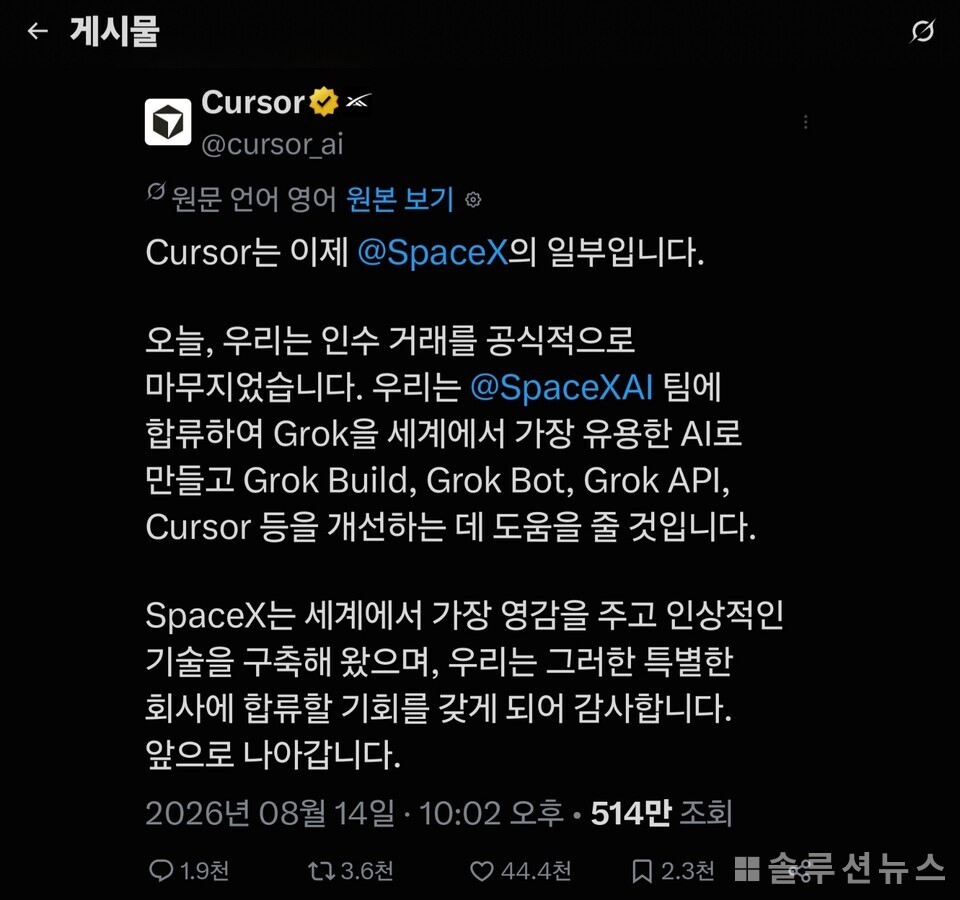
No changes for users were announced. Cursor said through its X account that there would be no immediate changes to accounts, subscriptions, or how the software is used.
◆ Why Musk wanted it
Cursor is a company that makes AI coding tools for developers. It combines AI with a code editor, acting like an assistant that writes and fixes code when developers give instructions in plain language.
It had already established an early position in the AI coding market and was said to have received acquisition offers from several companies, including OpenAI, but turned them down.
Its collaboration with SpaceX had been deep even before the merger. Cursor had been using the giant computing infrastructure owned by SpaceX’s AI division, SpaceXAI, to train its models. After Cursor’s developers joined the training effort, Grok’s performance evaluation improved noticeably. Grok 4.6, released on the 12th, tied OpenAI’s top model GPT-5.6 on Artificial Analysis’s Intelligence Index, a third-party benchmark.
In an X post, Cursor said it was “joining the SpaceXAI team to make Grok the most useful AI in the world and improve Grok Build, the Grok API, and Cursor.” Musk said, “It is an honor to have such a great team join SpaceX.”
◆ The stock-price calculation, and the calculation behind an orbital data center
Market reaction was mixed. On the day the merger was completed, SpaceX shares were trading around $137, down about 2%. However, they had risen more than 23% over the previous five trading days, reflecting expectations for Grok 4.6 and the completion of the acquisition, so some interpreted the decline as a pullback after the news was already priced in.
There are optimistic views on the outlook. Morgan Stanley analyst Adam Jonas said in a bullish scenario SpaceX stock could rise to $600, calling Cursor a key driver of further upside. The reason, he said, is that Cursor already holds a dominant position in the trend toward automated code generation.
There is also discussion of links to SpaceX’s space business. Musk’s long-promoted plan for an orbital data center is not just about putting equipment into space. It requires software capable of autonomously controlling systems in orbit, where no human can stay, and resolving bottlenecks on its own, and analysts say Cursor’s development capabilities could become the foundation for that.
For the developer ecosystem, another question remains. As a coding tool used daily by developers worldwide moves under a major tech company, observers say changes in pricing policies and support models will need to be watched closely. With Cursor already heavily relied on in South Korea’s development scene as well, some say this is not just someone else’s problem.