
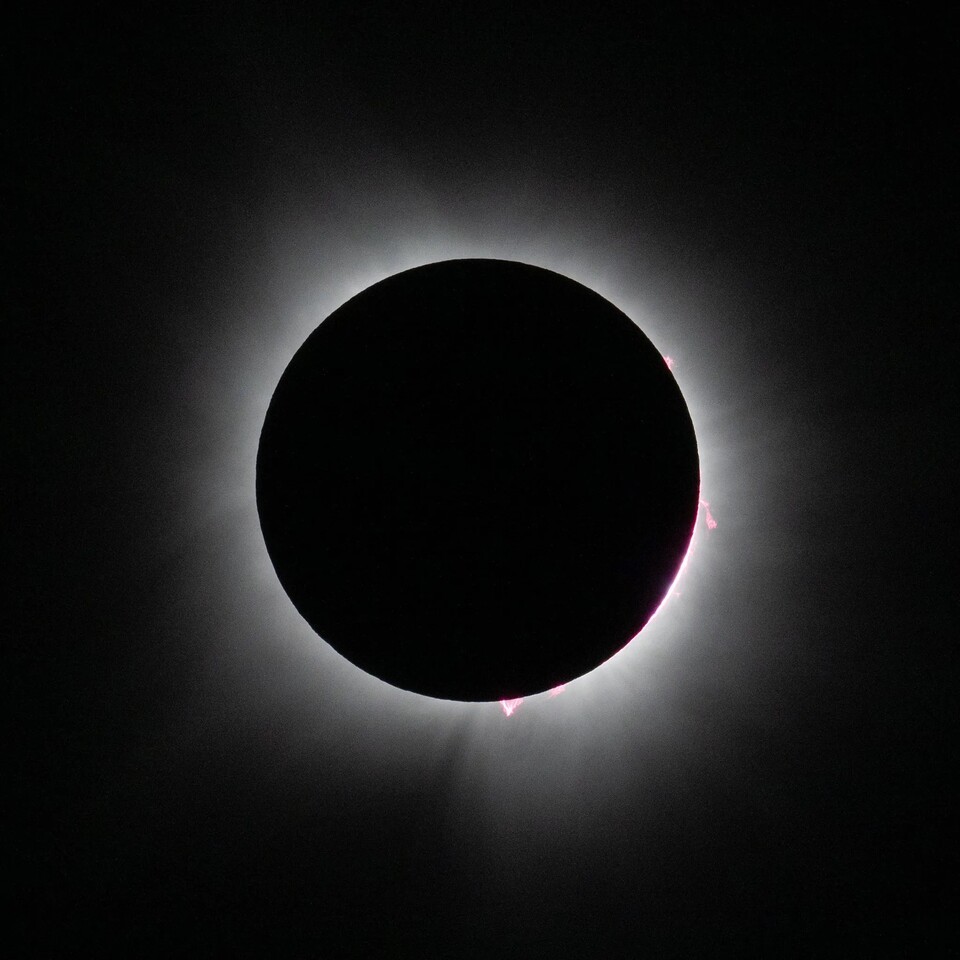
A total solar eclipse will take place in the European sky on the 12th. It will be the first time in 27 years since 1999 that a total eclipse has been visible from mainland Europe.
The moon’s shadow will begin in a remote area of northeastern Siberia, Russia, pass over Greenland’s ice sheet, brush the far western edge of Iceland, cross the North Atlantic, and make landfall on the northern coast of Spain. From there, it will travel north to south across the Iberian Peninsula and out into the Mediterranean.
◆ Inside and outside the path of totality, the difference between day and night
A total solar eclipse is the phenomenon in which the moon completely covers the sun. It occurs under conditions that are almost accidental, because as seen from Earth, the moon and the sun appear nearly the same size.
The band through which the moon’s shadow passes is called the path of totality. It is 290 km, or 180 miles, wide. Only within this path can observers see the sun disappear completely. Outside the path, only a partial eclipse will be visible, with part of the sun still uncovered.
The difference between the two phenomena is dramatic. During a partial eclipse, some of the sun remains visible, so the sky does not darken. During totality, night falls in the middle of the day. Stars become visible and temperatures drop.
Observation time depends on location. The closer one is to the center line of the path, the longer the sun remains fully covered. The entire eclipse lasts about two hours, but the period of complete blackout is only around two minutes.
The fact that the moon’s shadow crosses multiple time zones is also a factor. Without checking the local time at the observation site in advance, one could miss the two-minute peak. Sites such as Time and Date provide maps showing the eclipse’s start and end times, as well as its duration, by location.
◆ The only moment visible to the naked eye: the corona
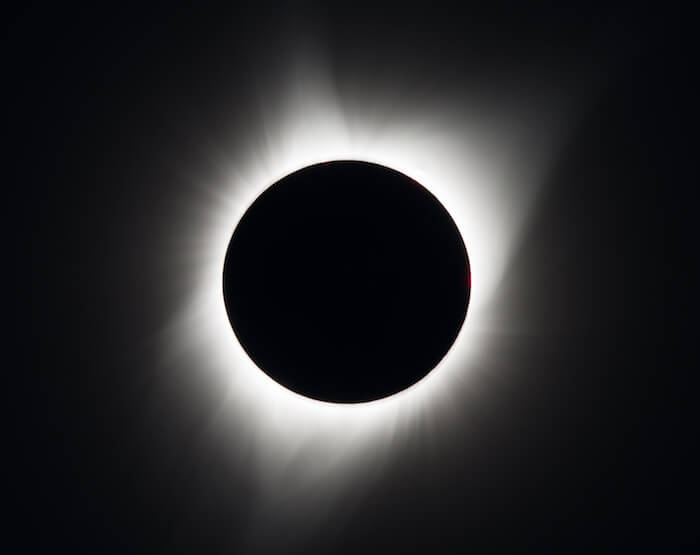
The reason total solar eclipses are so prized in astronomy is the corona. The corona is the sun’s outer atmosphere. Although its temperature exceeds 1 million degrees, it is far dimmer than the solar surface, so it is usually hidden by the sun’s bright light.
Only at the moment when the moon completely covers the solar disk does the corona appear. It looks like white rays spreading out around a black circle. It cannot be seen with the naked eye except during a total eclipse.
Weather is the final hurdle. If clouds move in, they may block the sun before the moon does. Areas expected to have a high chance of clear skies include Spain and Portugal.
Accommodation is another variable. In regions along the eclipse path, hotels and campgrounds are often fully booked months in advance, leading observers to be advised to make travel plans early.
For viewers who want to examine the path in detail, enlarged online eclipse maps are also available. The closer one is to the center line marked on the map, the longer the total eclipse will last.
◆ Safety rules and how to watch from Korea
The most important thing in observing the eclipse is protecting your eyes. Except for the two minutes of totality, eclipse glasses must be worn at all times. Sunglasses, film, or soot-darkened glass do not block ultraviolet and infrared radiation and are dangerous.
Telescopes and cameras require even greater caution. Looking at the sun through a telescope without a dedicated solar filter mounted on the front can instantly damage the retina because the lens concentrates light. It is also not safe to look through a telescope while wearing eclipse glasses.
Observation is possible even without special equipment. Any object with a hole will do. If a sieve or a perforated ladle is held up to sunlight, each hole acts like a pinhole camera and casts the crescent-shaped sun onto the ground. A simple projection device made from a cardboard box with a pinhole works on the same principle.
The eclipse will not be visible in Korea on the 12th because the path of totality lies across Europe and the Arctic regions, not reaching the eastern edge of Asia.
The alternative is a live online broadcast. The California Academy of Sciences’ Exploratorium plans to stream images from four telescopes set up at the scene on its website. It will be a way to view the corona and details of the solar surface even without a telescope.
A chance for domestic observation still remains. The next total solar eclipse visible from the Korean Peninsula is forecast for September 2, 2035. Calculations show that Pyongyang and parts of northern Gangwon Province will fall within the path of totality. In Seoul and central regions, it will be observed as a partial eclipse, with most of the sun covered.
Total solar eclipses occur about once every one or two years worldwide. However, because the shadow path is narrow and most of it falls over oceans or polar regions, the chance of seeing one from a specific location drops to roughly once every several hundred years.
Eclipses are among the most precisely predictable astronomical events. Schedules extending centuries into the future can be calculated to the second.