
Starting a series
Climate articles are everywhere. News that records have been broken, warnings that ice is melting, numbers showing temperatures have risen. Readers already know that the planet is getting hotter.
What is harder to understand is what comes next. Why are some continents warming twice as fast? Why do affluent cities collapse under heat waves? What measures actually protected people? The answers were always outside the article.
The World Health Organization reported last month that excess deaths during Europe’s heat wave topped 1,300. The same agency said that having response measures in place can reduce deaths by 80%. Read the other way around, that means the lack of preparation increased the damage. The climate crisis is no longer a question of temperature, but of readiness.
This is the beginning of “Climate, So What Do We Do?” It does not stop at warning about the crisis. It digs into the causes and looks for solutions that have already been verified. It also records failed measures. Only by identifying what worked and what did not can we move forward. Editor’s note
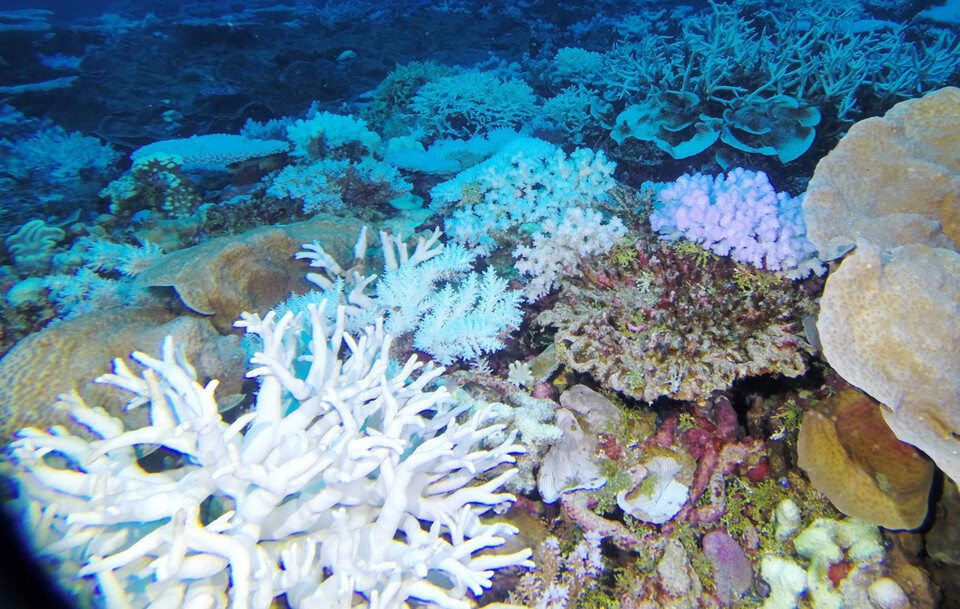
Climate change can explain nearly all of the global coral bleaching that has occurred over the past 40 years, according to an analysis published by researchers at Climate Central in an international academic journal.
The culprit long blamed for bleaching, El Niño, was only the trigger; the root cause, the researchers say, is the fossil-fuel-warmed ocean.
Of the 71 reef regions where large-scale bleaching was observed between 2018 and 2025, only one would have been at risk of bleaching if climate change had not existed.
By 2028, warming will outweigh El Niño in every coral region. Unless carbon emissions are cut now, coral reefs could disappear entirely, the warning goes.
The longstanding scientific view about the phenomenon of colorful corals turning white and dying beneath the sea has been overturned. Large-scale bleaching, once thought to be caused by the natural phenomenon known as El Niño, has now been analyzed as something driven by greenhouse gases emitted by humans. The study targets the real cause of coral mass die-offs over the past 40 years.
Researchers led by the U.S. climate research group Climate Central published their paper in the journal Oceanography on the 21st. They concluded that the large-scale coral bleaching that occurred around the world over the past 40 years would not have happened without human-caused climate change. Andrew Pershing, Climate Central’s chief program officer, led the study.
“Without climate change, coral bleaching would have been rare and localized,” Pershing said. “Global, large-scale bleaching would not have happened at all.” His assessment is that the heat warming the ocean came not from nature, but from humans.
The study examined all four major bleaching events ever recorded. They were first observed in 1998, then in 2010, 2014–2017, and 2018–2025. All overlapped with El Niño periods, but they also coincided with a time when global temperatures were steadily rising. The researchers untangled the two intertwined factors and separated out the human contribution.
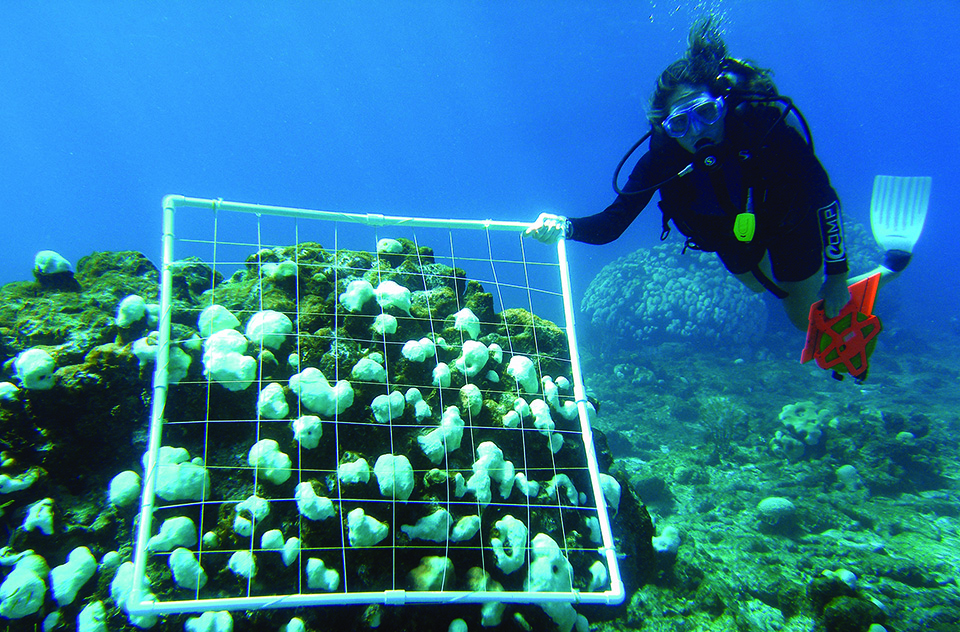
◆ The moment coral turns white: losing its color is a sign of starvation
First, it is necessary to understand what bleaching is. Coral may look like a plant, but it is actually an animal related to sea anemones. Inside its body, it hosts tiny algae known as zooxanthellae.
The algae provide nutrients to the coral through photosynthesis, and the coral’s distinctive vivid colors also come from the algae. The two are mutually dependent partners that struggle to survive without each other. A coral’s bright colors are evidence that the algae are healthy.
The problem occurs when seawater becomes too warm. Once the temperature exceeds a threshold, the coral expels the algae from its body. As the algae that give the coral its color leave, the white skeleton underneath is exposed. That is why bleaching appears as whitening.
A coral that has lost its color is not dead, but starving. The algae that supplied nutrients are gone. If the water cools soon enough, the algae return and the coral revives. But if high temperatures continue for too long, the coral eventually starves to death. When bleaching repeats too often without time to recover, coral reefs begin an irreversible decline.
Coral reefs are often called the “rainforests of the sea.” That is because countless species live in a small area. The rugged structures built by coral become shelters and spawning grounds for fish, shellfish, and crustaceans. When coral dies and the skeleton collapses, the seafloor turns into a flat desert, and the creatures that depended on it disappear as well.
◆ The method that overturned convention: drawing a hypothetical ocean without El Niño
The researchers’ rebuttal of the conventional view relied on a technique called attribution analysis. It is a method of quantifying how much human activity contributes to a particular event.
Using multiple climate models, the researchers calculated how much greenhouse gas emissions had raised sea surface temperatures. The principle is the same as analyses that estimate what percentage of a heat wave or flood can be blamed on climate change. It is also a methodology increasingly seen in recent reporting on weather disasters.
The key was a “counterfactual scenario.” The team recreated on a computer what the seawater temperature would have been if humans had never burned fossil fuels. They then compared the real ocean with the hypothetical one to see how coral bleaching risk changed. The results were applied to bleaching-risk models developed by NOAA’s Coral Reef Watch.
The findings were stark. During the bleaching event that lasted from 2018 to 2025, among the 71 reef regions where bleaching was observed, only one would have been in bleaching risk if climate change had not existed. In other words, the bleaching in the other 70 regions would not have occurred without warming.
The same conclusion was reached for all major bleaching events that coincided with El Niño in 1998, 2010, 2014–2017, and 2018–2025. The researchers pointed out that the decisive force pushing reefs past the bleaching threshold was human-made warming each time. Even the first event in 1998, long considered heavily influenced by El Niño, showed clear signs of climate change.
◆ El Niño was the trigger; the real gun was the overheated ocean
El Niño is often mistakenly seen as the main culprit behind coral bleaching. It is a natural phenomenon in which seawater near the equator in the Pacific becomes warmer than usual. It recurs every few years and shakes climate conditions worldwide. Because it raises water temperatures, bleaching has often clustered in El Niño years, leading it to be blamed as the cause.
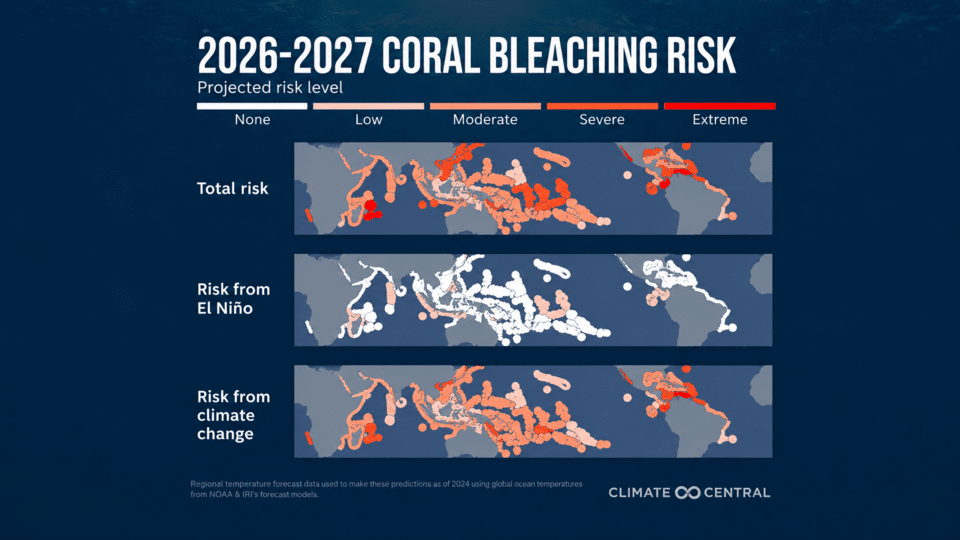
The researchers’ explanation is different. El Niño is only the trigger that adds the final bit of heat to an already overheated ocean, while warming loaded the gun. Greenhouse-gas-driven ocean warming has already pushed seawater temperature to just below the bleaching threshold, and when El Niño adds a little more heat, bleaching erupts. The core problem is that the baseline temperature is already near the danger line.
As time goes on, El Niño’s role shrinks and warming’s role grows. At the current warming rate, the researchers project that by 2028, in every coral habitat, the impact of human-caused warming will surpass that of El Niño. In the future, bleaching will no longer be the result of a special natural event coinciding with it, but a routine disaster brought on by persistently hot oceans.
The danger of repetition is especially severe. If corals hit by bleaching encounter warm water again before they have recovered, they lose their ability to regenerate. They also lose the chance to spread new offspring. That is why reefs that have been knocked down once rarely recover. What once happened only once every few decades has now recurred several times in the past 10 years.
How hot the ocean has become is also evident in the numbers. According to the European Copernicus Marine Service, global sea surface temperatures in June were the highest ever recorded. By the end of June, marine heat waves covered about 82% of the world’s oceans. The ocean absorbs more than 90% of the excess heat trapped by greenhouse gases, bearing the burden of atmospheric warming.
◆ If coral disappears, people are affected too; the time left depends on emissions
Coral bleaching may sound like a distant ocean story, but in reality it is tied to people’s livelihoods. Although coral reefs account for only 0.2% of the seafloor, about one-quarter of all marine species depend on them. They are nurseries where fish lay eggs and raise their young, and the foundation of fishing grounds that feed hundreds of millions of people.
The economic value is also enormous. According to an analysis by the U.S. Environmental Protection Agency, the world’s coral reefs generate about $29.8 billion in annual net benefits, or roughly 40 trillion won. Of that, tourism and recreation account for $9.6 billion, coastal protection that shields shorelines from waves accounts for $9 billion, and fisheries make up $5.7 billion. If coral reefs collapse, coastal fisheries lose productivity and tourism resources disappear. If the natural breakwaters that absorb waves vanish, coastal towns are left exposed to erosion and flooding.
The damage is already real. A survey by the U.N.-supported Global Coral Reef Monitoring Network found that 14% of the world’s coral reefs disappeared over the 10 years from 2009 to 2018. In the Caribbean, some coral species have effectively lost their function, and the Great Barrier Reef, visible from space, lost 15% to 40% of its coral cover depending on the area in 2024–2025. The United Nations has warned that up to 90% of the world’s coral reefs could disappear by 2050 if current trends continue.
Waters near Korea are not safe either. In waters off southern Taiwan, NOAA’s Coral Reef Watch was raised to the second-highest bleaching alert level, signaling the start of large-scale coral mortality. East Asian coastal waters were identified as one of the regions at especially high risk of bleaching during the 2026–2027 El Niño phase now underway, alongside the southern Caribbean and the coasts of Latin America.
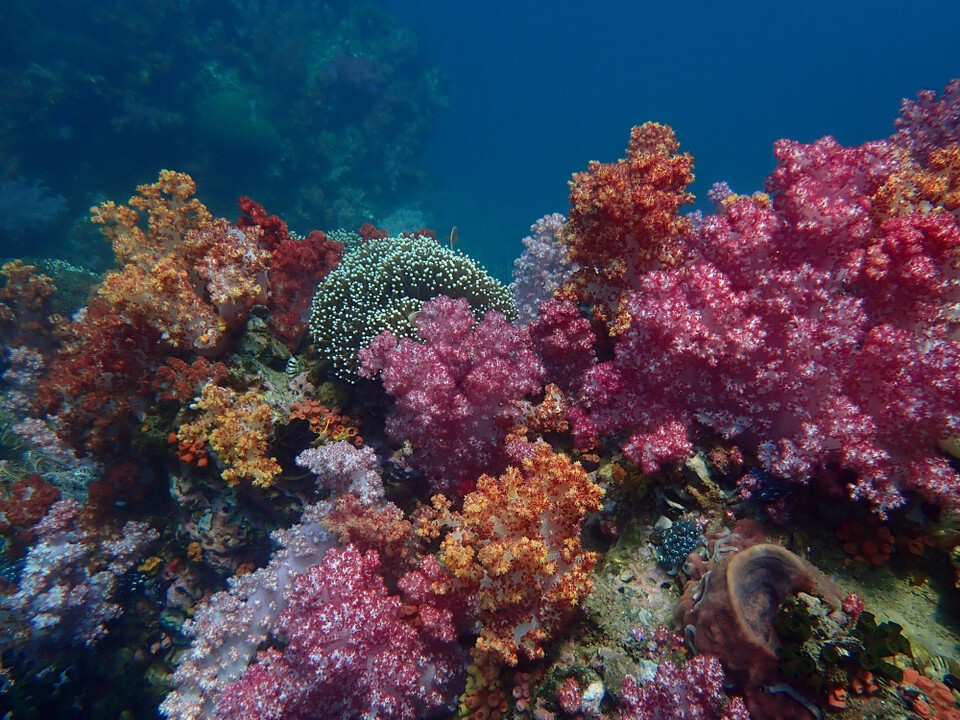
Subtropical waters around Taiwan, southern Japan, and Southeast Asia are naturally rich in coral diversity. That means there is also more to lose. Bleaching in waters near Korea is not something that can be dismissed as a fire across the river.
Scientists are not standing idle. In Florida, the U.S., efforts are underway to evacuate sensitive corals to deeper, cooler waters or to temperature-controlled laboratories. Research is also ongoing to identify heat-resistant coral strains for use in restoration. But experts say evacuation and restoration only buy time; they are not fundamental solutions.
Korea is not free from the coral problem either. Gwangyang? Wait, no. Jeju’s coastal waters are home to soft coral communities, and as subtropical conditions advance more quickly, corals are also moving north into the southern coast. Because waters around the Korean Peninsula are warming faster than the global average, the region also faces bleaching risks. It has been pointed out that this is not just a remote worry for coastal economies dependent on fishing and tourism.
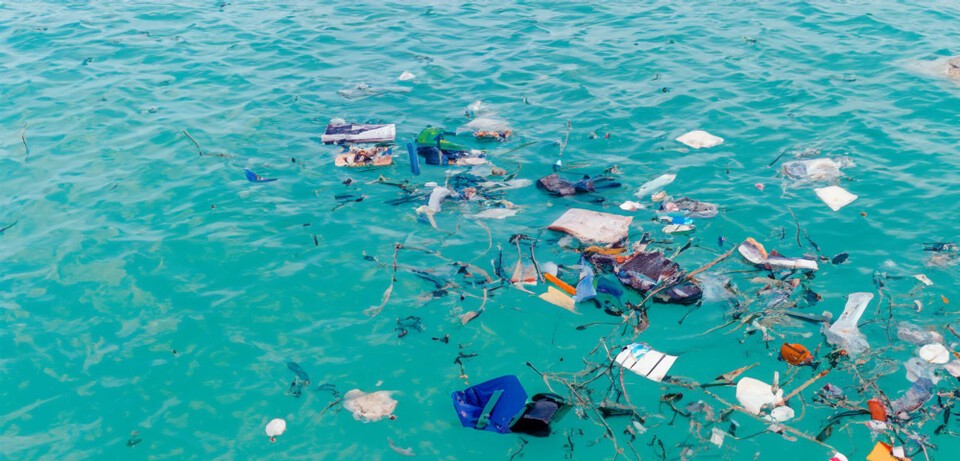
In the end, the researchers conclude that the answer is to reduce carbon emissions. No matter how well corals adapt to heat, they cannot endure if the ocean keeps getting hotter. Experts also stress expanding marine protected areas to give corals room to recover. The reason is that easing other stresses, such as fishing and pollution, can help corals better withstand heat. It may not slow warming itself, but it can buy time.
“Millions of people and many countries depend on healthy coral reefs for their livelihoods and food,” Pershing stressed. “If emissions are not cut right away, the coral reefs we know will disappear.” Even if corals still retain some ability to adapt, the pace of ocean warming is eating away at that margin every year, the researchers warn. How much time remains for the ocean depends on how quickly humans cut greenhouse gases.