
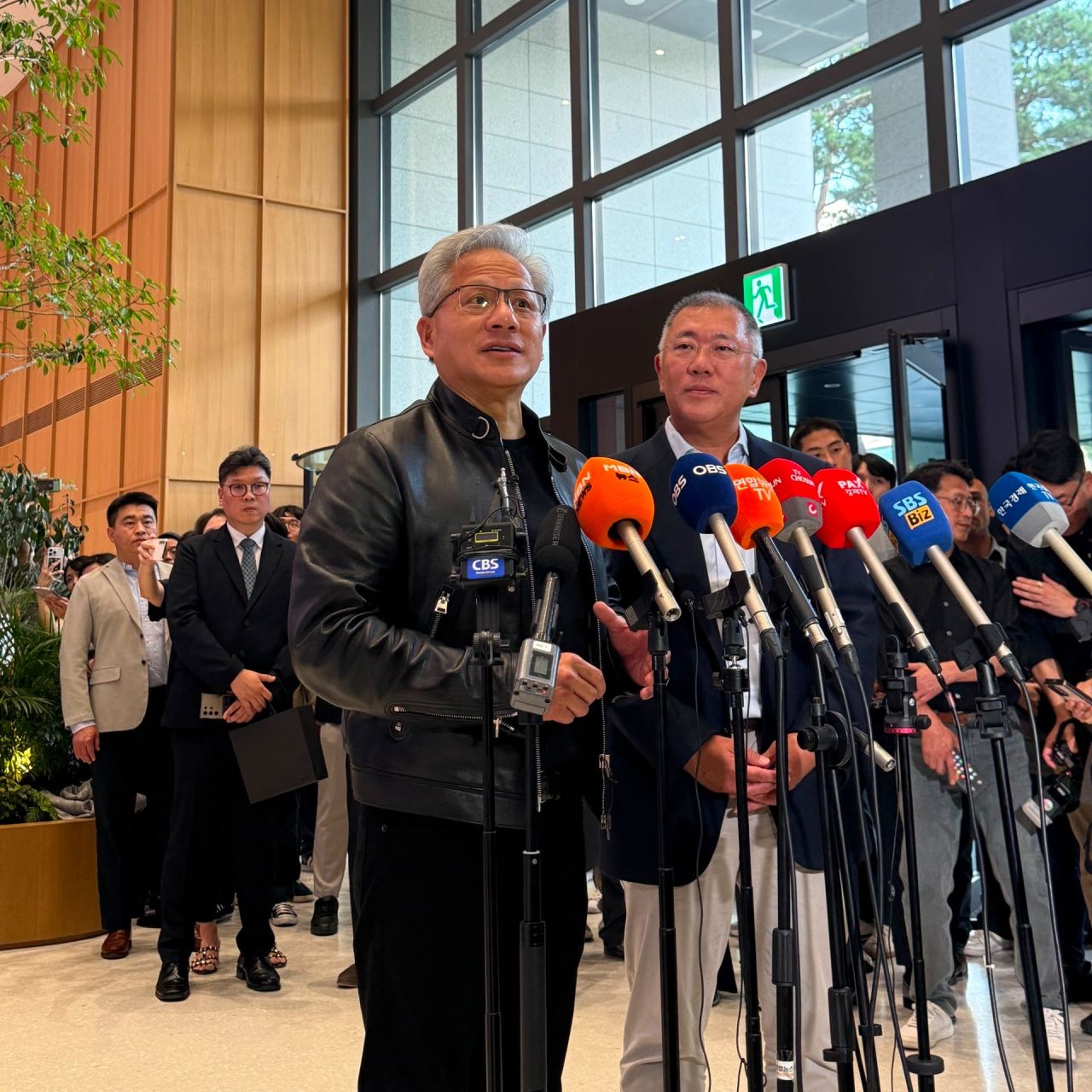
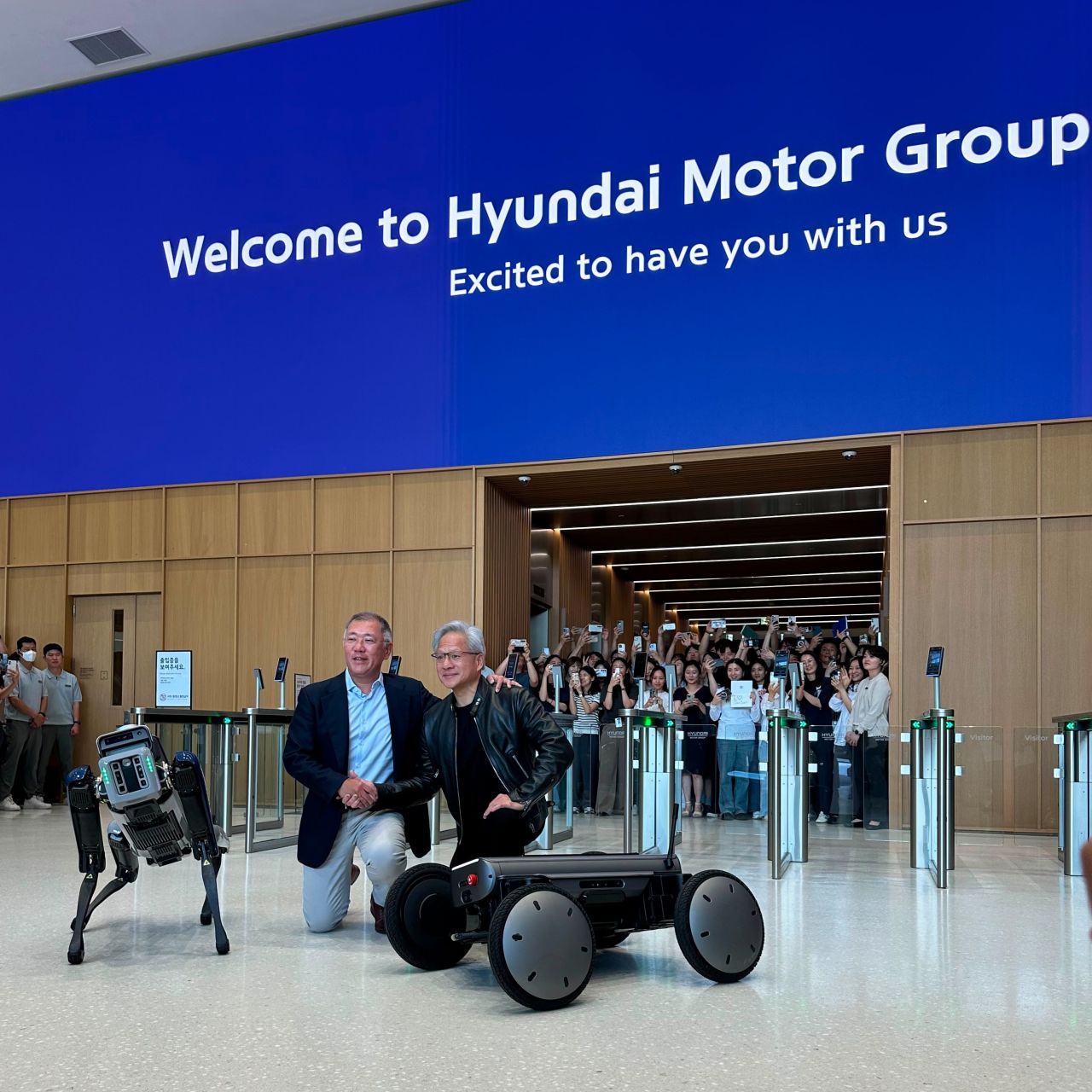
NVIDIA is reportedly considering building an “AI factory” in Korea. On June 8, Jensen Huang, CEO of NVIDIA, met with Hyundai Motor Group Chairman Euisun Chung and said he was willing to take part in the construction of a data center in Saemangeum, North Jeolla Province. At that meeting, he referred to Saemangeum as “Korea’s AI Valley,” likening it to Silicon Valley in the United States.
The meeting took place at Hyundai Motor Group’s headquarters in Yangjae-dong, Seoul. It was arranged in the form of Chairman Chung proposing participation in the Saemangeum project, with CEO Huang responding positively.
Earlier, in February, Hyundai Motor Group signed an agreement with the government and Jeonbuk Special Self-Governing Province to invest 9 trillion won and build robotics, AI, hydrogen, and solar power facilities on a roughly 340,000-pyeong site in Saemangeum. If NVIDIA joins the project, the site will become a key foundation supporting autonomous driving and robotics research.
The focus of attention comes down to one question: why did NVIDIA choose Saemangeum instead of the Seoul metropolitan area, where companies and talent are concentrated? The answer lies in both the concept of the “AI factory” and the realities of Korea’s power grid.
An AI production base beyond a data center
The AI factory Huang described is different from the data centers people usually imagine. Traditional data centers are closer to warehouses that store and transmit information. An AI factory goes one step further and functions as a plant that produces AI itself.
To put it in analogy, just as a car factory assembles parts into finished vehicles, an AI factory takes in vast amounts of industrial data and processes it into AI models for autonomous driving, robotics, and communications. That is the context behind Huang’s comment that “just as cars are produced in factories, AI must be produced in AI factories.”
Another phrase he emphasized carries the same meaning: “Humans need cloud data centers, and robots need AI factories.” In other words, for robots to make their own judgments, there must be a factory that continuously trains the AI serving as their brain.
This kind of facility consumes enormous amounts of electricity. Tens of thousands of AI chips run 24 hours a day, generating heat. Whether power can be supplied stably and as cheaply as possible becomes the key factor in determining location. This is where the Seoul metropolitan area runs into limits.
Why power saturation in the capital region pushed Saemangeum forward
More than 60 percent of Korea’s data centers are concentrated in the capital region, because companies, talent, and communications networks are all nearby.
The problem is electricity. Contracted power requested from Korea Electric Power Corporation by data centers surged from around 60 megawatts before 2020 to 3,091 megawatts in 2023, more than a 50-fold increase in just three years. The transmission and distribution network in the capital region has already reached its limits.
KEPCO is advising that it is difficult to accept new large-scale facilities in the capital region in the near term. In June 2024, the government enforced the Special Act on Promotion of Distributed Energy, requiring data centers that use more than 10 MW of electricity to undergo advance assessments of their impact on the power grid. In effect, this has put up barriers to new facilities in the capital region.
Concentration in the capital region is also a safety issue. A representative example is the 2022 fire at the Pangyo data center, which disrupted Kakao’s services. Infrastructure concentrated in one place is vulnerable to disasters. Behind the government’s push to disperse data centers to regional areas are two factors: power shortages and risk diversification.
Saemangeum fills that gap precisely. It has vast land at a low cost. The reclaimed land, with a total area of 409 square kilometers, offers enough flat terrain for large-scale facilities.
Electricity supply is also supported. By 2030, a 7 GW-scale renewable energy complex will be built in Saemangeum. This makes it possible to use power generated on site through solar and wind in a so-called “local production, local consumption” structure.
It is also favorable for achieving RE100, the goal of sourcing all electricity used by businesses from renewable energy. Global companies are increasingly strict about renewable power procurement because of carbon regulations. The Honam region also produces far more electricity than it consumes, meaning power is left over there. If large loads such as data centers absorb that excess electricity, it can also ease strain on the grid.
The conditions that will determine the success of the “AI Valley” vision
Huang’s use of the term “AI Valley” for Saemangeum is symbolic. If Silicon Valley is a place where semiconductor and software companies gathered to build an ecosystem, Saemangeum is aiming to become a hub where AI semiconductors, data centers, robotics, and autonomous driving all converge. A long-stalled reclamation project is now turning toward becoming a testing ground for future industries.
This meeting was not a one-off collaboration. On the same day, NVIDIA also unveiled AI factory cooperation plans with five Korean companies: SK, LG, Hyundai Motor Group, Naver, and Doosan.
These companies will both supply NVIDIA with core technologies such as semiconductors and memory, and serve as users of the completed AI factories. It is a structure that links supply and demand as a single package.
There are clear hurdles before this vision becomes reality. Even if renewable energy is abundant, a transmission network must be in place to deliver that power safely and stably to the data centers.
Solar and wind power, whose output fluctuates, cannot by themselves sustain data centers that must never stop even for a moment. Large-scale storage systems and backup power must be designed together.
Talent and living conditions are also challenges. Data centers and AI research require highly skilled workers, but compared with the capital region, it is harder for regional areas to attract such talent. Experts say that rather than simply relocating leased data centers, companies should move their research and headquarters functions as well, creating an ecosystem where people gather.
Regulatory predictability must also be ensured. The power grid impact assessment, which can determine the scale of investment, is still being run as a pilot program without formal notification, creating uncertainty for companies.
Only when the three pillars of grid infrastructure, talent, and institutions are aligned will Saemangeum AI Valley become more than a declaration and take on real substance. NVIDIA’s willingness to participate is only the starting line; filling in what follows will ultimately be Korea’s responsibility.