
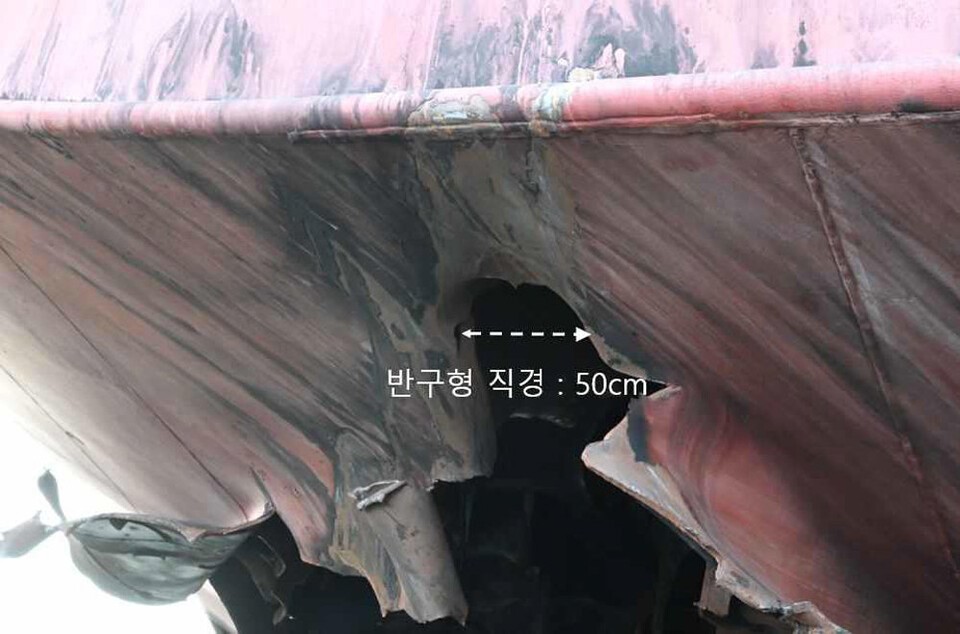
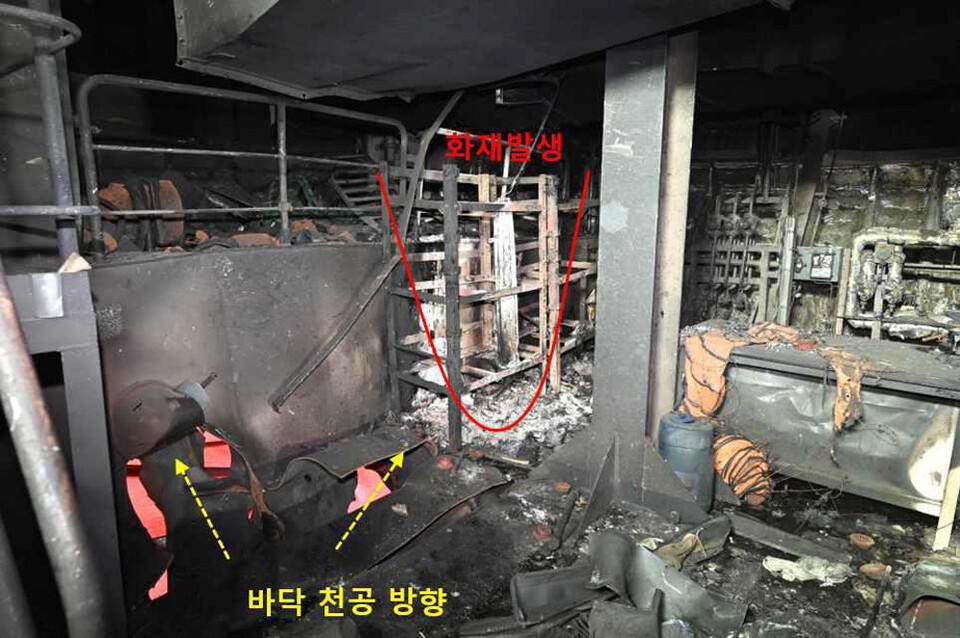
The cause of the explosion aboard the HMM Namuho, which burned in the middle of the Strait of Hormuz, has been concluded to be a strike by an unidentified flying object.
That was the finding announced on the 10th by a joint investigation team from the Korean government. Iran’s position of denying involvement is now entering a stage where it can no longer withstand blanket denials.
Although the responsible party has not been identified, circumstances strongly point in one direction, given that Iran has blocked the Strait of Hormuz since the start of the war with the United States and Israel and has repeatedly attacked merchant ships from third countries.
Iran has denied any connection to the incident since immediately after it occurred. However, the contradictions among the voices of the embassy, state media, and parliament, as well as the weight of those denials, only deepened the suspicion. With the Korean government’s announcement, attention in diplomatic circles has turned to what card Tehran will play next.
◆Embassy, state media, parliament… same incident, different voices
Iran’s first official response came two days after the accident, on the 6th. In a statement, the Iranian Embassy in Seoul said, “The Embassy of the Islamic Republic of Iran firmly rejects and strongly denies all claims that the Iranian military was involved in the incident in which a Korean ship was damaged in the Strait of Hormuz.”
Although the statement was forceful, its significance was diminished by the fact that it came from an overseas embassy rather than the foreign ministry. In diplomatic practice, a serious allegation involving military involvement is typically addressed directly by the foreign ministry of the country concerned. A denial issued under the embassy’s name can be read as a formal distancing tactic.
On the same day, a different tone appeared in an article published by Iran’s state-run Press TV. A column on its “Strategic Analysis Desk” said, “Targeting a Korean vessel that violated the maritime rules newly defined by Iran was a clear signal that Iran intends to defend its sovereignty through physical action.”
While it did not directly name the Iranian military, the phrase “physical action” strongly implied that an attack had in fact taken place. It directly conflicted with the embassy’s statement.
As the controversy grew, Ebrahim Azizi, chair of Iran’s parliamentary National Security and Foreign Policy Committee, stepped in the next day to calm the situation.
In a video meeting with Kim Seok-ki, chair of South Korea’s National Assembly Foreign Affairs and Unification Committee, Azizi stressed, “The Iranian military did not attack,” and added, “If Iran had truly targeted and attacked a Korean ship, the government or military would have said so openly.” He continued, “The report by an Iranian media outlet is not the official position of the Iranian government,” and “It is not true. Please believe us.”
The problem came after that. In a report by Iran’s state-run IRNA news agency on the same call, Azizi’s denial regarding the Namuho was omitted entirely.
IRNA gave prominent coverage only to Azizi’s assessment that “South Korea’s decision not to take part in military operations in the Strait of Hormuz was a wise move.” To South Korea, it was a denial; to the Iranian public, a different message was being sent.
◆The “grammar of denial” shown by the Turkish case
A similar pattern to the Namuho incident has already played out across the Middle East. Over the roughly two months since the war between the United States and Israel and Iran began, Iran has carried out retaliatory airstrikes targeting nearby U.S. military bases in neighboring countries. In the process, missiles repeatedly landed in the territory of Turkey, a NATO member.
Each time, Turkey’s Defense Ministry and NATO clearly stated that they had intercepted missiles fired from Iran toward Turkey. Iran’s response was consistent: it repeatedly and steadfastly denied any involvement in the missile attacks.
This pattern of denial is not merely diplomatic rhetoric. It reflects a strategic calculation to narrow the scope of responsibility by separating intended military targets from unintended collateral damage.
For Iran, which frames the blockade of the Strait of Hormuz and attacks on merchant ships as “defense of sovereignty,” acknowledging harm to vessels from third countries would undermine its justification.
The Namuho case is no exception to that same logic. The flow of events—Press TV using language that appeared to suggest an attack, followed by a parliamentary figure immediately conveying a denial message to the Korean side—fits the structure of dividing messages for domestic audiences and for foreign audiences.
◆There are still 26 vessels left
The starting point of the incident also needs to be revisited. On the 4th (local time), an explosion and fire broke out aboard the Namuho, which was anchored in waters near the United Arab Emirates inside the Strait of Hormuz. There were no casualties. However, it was the first case in which a Korean ship was damaged in the conflict.
The government towed the Namuho, which was unable to sail under its own power, to Dubai Port in the UAE on the 7th. A three-day investigation into the cause of the fire followed.
A government investigation team made up of three investigators from the Korea Maritime Safety Tribunal under the Ministry of Oceans and Fisheries and four forensic experts from the National Fire Agency secured the Namuho’s voyage data recorder (VDR) and closed-circuit television (CCTV) footage. They also interviewed crew members and conducted on-site forensic examinations.
U.S. President Donald Trump claimed on the 5th (local time) that the Namuho, while sailing alone without joining the U.S.-led “liberation project,” was attacked by Iran.
Since Iran effectively blocked the Strait of Hormuz starting March 1 in response to U.S. and Israeli attacks, 26 Korean-operated vessels, including the Namuho, have been anchored in the area. The fate of the other 25 ships is directly and indirectly tied to the way this case is handled.