
The cryptocurrency mining rigs are halting as servers are moving in. The computing rooms of Bitcoin mining companies are quietly transforming. In the first quarter, the hash rate of the Bitcoin network, representing total computational power, fell by 4% compared to the same period last year—a first in six years. This suggests that miners are departing, but more accurately, they are changing direction.
The ‘Q1 2026 Bitcoin Mining Report’ recently released by digital asset manager CoinShares provides numerical insights into the structural shift. The weighted average cash cost for public mining companies to produce one Bitcoin rose to approximately $79,995 by Q4 last year. Meanwhile, Bitcoin is trading between $67,000 and $70,000, meaning it is a losing deal to keep mining.
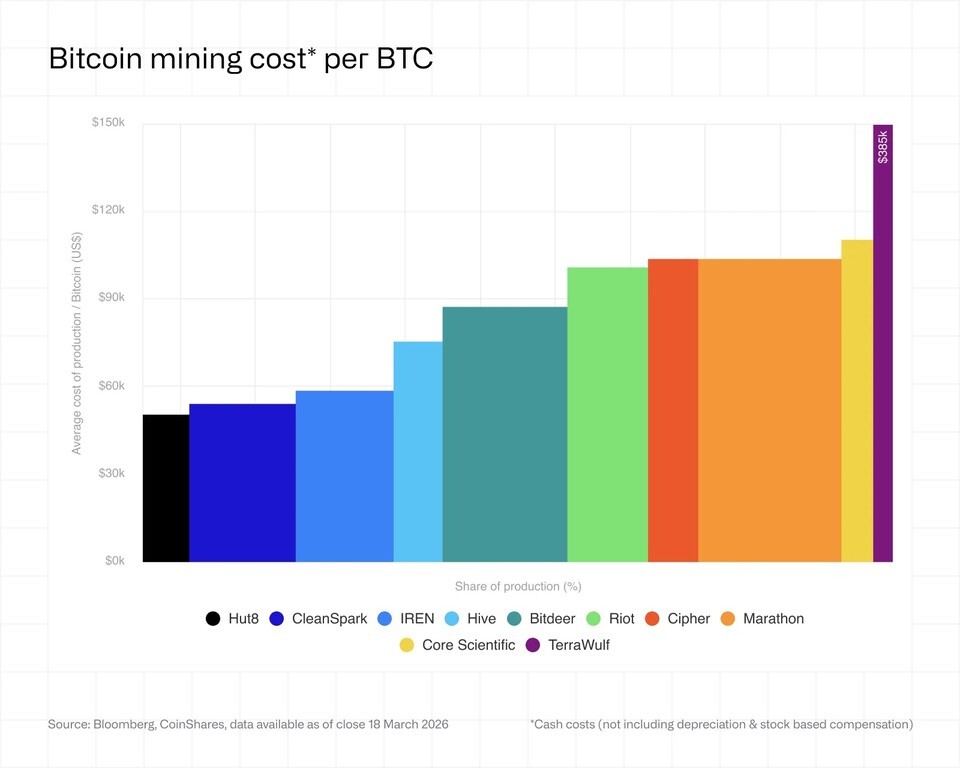
The complex equation of collapsing profitability is held by layered structural factors. Starting point is the April 2024 halving. As block rewards halved from 6.25BTC to 3.125BTC, the number of Bitcoins earned with the same power and computational resources dropped by half overnight, doubling mining costs effectively.
With the hash price—a measure of mining profitability—plummeting, the industry-wide profitability has swiftly deteriorated. The halving resulted in halved mining rewards, compounded by rising energy costs, leading to a significant reduction in potential earnings from the same computational resources. Some outdated equipment has dropped below the break-even point, applying structural reform pressure on the mining industry.
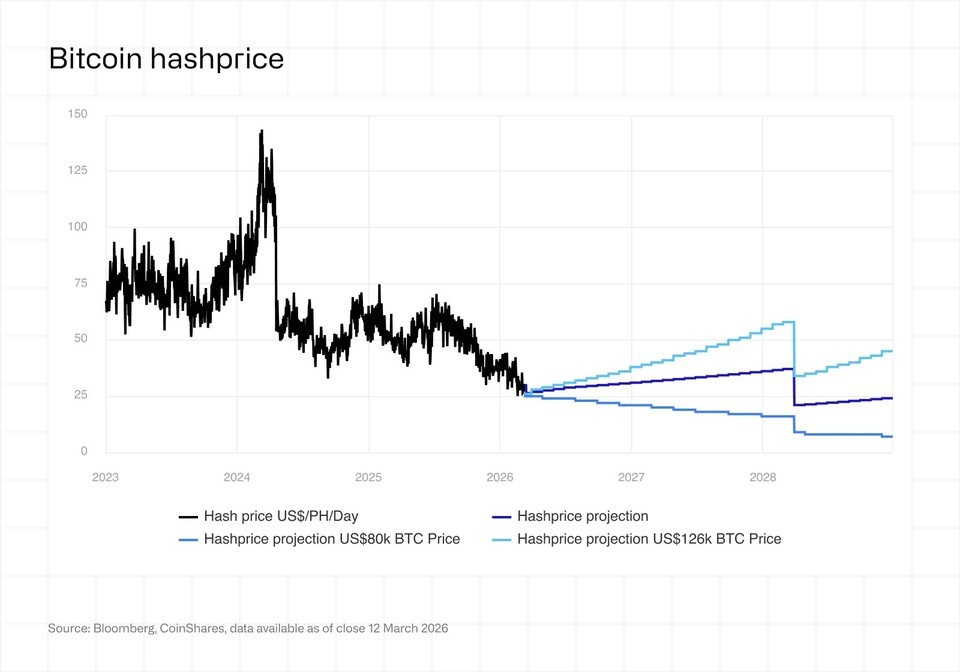
Bitcoin prices, which surged to about $124,500 last October, have since plummeted over 30%. ‘Hash price’, indicating earnings per hash power per day, fell from $63 (PH/s/day) in July last year to around $28–30 by early March this year—the lowest since 2021. CoinShares estimates that 15–20% of the entire mining network’s equipment, considered outdated, is currently operating below its break-even point.
Rising power costs also add to the woes. According to a digital mining industry report from the University of Cambridge, around 53% of mining companies use renewable energy. Despite this, the overall price pressures in the energy market have increased mining companies’ cost burdens, varying based on their grid connection methods and contract structures.
Under such circumstances, public mining companies have pivoted towards AI and high-performance computing (HPC). CoinShares’ report states that the cumulative size of AI·HPC contracts they have committed to already exceeds $70 billion. Notable deals include a 12-year $10.2 billion contract between Core Scientific and CoreWeave, and Hut 8’s $7 billion AI data center leasing agreement.
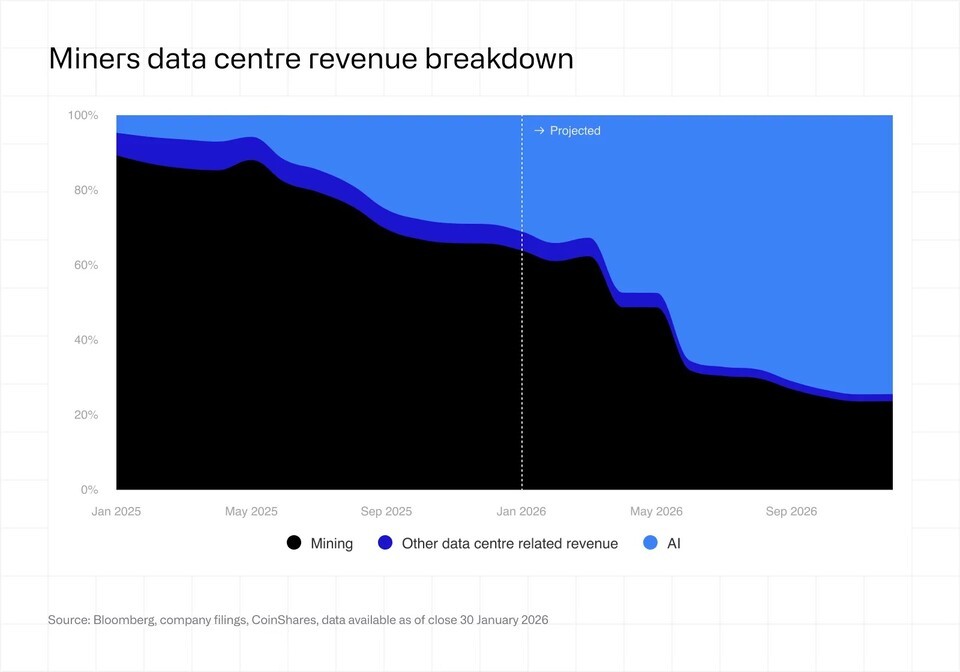
The capital market has already responded to this trend. Mining companies securing HPC contracts have a price-to-earnings ratio (EV/NTM sales) of 12.3 times, while pure mining companies fare at 5.9 times—over double the valuation gap within the same industry.
Some companies are even taking on debt to finance the transition. Mining firm Iris Energy (IREN) holds convertible bonds worth $3.7 billion. The cumulative volume sold from the BTC treasury by publicly listed mining companies exceeds 15,000 BTC. CoinShares predicts that by the end of this year, the AI revenue share of listed mining companies could rise from the current 30% to 70%.
Not all mining companies are moving in the same direction. Some continue to focus on Bitcoin mining by utilizing nearly cost-free energy sources, such as surplus renewable energy or flare gas from oil fields. CoinShares also implies that the transition to AI might not be permanent. Those returning when mining profitability improves aren’t unlikely.
The example of Hive Digital Technologies, a data center developer, stands out. The company designed its facilities with a transition in mind from the outset. Initially, it begins with adaptable power infrastructure equipped with dual power systems and renewable energy accessibility, progressively upgrading to AI-capable data centers.
Frank Holmes, chairman of Hive, stated that this structure allows bypassing considerable aspects of land acquisition, zoning changes, and various licensing procedures. In the reality where developing new data centers takes years, this detour provides tangible competitiveness.
Existing mining companies already equipped with massive power infrastructures like Hive’s 300MW project in Paraguay are well-positioned to sidestep the three major bottlenecks of logistics, supply chain, and power security that AI data center development faces.
Companies possessing hybrid infrastructures capable of flexibly toggling between mining and AI workloads, or simultaneously operating both depending on profitability, are likely to survive this industry overhaul.