
The investment plans of major tech companies, such as Microsoft, Amazon, Google, and Meta, which aimed to spend over 635 trillion won on AI infrastructure this year, are facing a red light due to the rise in international oil prices triggered by the Middle East war. AI data centers consume an immense amount of electricity, and a rise in energy costs can shake the very foundation of their operations. The chief research officer at S&P Global warns that if energy prices weigh down on corporates’ performance, the entire stock market may experience significant fluctuations.
Just seven years ago, the AI investments of big tech companies were merely a fraction compared to now. Back in 2019, the amount spent by Microsoft, Amazon, Alphabet, and Meta on AI-related infrastructure was around 59 billion USD (about 87 trillion won). This figure ballooned to 470 billion USD (about 635 trillion won) in just seven years, almost an eightfold increase.
Understanding where this money is spent gives an added sense of scale. To run AI, a vast quantity of semiconductors and the server computers housing them are needed. Data centers, massive buildings storing tens of thousands of these servers, are being built by big tech companies globally, spending hundreds of trillions of won in the process.
This investment competition has also fueled the stock market. As AI investments increase, semiconductor companies see enhanced performance, leading to a rise in related stock prices and lifting the overall market upwards. The global stock index, which reached its peak in 2025, was built on such expectations.
The war in the Middle East, particularly, the conflict with Iran, has disrupted this flow. Wars can destabilize energy supplies, causing oil prices to rise, which is problematic given AI data centers’ heavy reliance on electricity.
AI processing servers operate around the clock, consuming electricity equivalent to that of a medium-sized city when thousands of servers function simultaneously. Soaring electricity costs directly elevate the operational costs of data centers. If energy prices rise by 30%, big techs would incur several trillion won in additional operating expenses.
S&P Global’s head of research, Melissa Otto, stated in a March 31 interview in Tokyo that a 30% rise in energy prices would impact both consumers and companies. She added that if oil prices remain high as they are, big tech companies might revise their investment plans within one to two quarters, potentially leading to significant market corrections.
Similar concerns were echoed at the ‘CERAWeek 2026’ energy industry conference held in Houston, Texas, in the third week of March. Top executives from the oil industry unanimously stated that current oil prices do not fully reflect supply risks, suggesting that oil prices could rise further.
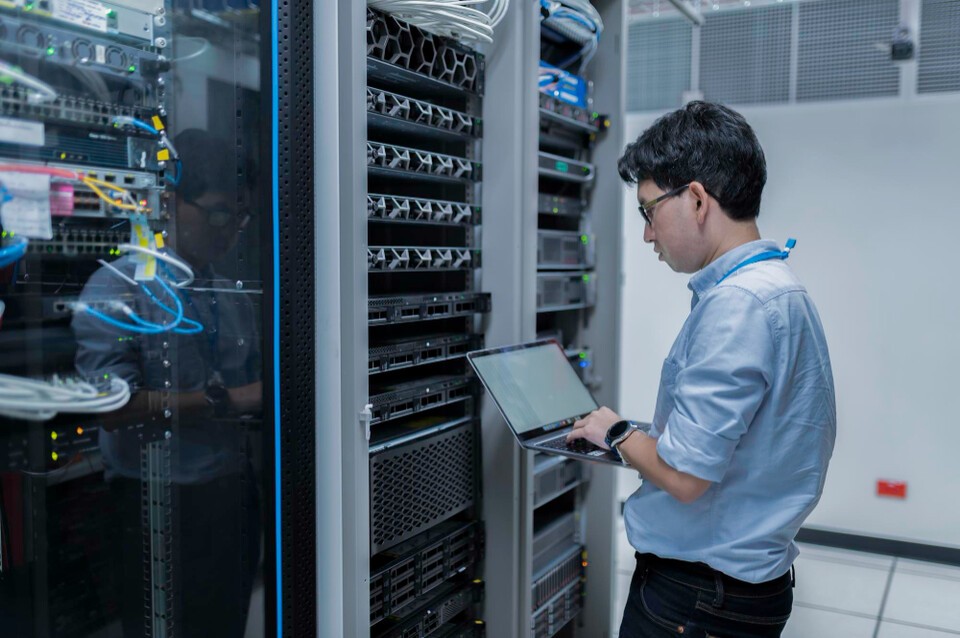
The U.S., having its own energy production base, might maintain relative stability in data center operations despite global energy uncertainties. (Photo=Freepik) Nevertheless, regional differences exist. The United States produces and exports natural gas, suggesting its domestic data centers may not immediately bear the brunt of energy price fluctuations.
Paul Kedrosky, a researcher at MIT Digital Economy Research Institute, noted that US data centers might not experience immediate cost spikes. However, he emphasized, other regions’ AI tasks could potentially shift to the U.S., but the existing supply queues are saturated, risking a potential system standstill.
Asia faces a more direct impact. Countries like Japan and South Korea, heavily dependent on Middle Eastern energy, greatly rely on oil and gas transported through the Strait of Hormuz. Analyses suggest that helium gas, crucial for semiconductor production in data centers, is also facing supply disruptions owing to potential blockades of the strait.
Moreover, reports indicate some data centers in the Middle East have suffered direct damage due to conflicts.
The semiconductor company Nvidia, perceived as the biggest beneficiary of the AI investment boom, is also affected. S&P Global analysis shows Nvidia’s stock price uptrend has weakened this year due to concerns that sustained investment levels might be unfeasible and overinflated market expectations.
Some companies are reportedly considering delaying planned AI infrastructure investments to 2027-2028.
Data centers might seem distant from war zones, but without electricity, servers stop, halting AI operations. The echoes of war in the Middle East are rewriting Silicon Valley’s blueprints.