
What happens if helium disappears from inside a semiconductor factory? Production lines stop. The manufacturing of chips that power smartphones, electric vehicles, and data center servers comes to a halt. That gas, often used to fill party balloons, holds the lifeblood of advanced industries.
Helium is a colorless, odorless element and the second lightest in the universe. It is an inert gas that does not undergo chemical reactions, and with a boiling point of minus 269 degrees Celsius, it is lower than any substance on Earth. These two characteristics play a crucial role in semiconductor processes.
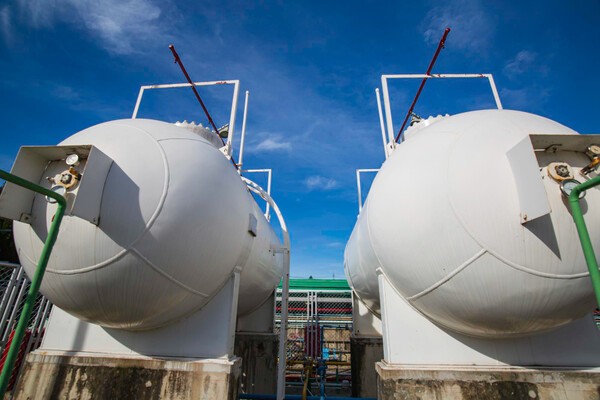
Semiconductor circuits are etched at a nanometer (nm) scale, which is several thousand times smaller than the thickness of a human hair. In this fine process, impurities lead to defects. Helium is responsible for thoroughly removing residual gases inside process chambers. Its small and lightweight atoms have a rapid diffusion rate, allowing them to penetrate even the tiniest gaps which cannot be cleaned by other gases.
In the wafer cooling process as well, helium is indispensable. During the exposure process where circuits are etched, if the wafer temperature rises, the circuit pattern becomes distorted. Helium rapidly reduces this temperature, maintaining precision. It is also used in laser cutting and etching processes.
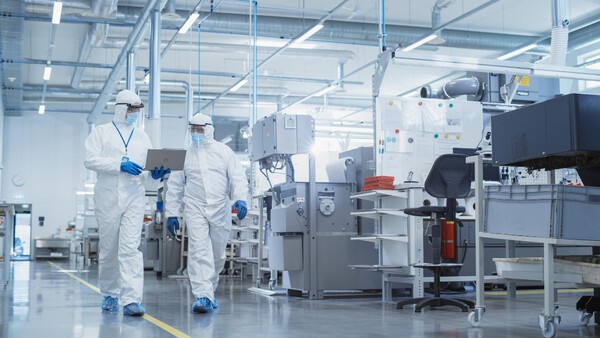
Phil Konbulus, a semiconductor industry consultant, stated, “Alternatives are already used where helium can be replaced.” This means that there are virtually no substitutes where helium is used in semiconductor processes.
The Semiconductor Industry Association (SIA) of America has also officially stated, “At the current level of technology, there is no substitute for ultra-high-purity helium.” If the supply of helium is cut, the process slows down or, in the worst-case scenario, the line stops.
Helium can be found in Earth’s atmosphere, but the concentration is too low to economically extract it. Industrial helium is mostly obtained during the processing of natural gas. It is separated and secured from natural gas during liquefaction (LNG) at temperatures below minus 162 degrees Celsius, where helium constitutes 0.1 to 0.5% of the gas mixture.
The core issue is that helium is a ‘by-product’ of LNG. Helium is not produced directly; it emerges from the production of LNG. Hence, if LNG production stops, helium supply automatically ceases as well.
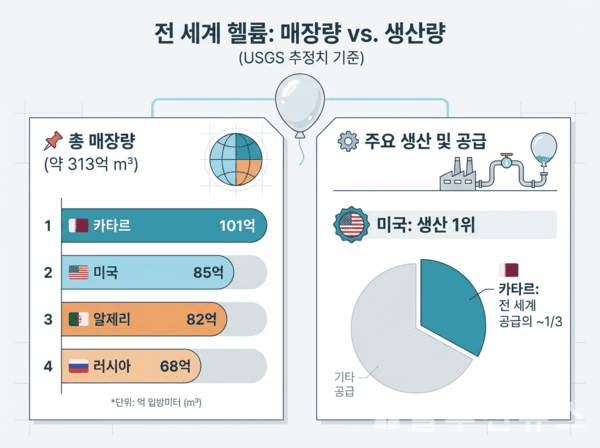
According to the report published earlier this year by the United States Geological Survey (USGS), global helium reserves are estimated to be about 31.3 billion cubic meters. Qatar has the largest reserves at 10.1 billion cubic meters, followed by the United States with 8.5 billion, Russia with 6.8 billion, and Algeria with 8.2 billion cubic meters. Based on actual production last year, the United States ranked first, and Qatar accounted for about one-third of the global supply.
The attack on Qatar’s LNG facilities by Iran dealt a direct blow to the helium supply chain. Qatar Energy, Qatar’s state-owned energy company, declared ‘force majeure’ earlier this month, indicating that existing contract fulfillment was impossible. The damage to the Ras Laffan plant, which is a key LNG processing facility in Qatar, led to a cascading halt in helium production. With Iran currently blocking naval passage through the Strait of Hormuz, even if production resumes, exports are blocked, leaving a dual blockade situation.
According to the Korea International Trade Association, 64.7% of the helium imported by Korea last year came from Qatar. Of the total 2,116 tons imported, 1,375 tons came from Qatar. Regarding high-purity helium used in semiconductor processes, the industry estimates Qatar’s dependence at nearly 80%.
Samsung Electronics and SK Hynix currently have inventory stockpiled for several months. Officially, the industry states that short-term production will not be affected. However, if supply disruptions persist beyond six weeks, production disruptions may arise. The international credit rating agency Fitch analyzed that if severe supply shortages occur, helium spot prices could surge by up to 200%. Spot prices have already risen by 35 to 50% over the past week.
Samsung Electronics has already begun its response. Since April last year, it has implemented its own Helium Reuse System (HeRS) in some production lines. This system recaptures and purifies helium emitted after use, then reintegrates it into the process. Samsung Electronics estimated that the early operation results could reduce helium usage by approximately 4.7 tons annually. When this system is expanded to all production lines, it is anticipated that approximately 18.6% of annual helium consumption can be reduced.
The industry is also hastily diversifying its supply sources. Apart from Qatar, the significant suppliers are the United States (28%) and Russia (6.2%). While the United States is prioritized as an alternative, global industrial gas companies like Linde, Air Products, and Air Liquide are also reviewing the reorganization of supply sources.
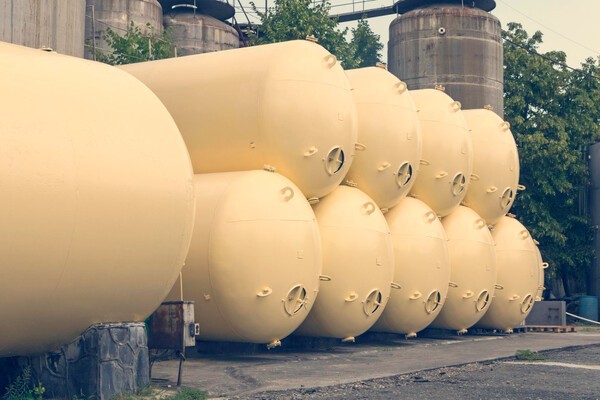
However, given the structural characteristic that helium supply is linked to LNG production, finding a new supply source in the short term is not easy. It takes at least several months to establish new helium production facilities, and a substantial portion of the volume is already tied up in long-term supply contracts. This incident once again highlights how vulnerable the semiconductor supply chain’s weakest link is to an energy conflict.