Apple has joined forces with Google to enhance its artificial intelligence (AI) technology.
In response to criticism that Siri, one of iPhone’s emblematic features, was lagging behind competitors, Apple made the decision to incorporate external technology.
The two companies recently made a joint statement announcing, “After careful consideration, we determined that Google’s technology is most suitable for advancing Apple’s AI systems.” As part of this collaboration, Apple plans to incorporate Google’s latest AI model ‘Gemini’ and Google Cloud technology into its system.
The financial terms of the collaboration have not been disclosed, but foreign media speculate that Apple will pay approximately $1 billion (about 1.3 trillion won) to utilize Google’s AI technology. The contract is non-exclusive, and Apple is also open to collaborating with other AI companies in the future.
For Apple, it is rare to collaborate with an external company like Google. Historically, Apple has designed both hardware and software internally to keep all aspects under complete control. However, with the rapid advancement of AI technology, it seems Apple has determined that internal development alone may not be enough to keep pace with market changes.
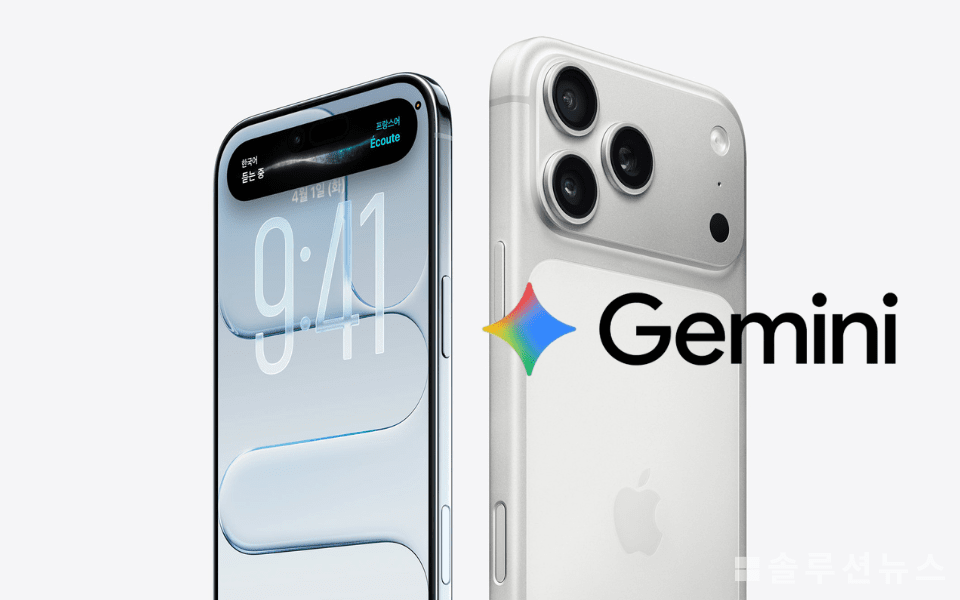
Initially installed on the iPhone in 2011, Siri quickly became a leading smart phone voice assistant. However, over time, it lagged in functional enhancements while competitors such as Samsung’s Bixby, Google Assistant, Amazon Alexa, and OpenAI’s ChatGPT rapidly advanced.
Users have criticized Siri for its limited responses and inability to understand context. For instance, when asked “Remind me to buy coffee before the meeting at 8 AM tomorrow,” Siri would merely set an alarm, unable to connect with the meeting schedule or location information.
In contrast, competitor products seamlessly use various information such as schedule, location, and email to provide more natural conversations. The gap has been recognized as a problem internally at Apple, leading to their decision to integrate Google’s technology and rebuild the core engine of Siri.
The ‘Gemini’ technology that Apple decided to adopt is a large-scale AI model that understands human language and learns independently, essentially acting like the brain for Siri.
Gemini can answer questions, summarize text, and even understand images or videos. Google has applied this to its own services such as YouTube, Gmail, and Chrome. Using this technology, Apple plans to make Siri better at understanding user speech and responding appropriately to context.
For example, if a user says, “Find the photo mom sent me last week,” Siri will evolve from merely opening the Photos app to automatically recognizing people and dates within photos to deliver results.
However, Apple plans to maintain its privacy policy even amidst collaboration. Most AI operations will be conducted on a user’s device, such as the iPhone, instead of over the internet cloud. By not sending data to external servers, Apple maintains a ‘closed system’ that it manages itself.
Apple is expected to unveil the new Siri this spring. A company spokesperson told TechCrunch, the tech specialist media, “We plan to showcase a major upgrade to Siri this year.”
The new Siri is being designed to go beyond executing simple commands by learning user preferences and offering proactive suggestions appropriately.
For example, understanding the music a user listens to on their commute or recognizing patterns in their schedule, Siri might suggest, “The commute is busy today, leave 10 minutes earlier than usual.”
AI functionality is set to expand beyond Apple’s smartphones to key product lines including MacBooks and iPads. Industry experts state, “Through this partnership, Apple has decisively entered the AI phone competition.”
Currently embroiled in several antitrust lawsuits in the United States, Google faces complex situations. In August 2024, a U.S. federal court ruled Google had paid immense sums to secure its dominant position in the search market with companies like Apple, and deemed this unlawful.
According to disclosed data during the trial, Google paid about $38 billion to Apple between 2021 and 2022 to secure default search engine positions on iPhones and Safari browsers.
In December 2025, Judge Amit Mehta ordered Google that it cannot enter into exclusive agreements lasting over a year.
The AI partnership with Apple is arranged under ‘non-exclusive terms’ considering these regulatory conditions. Both companies emphasized that this collaboration is unrelated to search services and limits itself to the AI technology sector.
This collaboration puts Apple’s strategy of balancing innovation with trust back on trial.
Apple has long maintained the philosophy that “the core of technology is privacy protection.” All data processing occurs within the device, without collecting or selling iPhone user data externally.
Experts evaluate this collaboration as “an experiment by Apple to maintain its own philosophy while newly introducing external AI technologies.” Utilizing Google’s technology within the framework of Apple’s security system distinguishes it from other AI companies.
The AI market is rapidly growing. Samsung Electronics has already unveiled new smartphones equipped with “Galaxy AI,” and Google and Microsoft are expanding their conversational AI ecosystems.
The analysis reveals that Apple, despite being late, is preparing a strong countermeasure for AI competition.