
The AI war now extends to “soup.”
The artificial intelligence (AI) supremacy battle in Silicon Valley has now reached the dining table.
Amid intense competition to secure talent between OpenAI and Meta, it has been revealed that Meta’s CEO, Mark Zuckerberg, personally cooked soup and offered it to OpenAI researchers.
OpenAI’s Chief Research Officer (CRO), Mark Chen, recently spoke with tech podcast host Ashlee Vance and said, “Meta tried to recruit half of my direct subordinate researchers. Zuckerberg personally cooked the soup and even delivered it himself.” He added, “At first, I thought it was a joke, but it was real.”
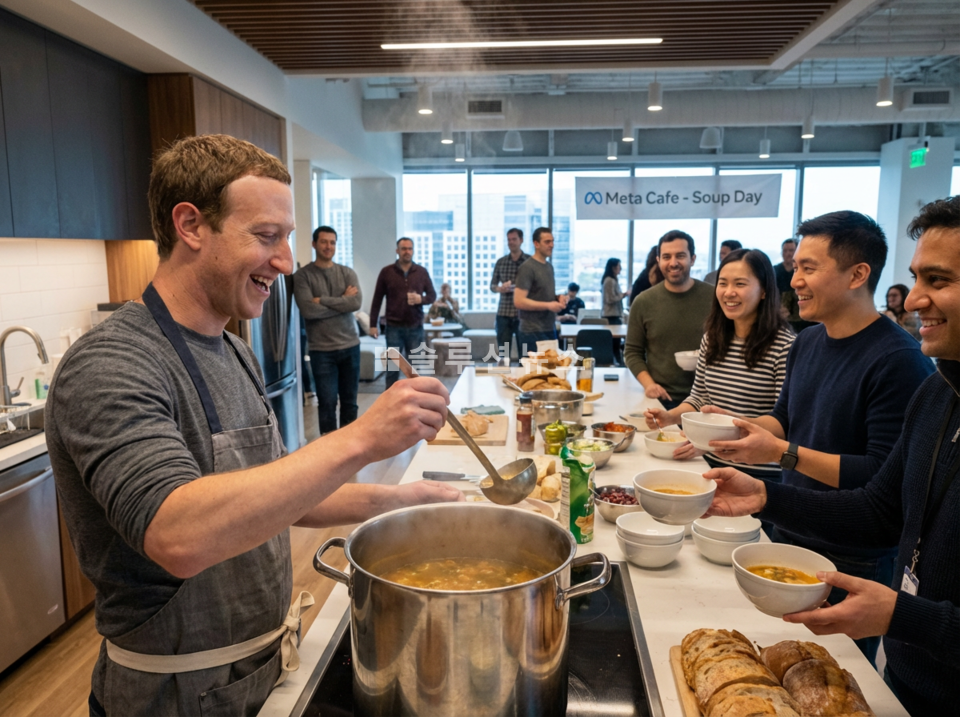
Meta is reported to have prepared a recruitment fund amounting to $10 billion (about 15 trillion won) to secure AI talent. However, Zuckerberg drew attention from inside and outside the industry by attempting a personal approach with his ‘homemade soup,’ going beyond mere financial competition.
“When your opponent comes with broth, you respond with broth,” Chen said. Initially, he was taken aback, but in Silicon Valley, if someone approaches you with soup, you have to respond likewise. He admitted to employing the ‘soup strategy’ when recruiting talent, though he quipped, “I don’t cook it myself.” Instead, he ordered from a premium Korean soup specialty restaurant called ‘Daeho’ in Silicon Valley and delivered it to researchers.
Chen remarked, “This approach is amusing but somewhat effective,” and he plans to strengthen teamwork among researchers by organizing ‘cooking class’ events.
There is a stark reality behind this amusing ‘soup war.’
Currently, there are fewer than 1,000 researchers around the world who can design and train state-of-the-art large language models (LLM).
This is the reason why AI competition has shifted from a ‘computing power’ and ‘salary war’ to a more ‘humane approach.’
For over a decade, Silicon Valley has been fiercely competing for talent. Companies like Google and Facebook (now Meta) attracted employees by offering free in-office sushi bars, coffee baristas, and fitness centers. Today, the scale of competition has expanded significantly beyond those earlier days.
Now, companies offer not just perks but also opportunities such as early liquidity events for company shares, priority allocation of supercomputer resources, and participation rights in determining AI development directions. The key message to researchers is, “You are crafting the future.”
“Belief matters more than money,” Chen said, sharing insight into OpenAI’s internal atmosphere during the interview.
Chen stated, “While the media portrays it as if Meta is aggressively poaching talent from OpenAI, in reality, more than half of the offers were rejected.”
He added, “Meta attempted many approaches, but most were unsuccessful.”
Chen explained that OpenAI’s strategy for retaining talent does not revolve around mere monetary competition. He stated, “Researchers remain with OpenAI because they resonate with the future direction of AI that OpenAI is pursuing.”
He emphasized, “None of the researchers who received job offers from Meta said that they believe Meta will achieve the true advancement of artificial intelligence (AGI) first.”
The significance of a bowl of soup transcends humor. It symbolizes the shift of the AI industry from a ‘technology battle’ to a ‘battle for people.’
The competitive edge now lies not just in a company’s technological prowess or capital but in how genuinely it treats its talent.
An industry insider in Silicon Valley commented, “When a CEO personally brings food, it signifies the value of a researcher,” adding, “In the AI industry, securing talent has now become a survival strategy.”
As the competition in AI development intensifies, the ‘soup war’ serves as another example of how far tech companies are willing to go to secure talent.