
The Rural Development Administration (Director Lee Seung-don) announced on the 4th that it has scientifically identified the weight loss effect, mechanism, and main active ingredients of Hongjam. As a result, it plans to establish the foundation for functional food materialization and industrialization of Hongjam.
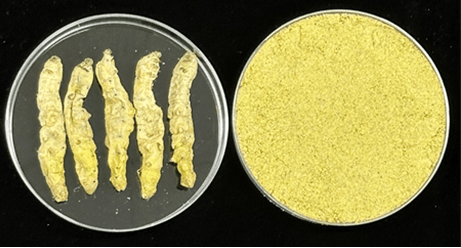
‘Hongjam’ is made by steaming silkworms at the stage when their protein content is at its highest (mature silkworms) and then freeze-drying them. It is characterized by being rich in silk protein, with more than 70% of its nutritional components composed of protein. It contains a large amount of amino acids such as glycine (10.4%), serine (6.3%), and alanine (8.4%). Its fat content (about 15%) is mainly composed of unsaturated fatty acids such as linolenic acid and oleic acid.
The Rural Development Administration, in collaboration with Cha University (Professor Kim Eun-hee’s research team), conducted animal experiments. When obese mice, induced by high-fat diet consumption, were given Hongjam (0.01~0.1g/kg body weight) for 12 weeks, the average weight gain of obese mice was 30.37g, but the group that consumed Hongjam showed a decrease of about 17% to 25.25g. Moreover, in the group that consumed 0.1g/kg body weight of Hongjam, liver triglycerides decreased by 56.1%, and liver cholesterol decreased by 41.8%.
The researchers analyzed that Hongjam acts on the metabolic regulation receptor, GPR35, in liver cells, reducing fat synthesis and promoting consumption, thereby decreasing weight and fat accumulation.
Active substances of Hongjam protein were identified as peptides in a repeated form of glycine, serine, and alanine. When these peptides were applied to cells (100μg/mL), the fat content in fat-storing cells decreased by 34.9%. This was found to be due to improved lipid metabolism and inhibition of fatty liver by increasing AMPK gene activity.
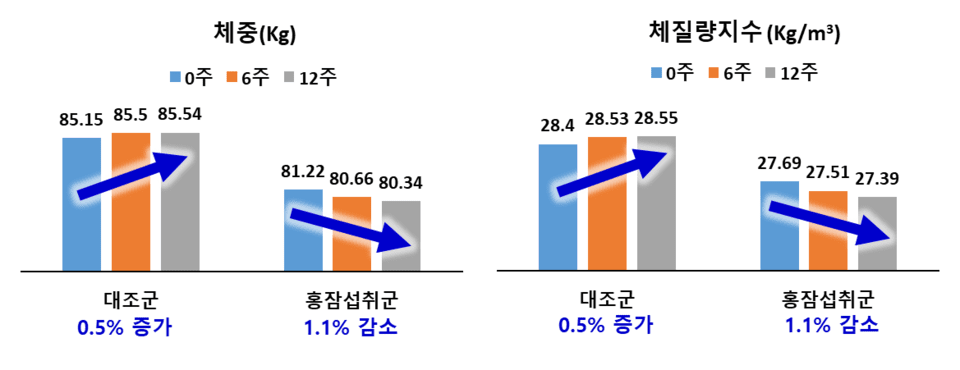
Based on preclinical results, the Rural Development Administration also conducted a human application test with industries. Conducted with Jeonbuk National University Hospital and Wonkwang University Jeonju Hanbang Hospital on 72 adults, participants ingested 1.2g of Hongjam powder daily for 12 weeks, resulting in an average weight loss of 0.9kg (-1.1%) and a body mass index (BMI) reduction of 0.3kg/m² (-1.1%). The effects were more pronounced in obese groups with fatty liver. No adverse reactions were observed, confirming the safety of Hongjam.
This research result has been patented as ‘A pharmaceutical composition for the prevention or treatment of non-alcoholic fatty liver disease containing Hongjam powder’ (Patent Application No. 10-2024-0139812). The Rural Development Administration plans to proceed with the process of registering Hongjam as a functional ingredient for health functional foods domestically and internationally, in collaboration with industries.
Furthermore, follow-up research for the industrialization of Hongjam is being pursued. They plan to develop genetic markers to distinguish domestic silkworm varieties suitable for Hongjam production (Baekokjam, Dodam Silkworm) to protect domestic silkworm farms from imported raw materials, and establish a year-round stable raw material supply system through automated breeding technology.
In South Korea, the adult obesity rate has increased by more than 8 percentage points from 26.3% to 34.4% over the past 10 years, with more than half of men in their 30s and 40s classified as obese. Consequently, as the market for health functional foods for weight control and obesity management continues to grow, the potential of Hongjam as a new functional material is gaining attention.
The Rural Development Administration has previously proven various physiological activities of Hongjam, such as inhibiting Alzheimer’s dementia, alleviating Parkinson’s disease, preventing liver cancer, and activating immune cells.
Bang Hye-seon, Director of the Agriculture Bio-Organism Division at the Rural Development Administration, said, “The weight loss effect and safety of Hongjam have been scientifically proven through animal and human tests,” and added, “We will contribute to farm income generation and public health improvement through the functional food materialization and industrialization of Hongjam.”